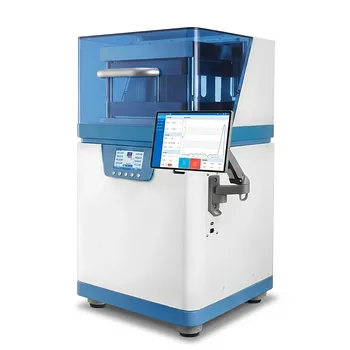
The high-pressure reactor acts as the essential thermodynamic chamber for the hydrothermal synthesis of $\text{ZnMn}_2\text{O}_4$ nanosheet precursors. It creates a sealed environment that allows the reaction to occur at temperatures far exceeding the normal boiling point of the solvent. This specific environment is required to drive the complete dissolution of raw materials and provide the kinetic energy necessary for precise nucleation and crystal growth.
Core Takeaway: The high-pressure reactor is the critical "engine" of the hydrothermal process, providing a superheated liquid phase that ensures $\text{ZnMn}_2\text{O}_4$ precursors achieve high crystallinity and the specific nanosheet morphology required for high-performance applications.
Overcoming Thermodynamic Barriers
Achieving Superheated Liquid States
In a standard open-air vessel, aqueous solvents cannot exceed their boiling point, which limits the energy available for chemical reactions. The high-pressure reactor maintains a sealed environment where internal pressure rises alongside temperature, keeping the solvent in a liquid state well above $100^\circ\text{C}$.
Enhancing Precursor Solubility
The combination of high temperature and high pressure significantly increases the solubility of raw material powders. This allows zinc and manganese precursors to dissolve more thoroughly into the solution than they would under ambient conditions, ensuring a homogenous reaction mixture.
Providing Kinetic Conditions
The reactor provides the necessary kinetic energy to overcome activation barriers for the formation of complex metal oxides. This environment is what allows the chemical precursors to react fully and reorganize into the desired $\text{ZnMn}_2\text{O}_4$ phase.
Precision Control of Morphology and Crystallization
Promoting Uniform Nucleation
A stable, high-pressure environment is vital for uniform nucleation, where the first "seeds" of the crystal form throughout the solution. Without the controlled pressure of the reactor, nucleation could be erratic, leading to inconsistent particle sizes and poor structural integrity.
Facilitating Oriented Crystal Growth
To obtain a nanosheet morphology, the growth of the crystal must be directed along specific planes. The hydrothermal environment within the reactor facilitates this oriented growth, allowing the $\text{ZnMn}_2\text{O}_4$ to develop into thin, high-surface-area sheets rather than bulk, irregular particles.
Ensuring High Crystallinity
The reactor's ability to maintain a steady state for extended periods—often several hours—allows for recrystallization. This process heals defects in the crystal lattice, resulting in nanosheets with high crystallinity that are more stable and efficient in electrochemical or catalytic roles.
Understanding the Trade-offs
Safety and Equipment Requirements
Operating at high temperatures and pressures requires specialized autoclaves with robust sealing mechanisms and safety valves. If the pressure is not monitored correctly, there is a risk of equipment failure or "venting" that can ruin the synthesis batch.
Complexity of Parameter Tuning
Finding the "sweet spot" for pressure and temperature is difficult, as even minor deviations can change the precursor's shape. For example, if the temperature is too low, you may get incomplete dissolution, while too much heat might shift the morphology from nanosheets to nanorods or bulk powders.
Scaling and Throughput
While high-pressure reactors are excellent for precision at the laboratory scale, they represent a bottleneck in mass production. Batch processing in sealed vessels is more time-consuming and energy-intensive than continuous, ambient-pressure manufacturing methods.
Making the Right Choice for Your Goal
How to Apply This to Your Project
To successfully synthesize $\text{ZnMn}_2\text{O}_4$ nanosheet precursors, you must align your reactor settings with your specific material requirements.
- If your primary focus is High Specific Surface Area: Focus on optimizing the pressure-to-temperature ratio to favor the two-dimensional growth of the nanosheets.
- If your primary focus is Structural Stability: Prioritize longer reaction times within the reactor to allow for thorough recrystallization and the elimination of lattice defects.
- If your primary focus is Material Purity: Ensure the reactor environment reaches a high enough temperature to facilitate the complete dissolution of all raw material powders.
By mastering the high-pressure hydrothermal environment, you can move beyond simple chemical mixing to achieve true "molecular architecture" in your nanosheet synthesis.
Summary Table:
| Reactor Function | Impact on ZnMn2O4 Synthesis | Key Benefit |
|---|---|---|
| Superheated Solvent | Keeps liquid phase well above 100°C | Overcomes thermodynamic activation barriers |
| Enhanced Solubility | Ensures thorough dissolution of raw powders | Creates a homogenous reaction mixture |
| Oriented Growth | Directs crystal growth along specific planes | Achieves high-surface-area nanosheet morphology |
| Stable State | Facilitates long-duration recrystallization | Produces high crystallinity with fewer defects |
Elevate Your Material Synthesis with KINTEK Precision
Achieving the perfect $\text{ZnMn}_2\text{O}_4$ nanosheet morphology requires absolute control over your hydrothermal environment. KINTEK specializes in advanced laboratory solutions, providing the high-performance tools researchers need for breakthrough results.
Our specialized portfolio for material science and battery research includes:
- High-Temperature High-Pressure Reactors & Autoclaves: Engineered for safety and precision in hydrothermal synthesis.
- Advanced Thermal Systems: Muffle, tube, and vacuum furnaces for post-synthesis annealing.
- Sample Preparation: Precision crushing, milling systems, and hydraulic pellet presses.
- Essential Consumables: High-purity PTFE products, ceramics, and crucibles designed for extreme conditions.
Whether you are optimizing energy storage materials or developing new catalysts, KINTEK provides the reliability and technical support to scale your innovation.
Contact KINTEK today to find the ideal reactor for your lab
References
- Yandong Xu, Chengjun Ge. Construction of Multi-Defective ZnMn2O4/Carbon Nitride Three-Dimensional System for Highly Efficient Photocatalytic Sulfamethoxazole Degradation. DOI: 10.3390/catal13010172
This article is also based on technical information from Kintek Solution Knowledge Base .
Related Products
- Customizable Laboratory High Temperature High Pressure Reactors for Diverse Scientific Applications
- Customizable High Pressure Reactors for Advanced Scientific and Industrial Applications
- Stainless High Pressure Autoclave Reactor Laboratory Pressure Reactor
- Mini SS High Pressure Autoclave Reactor for Laboratory Use
- High Pressure Laboratory Autoclave Reactor for Hydrothermal Synthesis
People Also Ask
- How do high-pressure and high-temperature reactors ensure the effective treatment of lignocellulosic wastewater in WAO?
- What equipment is required for high-pressure high-temperature reactions? Master Extreme Chemistry Safely
- How do you control high pressure in a reactor? A Guide to Safe & Stable Operation
- How does initial oxygen pressure affect the wet oxidation of pharmaceutical sludge? Master Your Oxidation Depth
- Why is argon better than nitrogen for inert atmosphere? Ensure Absolute Reactivity & Stability