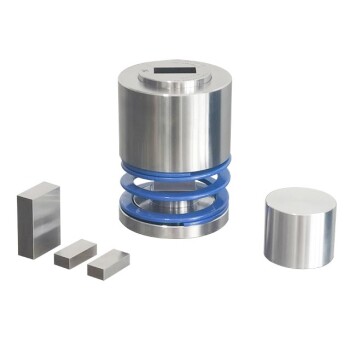
A high-pressure stainless steel reactor acts as the critical containment vessel that forces water into a unique "subcritical" state, serving as the engine for transforming Stevia rebaudiana.
By sealing the system to withstand pressures up to 35 MPa and temperatures between 185 °C and 275 °C, the reactor prevents water from boiling, allowing it to act as a powerful solvent and catalyst. This environment drives the chemical breakdown of the Stevia plant—through hydrolysis, dehydration, decarboxylation, and polymerization—converting wet biomass into high-value, carbon-rich hydrochar.
Core Takeaway The reactor is not merely a heating container; it is a process enabler that maintains water in a liquid state far above its boiling point. This "subcritical" environment allows water to act as an acid-base catalyst, breaking down biomass structures efficiently without the need for pre-drying or external chemicals.
Creating the Subcritical Environment
The primary function of the reactor is to manipulate the physical state of water. This is the foundation of Hydrothermal Carbonization (HTC).
Maintaining Liquid State at High Heat
Under normal atmospheric conditions, water boils at 100 °C. The reactor’s sealed, high-pressure design allows water to remain liquid at temperatures ranging from 185 °C to 275 °C.
Generating Autogenous Pressure
The reactor creates "autogenous pressure," meaning the pressure is self-generated by the heating of the enclosed liquid. This pressure, reaching up to 35 MPa, forces the water molecules into close proximity, significantly altering their behavior.
Enhancing Solvent Properties
In this high-pressure subcritical state, the density of water changes, enhancing its solvation capacity. The reactor allows the water to dissolve biomass components that are typically insoluble under standard conditions.
Driving Chemical Metamorphosis
Once the reactor establishes the subcritical environment, it facilitates a specific sequence of chemical reactions that turn the Stevia plant into hydrochar.
Hydrolysis of Polysaccharides
The high-pressure environment increases the ion product of water, effectively making the water itself act as an acid-base catalytic medium. This allows for the hydrolysis (breakdown) of complex polysaccharides in the Stevia into simpler monosaccharides without adding external acids.
Dehydration and Decarboxylation
Following hydrolysis, the reactor's sustained thermal energy promotes dehydration (removal of water molecules) and decarboxylation (removal of carboxyl groups). These steps are crucial for lowering the oxygen and hydrogen content of the biomass, thereby increasing its carbon density.
Polymerization into Hydrochar
Finally, the reactor facilitates polymerization and condensation. The breakdown products re-combine to form solid, spherical, porous carbon materials known as hydrochar.
The Importance of Material Choice
The specification of "stainless steel" is not incidental; it is a functional requirement for the safety and success of the process.
Withstanding Extreme Pressure
The reactor acts as a pressure vessel. It must possess high tensile strength to safely contain internal pressures that can spike up to 35 MPa without rupturing.
Resisting Corrosive Byproducts
The hydrothermal process creates an acidic environment as biomass breaks down. Stainless steel provides necessary corrosion resistance to prevent the reactor walls from degrading and contaminating the hydrochar.
Understanding the Trade-offs
While high-pressure reactors are the gold standard for HTC, they introduce specific challenges that must be managed.
Safety Risks
Operating at 35 MPa and 275 °C creates a significant safety hazard. The reactor requires rigorous monitoring and pressure relief mechanisms to prevent catastrophic failure.
Energy Intensity
Raising the temperature of a water-heavy slurry to 275 °C requires substantial energy input. While pre-drying is not required (saving energy there), the heating load for the reactor itself is high.
Equipment Cost
The requirement for high-grade stainless steel and precision engineering to seal against such high pressures makes the capital cost of these reactors significantly higher than standard atmospheric heating vessels.
Making the Right Choice for Your Goal
The way you utilize the reactor depends on the specific characteristics you want to engineer into your Stevia-derived hydrochar.
- If your primary focus is Energy Content (Solid Fuel): Operate the reactor at the higher end of the temperature range (approx. 250–275 °C) to maximize carbonization and heating value.
- If your primary focus is Soil Amendment or Adsorption: Target the lower to mid-temperature range (185–200 °C) to preserve oxygen-containing functional groups and maximize porosity.
- If your primary focus is Process Efficiency: Utilize the reactor's autogenous pressure to process wet Stevia waste directly, eliminating the energy-intensive step of pre-drying the biomass.
Ultimately, the high-pressure reactor is the tool that unlocks the latent potential of wet biomass, turning waste into a versatile carbon resource.
Summary Table:
| Feature | Role in Stevia Carbonization | Benefit |
|---|---|---|
| Subcritical Environment | Maintains water liquid at 185°C–275°C | Acts as a powerful solvent and catalyst |
| Autogenous Pressure | Self-generated pressure up to 35 MPa | Forces chemical breakdown without pre-drying |
| Chemical Catalysis | Increases ion product of water | Facilitates hydrolysis, dehydration, and polymerization |
| Stainless Steel Build | High tensile strength & corrosion resistance | Ensures safety and prevents hydrochar contamination |
Elevate your hydrothermal research with KINTEK's precision engineering.
Whether you are refining Stevia rebaudiana into high-value hydrochar or exploring advanced materials synthesis, KINTEK provides the robust high-temperature, high-pressure reactors and autoclaves necessary for success. Our specialized stainless steel vessels are designed to withstand extreme conditions (up to 35 MPa) while resisting corrosive byproducts, ensuring safety and purity in every batch.
From crushing and milling systems for biomass preparation to advanced cooling solutions and ceramic crucibles, KINTEK is your comprehensive partner for laboratory equipment. Transform your waste into resources today—contact our specialists to find the perfect reactor for your application!
References
- Koray Alper. Effect of Acrylic Acid Concentration on the Hydrothermal Carbonization of Stevia rebaudiana Biomass and Resulting Hydrochar Properties. DOI: 10.3390/pr13092731
This article is also based on technical information from Kintek Solution Knowledge Base .
Related Products
- Stainless High Pressure Autoclave Reactor Laboratory Pressure Reactor
- Mini SS High Pressure Autoclave Reactor for Laboratory Use
- Customizable High Pressure Reactors for Advanced Scientific and Industrial Applications
- Customizable Laboratory High Temperature High Pressure Reactors for Diverse Scientific Applications
- High Pressure Laboratory Autoclave Reactor for Hydrothermal Synthesis
People Also Ask
- Why is a laboratory high-pressure reactor used in the hydrothermal synthesis of hydroxyapatite catalysts?
- Why is a laboratory high-pressure reactor necessary for synthesizing fly ash-based zeolite? Achieve Pure Crystallization
- What role does a laboratory high-pressure reactor play in the leaching process of spent cathode materials? Optimize Recovery
- What conditions do laboratory high-pressure reactors provide for HTC? Optimize Your Biochar Production Processes
- How are high-pressure reactors used to prepare metaphosphate electrocatalysts? Master In-Situ Precursor Growth