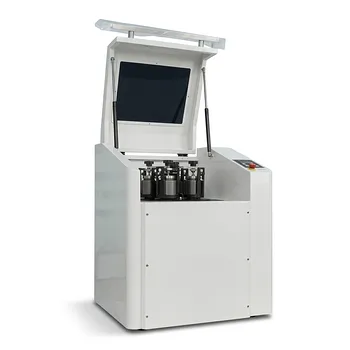
The planetary ball mill acts as the critical engine for high-energy mechanical alloying in the preparation of Zirconium and Chromium mixtures. It utilizes precise rotation and hard grinding media to refine Chromium components down to the micro-nanoscale, ensuring they are uniformly dispersed within the Zirconium matrix. This physical homogenization is a prerequisite for creating the specific microstructures needed to accurately study the electrical properties and corrosion behavior of the material.
Core Takeaway The planetary ball mill does not simply mix powders; it forces a deep homogenization through high-energy grinding. This process defines the distribution of second-phase particles within the matrix, which is the single most important variable when analyzing the space charge region's contribution to electrical properties during oxidation.
Mechanisms of Preparation
Achieving Mechanical Alloying
The primary function of the mill is to facilitate mechanical alloying. Through high-precision rotation speed control, the device generates significant kinetic energy.
This energy subjects the powder mixture to intense reciprocating impact and shear forces. These forces fracture and weld the particles repeatedly, driving the Chromium metal or oxide powders into the Zirconium structure.
Micro-Nanoscale Refinement
Standard mixing is insufficient for advanced corrosion studies. The ball mill refines the Chromium components to the micro-nanoscale level.
This extreme refinement ensures that when the material is later pressed and oxidized, the Chromium exists as controlled second-phase particles. This specific architecture is required to facilitate the study of the Zirconium Dioxide (ZrO2) matrix and its space charge region.
Critical Process Controls
Selecting the Right Grinding Media
To maintain the integrity of the corrosion study, zirconia balls are typically used as the grinding media.
Zirconia is chosen for its chemical compatibility with the Zirconium powder base. This minimizes the introduction of heterogeneous impurities (cross-contamination) that could skew the electrical property data or alter corrosion resistance artificially.
Controlling Particle Distribution
The goal of the milling process is deep homogenization. The mill ensures that the distinct Chromium powders achieve a uniform distribution throughout the Zirconium matrix.
Without this uniformity, the resulting oxide layer would have inconsistent electrical properties, rendering the study of the space charge region invalid.
Common Pitfalls and Trade-offs
Managing Reactivity Risks
While high energy is needed for alloying, Zirconium powder is highly reactive. There is a distinct trade-off between the kinetic energy required for grinding and safety.
Operating the mill at excessive speeds can lead to spontaneous combustion of the Zirconium. Therefore, the process often requires operating at lower rotational speeds to mitigate thermal buildup while still achieving the necessary shear force.
Balancing Energy and Purity
Higher impact forces result in faster homogenization but increase the wear on grinding bowls and balls.
Even with compatible zirconia media, excessive wear can introduce too much particulate matter. The process requires a balance where the shear forces are sufficient to mix the niobium or chromium, but gentle enough to preserve the purity of the matrix.
Making the Right Choice for Your Goal
When setting up your preparation protocol, prioritize your parameters based on the specific requirements of your corrosion study:
- If your primary focus is Data Integrity: Use zirconia grinding media to ensure chemical compatibility and prevent the introduction of foreign impurities that distort electrical readings.
- If your primary focus is Microstructural Precision: Focus on high-precision rotation speed control to refine Chromium to the micro-nanoscale, ensuring the formation of controlled second-phase particles.
- If your primary focus is Safety: Operate at lower rotational speeds to prevent the spontaneous combustion of reactive Zirconium powder during the high-energy friction of milling.
By controlling the energy and media of the planetary ball mill, you transform raw powder into a sophisticated composite ready for precise electrochemical analysis.
Summary Table:
| Process Objective | Mechanism | Key Process Parameter |
|---|---|---|
| Mechanical Alloying | High-energy impact & shear forces | Rotation speed & kinetic energy |
| Micro-Nanoscale Refinement | Continuous fracturing and welding | Grinding time & media-to-powder ratio |
| Deep Homogenization | Uniform dispersion of 2nd phase particles | Ball-to-powder weight ratio |
| Contamination Control | Chemical compatibility | Use of Zirconia grinding media |
| Safety Management | Thermal buildup mitigation | Low-speed operation for reactive Zr |
Elevate Your Material Research with KINTEK
Precision is paramount when preparing reactive powder mixtures for advanced corrosion studies. KINTEK specializes in high-performance laboratory equipment designed to meet the rigorous demands of material science. Our industry-leading planetary ball mills, crushing and milling systems, and zirconia grinding media ensure your Zirconium and Chromium mixtures achieve the exact micro-nanoscale refinement and purity required for accurate electrochemical analysis.
From high-temperature furnaces and vacuum systems to specialized hydraulic presses and chemical-resistant consumables, KINTEK provides the end-to-end solutions your lab needs to drive innovation. Don't compromise on your data integrity—contact us today to discover how our expert tools can optimize your research outcomes.
References
- Jing Yang, Bilge Yildiz. Predicting point defect equilibria across oxide hetero-interfaces: model system of ZrO<sub>2</sub>/Cr<sub>2</sub>O<sub>3</sub>. DOI: 10.1039/c6cp04997d
This article is also based on technical information from Kintek Solution Knowledge Base .
Related Products
- High Energy Planetary Ball Mill for Laboratory Horizontal Tank Type Milling Machine
- Laboratory Planetary Ball Mill Rotating Ball Milling Machine
- High-Energy Omnidirectional Planetary Ball Mill Milling Machine for Laboratory
- High Energy Planetary Ball Mill Milling Machine for Laboratory
- Laboratory Horizontal Planetary Ball Mill Milling Machine
People Also Ask
- What is the role of a planetary ball mill in sulfide-based solid-state batteries? Engineer High-Performance Cathodes
- What are the parameters of a planetary ball mill? Master Speed, Time, and Media for Perfect Grinding
- What is the function of a planetary ball mill for nanostructured eutectic steel? Essential Prep for High-Strength Alloys
- What role does a planetary ball mill play in the preparation of NASICON-type solid electrolytes like LATP and LAGP?
- What is the function of a planetary ball mill in solid-state electrolyte prep? Milling vs. SDS Methods Explained