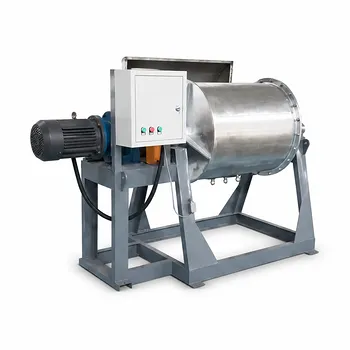
The planetary ball mill serves as the primary reactor for the synthesis of Li2O–LiI–MoO3 solid electrolytes. Rather than functioning merely as a mixer for subsequent heating, the device utilizes high-energy mechanical forces to drive chemical reactions and structural transformation directly at room temperature.
Core Insight: This process is defined as mechanochemical synthesis. By replacing high-temperature sintering with high-energy impact, the planetary ball mill creates a highly conductive amorphous structure while eliminating the risk of thermal side reactions that could degrade the electrolyte's performance.
The Mechanism of Action
High-Energy Mechanochemistry
In this specific application, the planetary ball mill does far more than blend ingredients. It utilizes high-speed rotation to generate intense centrifugal and shear forces.
These forces facilitate chemical reactions between the raw powder materials (Li2O, LiI, and MoO3) without the application of external heat. The mechanical energy is converted into chemical energy, driving the synthesis.
Amorphization of Structure
The primary goal of this process is to alter the crystalline structure of the raw materials. Through continuous high-energy impact, the mill destroys the original crystal lattice of the ingredients.
This results in the formation of an amorphous (glassy) structure. For Li2O–LiI–MoO3 electrolytes, this amorphous state is critical as it is directly linked to achieving superior ionic conductivity compared to their crystalline counterparts.
Room Temperature Processing
Unlike traditional solid-state synthesis, which requires kilns or furnaces, this process occurs at room temperature.
The mill allows for the synthesis of the final electrolyte phase without thermal processing. This is a crucial advantage for materials sensitive to heat, ensuring the composition remains stable.
Why This Approach is Preferred
Prevention of Side Reactions
High-temperature sintering often introduces complications for complex oxides and iodides. Thermal processing can lead to undesirable side reactions, phase separation, or the evaporation of volatile components like lithium iodide.
By utilizing the planetary ball mill, you bypass the sintering stage entirely. This ensures the chemical integrity of the mixture is preserved and prevents the formation of impurity phases that would impede ion flow.
Enhanced Ionic Conductivity
The specific amorphous structure created by the ball mill offers a more favorable pathway for lithium-ion transport.
The milling process creates a disordered structure that often exhibits higher ionic conductivity than ordered, crystalline structures formed through traditional heating methods.
Understanding the Trade-offs
Contamination Risks
While ball milling avoids thermal degradation, it introduces the risk of mechanical contamination. The intense impact between the grinding media (balls) and the jar walls can result in trace amounts of the jar material (often Zirconia or Alumina) leaching into your electrolyte mixture.
Processing Time and Scalability
Mechanochemical synthesis is an energy-intensive and time-consuming process. Achieving complete amorphization often requires extended milling durations (typically 24 to 48 hours).
Furthermore, this is inherently a batch process. Scaling up from laboratory grams to industrial kilograms can be challenging compared to continuous thermal processes.
Localized Heating
Although the process is technically "room temperature," the friction and impact generate significant localized heat. If uncontrolled, this can inadvertently crystallize the material or degrade sensitive components. Usage of pause intervals or cooling systems is often necessary.
Making the Right Choice for Your Goal
To maximize the effectiveness of a planetary ball mill for Li2O–LiI–MoO3 synthesis, consider your specific objectives:
- If your primary focus is Ionic Conductivity: Prioritize high rotational speeds and longer milling durations to ensure complete amorphization, as residual crystalline phases may hinder ion transport.
- If your primary focus is Material Purity: Select milling jars and balls made of materials that are chemically inert regarding your reactants, and monitor milling times to minimize abrasive contamination.
- If your primary focus is Compositional Stability: Utilize the mill's ability to operate at room temperature to avoid the volatility issues associated with Lithium Iodide (LiI) during thermal sintering.
The planetary ball mill is not just a mixing tool; it is the engine that unlocks the high-performance amorphous state required for advanced solid electrolytes.
Summary Table:
| Feature | Role/Benefit in Electrolyte Synthesis |
|---|---|
| Primary Function | Acts as the reactor for mechanochemical synthesis via high-energy impact. |
| Structural Goal | Drives amorphization to create high-conductivity glassy structures. |
| Thermal Advantage | Room-temperature processing prevents volatile loss of LiI and side reactions. |
| Mechanism | Converts centrifugal and shear forces into chemical energy. |
| Key Outcome | Enhanced ionic conductivity compared to traditional crystalline phases. |
Elevate Your Solid-State Battery Research with KINTEK
Precise control over mechanochemical synthesis is critical for developing high-performance Li2O–LiI–MoO3 electrolytes. KINTEK specializes in advanced laboratory equipment designed to meet the rigorous demands of material science.
Our extensive portfolio includes:
- High-Energy Planetary Ball Mills and precision crushing/milling systems for perfect amorphization.
- High-Temperature Furnaces (Muffle, Vacuum, and Atmosphere) for post-processing and sintering.
- Hydraulic Pelleting Presses for electrolyte pellet preparation.
- Battery Research Tools and specialized consumables like high-purity Zirconia jars and crucibles.
Whether you are scaling your lab process or optimizing ionic conductivity, KINTEK provides the reliability and expertise you need to stay ahead.
Contact KINTEK Today to Find the Right Solution for Your Lab
Related Products
- Laboratory Planetary Ball Mill Cabinet Planetary Ball Milling Machine
- High Energy Planetary Ball Mill for Laboratory Horizontal Tank Type Milling Machine
- High-Energy Omnidirectional Planetary Ball Mill Milling Machine for Laboratory
- High Energy Planetary Ball Mill Milling Machine for Laboratory
- Mini Planetary Ball Mill Machine for Laboratory Milling
People Also Ask
- Why is a laboratory ball mill required for ultra-fine fly ash? Unlock Nano-Scale Adsorption Power
- What is the function of a laboratory ball mill in the preparation of AMMCs? Optimize Dispersion & Grain Refinement
- How do laboratory ball mills facilitate the mechanochemical synthesis of ZIF-8? Solvent-Free Synthesis Explained
- What is the primary function of a laboratory ball mill in the modification of sulfide-based solid electrolytes with LiPO2F2?
- What is the function of a laboratory ball mill in the pretreatment of waste tire char (WTC)? Optimize Material Reactivity