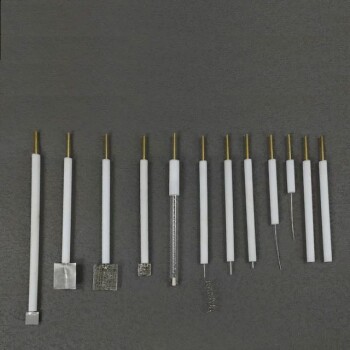
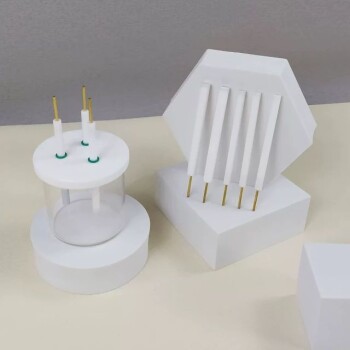
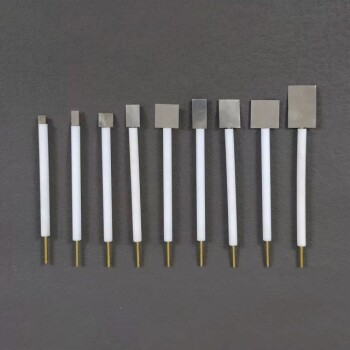
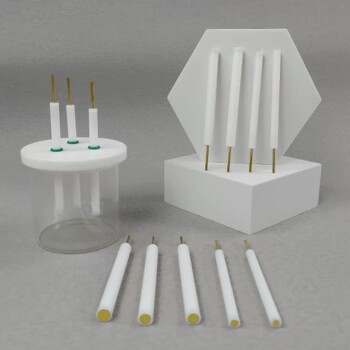
The platinum counter electrode serves as the essential current conduit in a three-electrode electrolytic cell, functioning as an auxiliary partner to your working electrode. It completes the electrical circuit, allowing current to pass through the electrolyte during polarization, while its high chemical stability ensures the test environment remains uncontaminated.
Core Insight: In a potentiodynamic polarization test, the platinum electrode is responsible for carrying the current load to spare the delicate reference electrode. Its chemical inertness is critical: it facilitates electron flow without dissolving or introducing impurities that would skew the corrosion data of the sample being tested.
The Mechanics of the Three-Electrode System
Completing the Current Loop
In a three-electrode setup, the primary objective is to study the "working electrode" (such as a steel sample). However, electricity requires a complete circuit to flow.
The platinum electrode acts as the counter electrode (CE), also known as the auxiliary electrode. It forms a dedicated current loop with the working electrode.
This configuration allows the system to drive significant current through the electrolyte between the platinum and the sample, while the third electrode (the reference electrode) remains isolated from this flow to maintain a stable voltage baseline.
Dynamic Reaction Balancing
According to fundamental electrochemical principles, oxidation and reduction must occur simultaneously within the cell to sustain a current.
If the working electrode is undergoing oxidation (acting as the anode), the platinum counter electrode acts as the cathode where reduction occurs.
Conversely, if the electron flow reverses, the platinum becomes the anode. This role is not permanently fixed; the platinum adapts to the direction of the current to balance the reactions occurring at the working electrode.
Why Platinum is the Standard
Unwavering Chemical Inertness
The primary reference highlights that platinum is characterized by high chemical inertness.
During testing, electrodes can be subjected to harsh potentials that would cause lesser materials to corrode or dissolve.
Platinum’s stability ensures that no additional ions or impurities are introduced into the electrolyte through electrode dissolution. This guarantees that the data collected reflects only the properties of the sample, not the deterioration of the test equipment.
High Conductivity
Platinum is an excellent electrical conductor.
This property minimizes the resistance (ohmic drop) introduced by the counter electrode itself.
By ensuring efficient electron transfer, the platinum electrode allows the potentiostat to control the cell accurately without significant energy loss at the auxiliary side of the circuit.
Common Pitfalls and Considerations
The Importance of Surface Area
While platinum is chemically ideal, its physical geometry matters. The counter electrode must usually have a larger surface area than the working electrode.
If the platinum electrode is too small, it may become the limiting factor in the current loop, preventing the working electrode from reaching high current densities during a polarization scan.
Reaction Byproducts
Although platinum itself is inert, the reactions it facilitates (such as hydrogen evolution or oxygen evolution) can alter the local chemistry.
For example, acting as a cathode may generate hydrogen gas bubbles. While the platinum does not degrade, the user must ensure these bubbles do not interfere with the conductive path in the solution.
Making the Right Choice for Your Goal
To ensure the validity of your potentiodynamic polarization tests, consider the following regarding your counter electrode setup:
- If your primary focus is data purity: Ensure your platinum electrode is regularly cleaned, as its inert nature relies on a surface free of previous reaction deposits.
- If your primary focus is high-current testing: Verify that the surface area of your platinum counter electrode is significantly larger than that of your working electrode to prevent current throttling.
The integrity of your electrochemical data relies on the platinum counter electrode acting as an invisible, highly efficient bridge for electron flow.
Summary Table:
| Feature | Role of Platinum Counter Electrode | Benefit to Electrochemical Testing |
|---|---|---|
| Electrical Role | Completes the current loop with the working electrode | Protects the reference electrode from current flow. |
| Chemical Stability | High chemical inertness and corrosion resistance | Prevents electrolyte contamination and data skewing. |
| Reaction Balance | Facilitates simultaneous oxidation/reduction | Sustains continuous current flow during polarization. |
| Conductivity | High electrical conductivity | Minimizes ohmic drop and improves control accuracy. |
| Surface Area | Typically larger than the working electrode | Prevents current throttling at high densities. |
Elevate Your Electrochemical Research with KINTEK
Precision in potentiodynamic polarization requires high-quality components that guarantee data integrity. KINTEK specializes in premium laboratory equipment, offering high-performance electrolytic cells and electrodes—including platinum, gold, and glassy carbon options—designed for demanding research environments.
Whether you are conducting corrosion studies or battery research, our comprehensive portfolio includes high-temperature furnaces, crushing and milling systems, and advanced cooling solutions to support your entire workflow.
Ready to optimize your lab's performance? Contact us today to discover how KINTEK's precision-engineered consumables and equipment can deliver the accuracy your research deserves.
References
- Zbigniew Oksiuta, Ewa Och. CORROSION RESISTANCE OF MECHANICALLY ALLOYED 14%Cr ODS FERRITIC STEEL. DOI: 10.2478/ama-2013-0007
This article is also based on technical information from Kintek Solution Knowledge Base .
Related Products
- Platinum Auxiliary Electrode for Laboratory Use
- Rotating Platinum Disk Electrode for Electrochemical Applications
- Platinum Sheet Electrode for Laboratory and Industrial Applications
- Platinum Sheet Electrode for Battery Lab Applications
- RRDE rotating disk (ring disk) electrode / compatible with PINE, Japanese ALS, Swiss Metrohm glassy carbon platinum
People Also Ask
- What is the function of a platinum electrode as an auxiliary electrode? Ensure Precise Nickel Coating Corrosion Testing
- Why is platinum typically selected as the auxiliary electrode for electrochemical testing of oxazoline inhibitors?
- What does the auxiliary electrode do? Ensuring Accurate Electrochemical Measurements
- What are the roles of Pt counter and reference electrodes in nitrided steel testing? Optimize Your Electrochemical Data
- What are the advantages of using a platinum counter electrode? Ensure Purity in Photocatalytic Coating Deposition