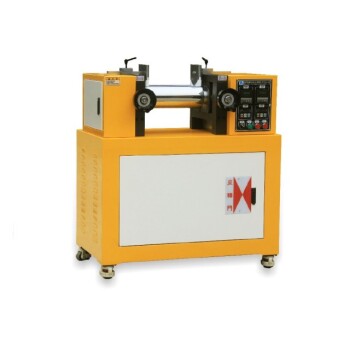
In the Self-Propagating High-Temperature Synthesis (SHS) process, the open reactor functions as a controlled vessel for conducting chemical heat treatments at atmospheric pressure. Specifically designed for creating wear-resistant coatings, it holds the required powder mixture and maintains a critical isothermal temperature range between 900°C and 1050°C. This thermal regulation allows active atoms to diffuse into the steel substrate, creating a metallurgical bond rather than a superficial layer.
The open reactor's primary value lies in its ability to sustain high temperatures at atmospheric pressure, ensuring active atoms have sufficient time to diffuse into the base metal and form a stable intermetallic protective layer.
Creating the Ideal Conditions for Diffusion
To understand the open reactor's role, you must look beyond simple combustion. The device is engineered to facilitate a deep atomic interaction between the coating materials and the steel substrate.
Maintaining Isothermal Stability
The reaction does not occur in a chaotic thermal spike. Instead, the open reactor maintains a steady isothermal environment, specifically between 900°C and 1050°C.
This temperature range is critical. It is hot enough to activate the chemical species but controlled enough to prevent substrate damage or uncontrolled phase changes.
Enabling Time-Dependent Diffusion
For a coating to be wear-resistant, it cannot merely sit on top of the steel; it must integrate with it.
The open reactor ensures that "active atoms" generated during the synthesis have sufficient time to migrate. This migration allows the atoms to penetrate the steel surface, facilitating the formation of a diffusion-type protective layer.
Atmospheric Pressure Operation
Unlike closed systems designed to trap gases, the open reactor operates at atmospheric pressure.
This environment allows for the thermal induction of chemical reactions without the complexities of high-pressure containment. It focuses the energy on the solid-state diffusion process required for surface hardening.
Distinguishing Reactor Types
It is vital to select the correct reactor architecture based on your desired end product. Not all SHS reactors serve the same function.
Open Reactors vs. High-Pressure Reactors
While open reactors focus on coatings and diffusion, high-pressure reactors serve a different purpose.
High-pressure systems are typically used for synthesizing composite ferroalloys, where gas pressure (up to 12 MPa) is manipulated to control nitrogen filtration speed. If your goal is fixing nitrogen into a bulk product, an open reactor is unsuitable.
Solid Flame Stability
Regardless of the pressure setting, the reactor system must ensure the powder components enter a stable "solid flame" combustion mode.
In an open reactor, this stability supports the uniformity of the coating. This is often aided by integrated parameter regulation systems that manage the initiation and progression of the combustion wave.
Making the Right Choice for Your Goal
The choice of reactor configuration dictates the fundamental properties of your final material.
- If your primary focus is surface protection: Prioritize an open reactor setup to leverage atmospheric pressure and isothermal conditions (900–1050°C) for deep atomic diffusion into the substrate.
- If your primary focus is bulk nitrogen alloying: You require a high-pressure reactor capable of reaching 12 MPa to control gas filtration and fixation, rather than an open system.
By matching the reactor environment—specifically pressure and temperature duration—to the chemistry of your application, you ensure the formation of a durable, high-adhesion protective layer.
Summary Table:
| Feature | Open Reactor Specification | Purpose in SHS Process |
|---|---|---|
| Temperature Range | 900°C – 1050°C | Maintains isothermal stability for atomic diffusion |
| Operating Pressure | Atmospheric Pressure | Facilitates chemical heat treatment without high-pressure complexity |
| Bonding Type | Metallurgical / Diffusion | Ensures coating integrates into the substrate rather than just surface adhesion |
| Primary Application | Surface Hardening & Coatings | Ideal for creating wear-resistant layers on steel substrates |
| Combustion Mode | Stable 'Solid Flame' | Ensures uniformity and consistency of the protective layer |
Elevate your material science capabilities with KINTEK’s industry-leading thermal technology. Whether you are developing wear-resistant coatings via SHS or require precise nitrogen fixation, KINTEK specializes in high-performance laboratory equipment. From our advanced high-temperature reactors and autoclaves to specialized muffle and vacuum furnaces, we provide the tools needed for superior metallurgical results. Contact KINTEK today to discuss how our custom crushing, milling, and high-temperature solutions can optimize your research and production workflows.
References
- B. Sereda, Д.Б. Середа. МАТЕМАТИЧНЕ МОДЕЛЮВАННЯ ОТРИМАННЯ ЗНОСОСТІЙКИХ ПОКРИТТІВ З ВИКОРИСТАННЯМ ТЕХНОЛОГІЇ САМОРОЗПОВСЮДЖУВАЛЬ-НОГО ВИСОКОТЕМПЕРАТУРНОГО СИНТЕЗУ. DOI: 10.31319/2519-8106.1(46)2022.258449
This article is also based on technical information from Kintek Solution Knowledge Base .
Related Products
- Customizable Laboratory High Temperature High Pressure Reactors for Diverse Scientific Applications
- Open Type Two Roll Mixing Mill Machine for Rubber Crusher
- Customizable High Pressure Reactors for Advanced Scientific and Industrial Applications
- Stainless High Pressure Autoclave Reactor Laboratory Pressure Reactor
- Visual High-Pressure Reactor for In-Situ Observation
People Also Ask
- How do high-pressure and high-temperature reactors ensure the effective treatment of lignocellulosic wastewater in WAO?
- What equipment is required for high-pressure high-temperature reactions? Master Extreme Chemistry Safely
- How do you control high pressure in a reactor? A Guide to Safe & Stable Operation
- Why is argon better than nitrogen for inert atmosphere? Ensure Absolute Reactivity & Stability
- How does initial oxygen pressure affect the wet oxidation of pharmaceutical sludge? Master Your Oxidation Depth