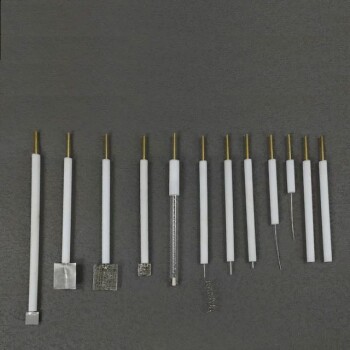
The Rotating Ring-Disk Electrode (RRDE) functions as a precise hydrodynamic diagnostic tool that allows researchers to distinguish between competing reaction pathways during electrochemical analysis. By physically separating the generation of products on the disk from their detection on the ring, it provides the quantitative data necessary to determine if a catalyst is producing hydrogen peroxide or water.
Core Takeaway In hydrogen peroxide synthesis, measuring total current is insufficient because it does not identify the specific product. The RRDE solves this by using centrifugal force to transport reaction products to a secondary electrode for detection, enabling the precise calculation of reaction selectivity and the electron transfer number.
The Mechanics of RRDE Operation
Simultaneous Reaction and Detection
The RRDE setup consists of a central disk electrode surrounded by a concentric ring electrode, usually made of platinum.
During the experiment, the oxygen reduction reaction (ORR) is induced on the central disk.
As the electrode rotates, the reaction products—either water or hydrogen peroxide—are swept outward across the gap to the ring electrode.
The Role of Centrifugal Force
The transfer of products from the disk to the ring is driven by centrifugal force.
Once the products reach the ring, they are oxidized, generating a measurable ring current.
This physical transport mechanism is the key to decoupling the generation of the product from its quantification.
Controlling Reactant Flux
The rotation of the electrode plays a dual role by also managing the arrival of reactants.
Adjusting the rotation speed alters the flux of the analyte (oxygen) to the disk surface.
This provides precise, reproducible control over convection and diffusion, which is essential for accurate kinetic modeling.
Quantifying Catalyst Performance
Calculating H2O2 Selectivity
The primary value of RRDE in this context is its ability to measure selectivity.
By comparing the current generated at the disk (total reduction) with the current at the ring (peroxide oxidation), researchers can quantify the yield.
This confirms whether the catalyst favors the desired hydrogen peroxide pathway or the unwanted water pathway.
Determining the Electron Transfer Number
The efficiency of the electrochemical process is often expressed as the "electron transfer number."
A pure hydrogen peroxide synthesis path involves two electrons, while water production involves four.
Using the ratio of ring current to disk current, the RRDE allows for the precise calculation of this number, revealing the dominant mechanism.
Understanding the Trade-offs
Sensitivity to Hydrodynamics
While RRDE provides granular data, it is heavily dependent on precise hydrodynamic conditions.
The accuracy of the data relies on the assumption of controlled flow and known collection efficiency (the fraction of product that actually reaches the ring).
Experimental Complexity
Unlike static electrodes, RRDE requires rigorous control of rotation speeds to ensure consistent flux.
Any instability in rotation can lead to fluctuations in reactant diffusion, introducing errors into kinetic calculations.
Making the Right Choice for Your Goal
To effectively utilize RRDE data for your catalyst evaluation, focus on the metric that aligns with your specific objective:
- If your primary focus is production efficiency: Prioritize the selectivity calculation derived from the ring current to ensure your catalyst minimizes the four-electron pathway to water.
- If your primary focus is fundamental kinetics: Analyze the electron transfer number across different rotation speeds to understand how mass transport limitations influence the reaction mechanism.
By isolating the product stream, the RRDE transforms a general electrochemical reading into a specific chemical inventory.
Summary Table:
| Feature | Function in H2O2 Synthesis | Benefit for Researchers |
|---|---|---|
| Disk Electrode | Induces Oxygen Reduction Reaction (ORR) | Generates initial reaction products |
| Ring Electrode | Oxidizes H2O2 swept from the disk | Directly quantifies peroxide yield |
| Rotation Speed | Controls reactant flux & product transport | Ensures reproducible hydrodynamic data |
| Current Ratio | Calculates electron transfer number | Identifies 2-e vs 4-e reaction pathways |
Maximize Your Electrochemical Research Precision with KINTEK
Are you looking to refine your catalyst performance? KINTEK specializes in high-performance laboratory equipment, including precision electrolytic cells and electrodes designed for demanding hydrodynamic studies.
Our comprehensive range of tools—from high-temperature furnaces and high-pressure reactors to specialized battery research consumables—empowers researchers to achieve accurate, reproducible results. Whether you need reliable PTFE products, ceramics, or advanced cooling solutions, KINTEK provides the quality you need to lead your field.
Ready to elevate your lab's capabilities? Contact us today to discuss how our specialized equipment can enhance your H2O2 synthesis research!
References
- Ao Yu, Yang Yang. Recent advances in electrosynthesis of H<sub>2</sub>O<sub>2</sub><i>via</i> two-electron oxygen reduction reaction. DOI: 10.1039/d4cc01476f
This article is also based on technical information from Kintek Solution Knowledge Base .
Related Products
- RRDE rotating disk (ring disk) electrode / compatible with PINE, Japanese ALS, Swiss Metrohm glassy carbon platinum
- Rotating Platinum Disk Electrode for Electrochemical Applications
- Metal Disc Electrode Electrochemical Electrode
- Graphite Disc Rod and Sheet Electrode Electrochemical Graphite Electrode
- Gold Disc Electrode
People Also Ask
- What is the rotating ring disk electrode method? Unlock Real-Time Reaction Analysis
- Role of RRDE & Workstations in Aerogel Catalysis: Master Precise Kinetic Analysis & Electron Transfer Pathways
- What is the RRDE in electrochemistry? Unlock Detailed Reaction Pathways with Dual-Electrode Analysis
- What is the application of RRDE? Unlock Quantitative Catalyst and Reaction Insights
- What is the difference between RDE and RRDE? Unlock Advanced Electrochemical Reaction Analysis