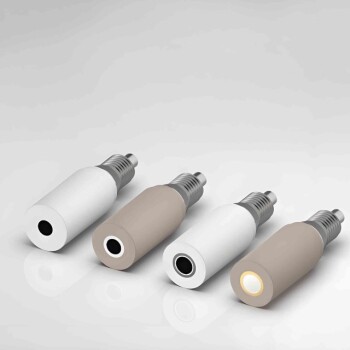
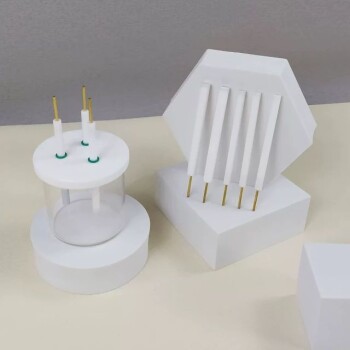
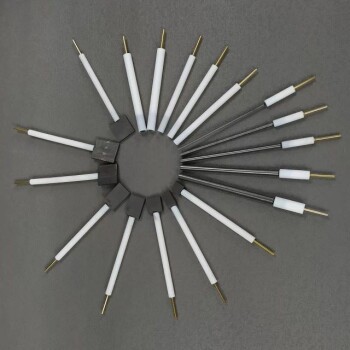
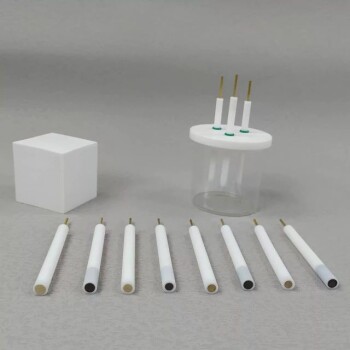
The Laboratory Rotating Disk Electrode (RDE) system serves as the foundational screening tool for non-precious metal Oxygen Evolution Reaction (OER) catalysts. It functions as a precise "half-cell" testing environment that uses controlled rotation to generate stable convection, thereby eliminating mass transfer limitations. This allows researchers to isolate and measure the catalyst's intrinsic kinetic activity—specifically its overpotential and Tafel slopes—without the interference of diffusion constraints or bubble accumulation.
Core Takeaway By regulating the hydrodynamic conditions of the electrolyte, the RDE system removes physical barriers (like reactant diffusion and gas bubble buildup) that mask chemical performance. It enables the rapid, low-cost comparison of catalyst materials based on their true reaction kinetics rather than their transport properties.
Overcoming Mass Transfer Limitations
The Role of Controlled Convection
In a static electrochemical setup, the reaction rate is often limited by how fast reactants can reach the electrode surface (diffusion).
The RDE system solves this by spinning the electrode at precise speeds. This rotation creates a predictable, stable forced convection that continuously replenishes reactants at the catalyst surface.
Eliminating Diffusion Interference
By controlling the rotation speed, researchers can mathematically calculate and subtract the effects of physical transport.
This allows for the extraction of kinetic current data, ensuring that the measured performance represents the chemical speed of the catalyst, not the movement of the liquid.
Managing Gas Evolution (OER Specific)
The Oxygen Evolution Reaction generates microbubbles on the electrode surface, which can block active sites and distort data.
The high-speed rotation of the RDE effectively strips away oxygen microbubbles as they form. This creates a clean interface for the reaction to continue, providing a more accurate assessment of activity than static methods.
Critical Metrics and Screening
Measuring Intrinsic Activity
Once mass transfer effects are removed, the RDE system allows for the precise measurement of overpotential (the energy required to drive the reaction) and Tafel slopes (indicators of the reaction mechanism).
These metrics are vital for determining the "true" efficiency of high-entropy alloys and other non-precious metal combinations.
Facilitating Rapid Comparisons
The RDE system utilizes low catalyst loading and thin-layer coating techniques.
This setup does not require the construction of a complex Membrane Electrode Assembly (MEA). Researchers can quickly test multiple material ratios and assess multi-metal synergistic effects at a laboratory scale with minimal material waste.
Understanding the Trade-offs
Idealized vs. Real-World Conditions
The RDE provides an idealized environment using liquid electrolytes, which differs from the solid-state environment of a practical fuel cell or electrolyzer.
While excellent for screening, high performance in an RDE setup does not guarantee identical performance in a full Membrane Electrode Assembly (MEA), where different resistance factors come into play.
Surface Stability Constraints
While the RDE tests stability, the thin-film nature of the sample means it is sensitive to mechanical detachment.
Long-term durability tests in RDE must distinguish between chemical degradation of the catalyst and the physical delamination of the film from the disk.
Making the Right Choice for Your Goal
- If your primary focus is fundamental kinetics: Use the RDE to calculate Tafel slopes and exchange current densities by isolating the reaction from diffusion effects.
- If your primary focus is material screening: Leverage the low-loading requirements to rapidly test various non-precious metal compositions before scaling up.
- If your primary focus is full-system validation: Recognize that RDE is a preliminary filter; promising candidates must eventually be validated in an MEA setup.
The RDE system is the industry-standard "filter" that separates physically limited data from chemically significant insights, ensuring only the most intrinsically active materials advance to development.
Summary Table:
| Feature | RDE System Function in OER Research | Impact on Data Accuracy |
|---|---|---|
| Hydrodynamic Control | Creates stable convection via controlled rotation | Eliminates reactant diffusion limitations |
| Bubble Management | Strips oxygen microbubbles from electrode surface | Prevents active site blocking & data distortion |
| Kinetic Extraction | Isolate overpotential and Tafel slope metrics | Measures true chemical speed vs. transport speed |
| Rapid Screening | Uses low catalyst loading & thin-layer coating | Enables fast, low-cost material comparisons |
Accelerate your electrochemical research with KINTEK’s precision engineering. As specialists in laboratory equipment, KINTEK provides high-performance electrolytic cells and electrodes, alongside advanced rotating disk electrode components to streamline your catalyst screening. From high-temperature furnaces for material synthesis to shakers and cooling solutions for precise environment control, we offer a comprehensive portfolio tailored for battery research and OER development. Contact KINTEK today to equip your lab with the tools needed for true kinetic insights and superior material performance!
References
- Xiaohong Xie, Yuyan Shao. Oxygen Evolution Reaction in Alkaline Environment: Material Challenges and Solutions. DOI: 10.1002/adfm.202110036
This article is also based on technical information from Kintek Solution Knowledge Base .
Related Products
- RRDE rotating disk (ring disk) electrode / compatible with PINE, Japanese ALS, Swiss Metrohm glassy carbon platinum
- Rotating Platinum Disk Electrode for Electrochemical Applications
- Graphite Disc Rod and Sheet Electrode Electrochemical Graphite Electrode
- Metal Disc Electrode Electrochemical Electrode
- Customizable CO2 Reduction Flow Cell for NRR ORR and CO2RR Research
People Also Ask
- What is the rotating ring disk electrode method? Unlock Real-Time Reaction Analysis
- Role of RRDE & Workstations in Aerogel Catalysis: Master Precise Kinetic Analysis & Electron Transfer Pathways
- What role does the RRDE play in catalyst evaluation for H2O2 synthesis? Enhance Selectivity and Kinetic Precision
- What is the RRDE in electrochemistry? Unlock Detailed Reaction Pathways with Dual-Electrode Analysis
- What is the application of RRDE? Unlock Quantitative Catalyst and Reaction Insights