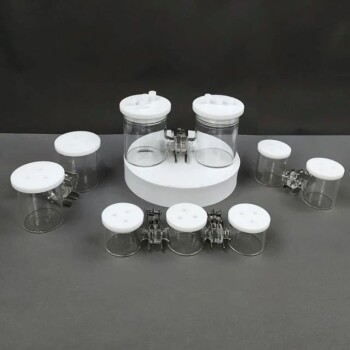
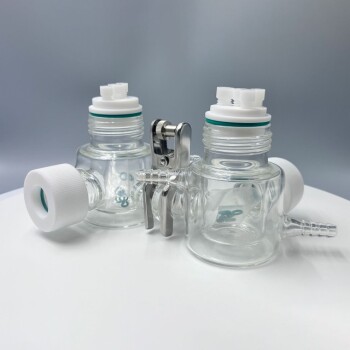
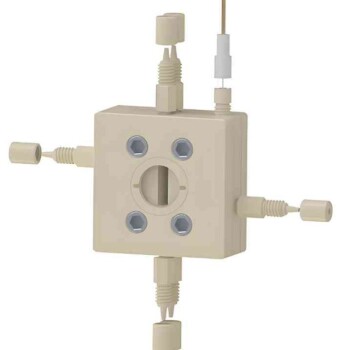
The three-electrode electrolytic cell and the platinum auxiliary electrode provide the precision and stability required to isolate and measure the electrochemical behavior of Cu/SiC composites. This configuration separates the circuit that measures potential from the circuit that carries current, ensuring that the data collected reflects the actual corrosion kinetics and redox properties of the composite material rather than system-induced errors.
The core advantage of this setup is the decoupling of potential control and current flow, which allows for highly accurate, repeatable measurements of a material's surface characteristics by eliminating interference from electrode polarization and chemical contamination.
The Functional Architecture of the Three-Electrode Cell
Decoupling Potential and Current
The three-electrode cell divides the electrochemical system into a Working Electrode (the Cu/SiC sample), a Reference Electrode, and an Auxiliary (Counter) Electrode. By separating the path through which current flows from the path used to monitor potential, the system eliminates errors caused by electrode polarization. This ensures that the potential scanning performed on the Cu/SiC composite is executed with extreme accuracy.
Establishing a Controlled Environment
This cell provides a standardized environment necessary for identifying the specific corrosion kinetics of metal-matrix composites. In this setup, a reference electrode (typically Ag/AgCl or a Saturated Calomel Electrode) monitors the potential of the Cu/SiC electrode without drawing significant current. This stability allows researchers to pinpoint characteristic oxidation potentials and identify the behavior of various ions within the composite structure.
Enhancing Measurement Repeatability
Because the system prevents the reference electrode from becoming polarized, the reference potential remains constant throughout the test. This constancy is vital when performing long-duration tests or sensitive measurements like Electrochemical Impedance Spectroscopy (EIS). It ensures that the resulting data—such as charge transfer resistance—is both reliable and repeatable across different samples.
The Strategic Role of the Platinum Auxiliary Electrode
Ensuring Chemical Inertness
Platinum is selected as the auxiliary electrode primarily for its extraordinary chemical stability and resistance to corrosion. During the testing of Cu/SiC composites, the auxiliary electrode must complete the circuit without releasing ions into the electrolyte. Platinum’s inertness ensures that the electrolyte remains pure and that the measured current signals reflect only the redox characteristics of the Cu/SiC surface.
Facilitating High Conductivity and Charge Transfer
The platinum auxiliary electrode provides a low-resistance path for the current to return to the electrochemical workstation. Its high electrical conductivity and catalytic activity for reactions like hydrogen evolution allow it to receive electrons rapidly. This ensures that the system can monitor milliampere-level current responses with high fidelity, which is critical for calculating specific capacitance.
Minimizing Polarization Interference
Because platinum has a very low overpotential, it completes the electrical circuit with minimal resistance. This prevents the auxiliary electrode from becoming a bottleneck in the testing process. Consequently, the workstation can accurately measure the photogenerated charge carrier behavior or corrosion current of the working electrode without being skewed by the auxiliary electrode's own polarization.
Understanding the Trade-offs
Cost vs. Performance
While platinum is the "gold standard" for auxiliary electrodes due to its performance, it represents a significant capital investment. In large-scale industrial applications where high-precision research is not the primary goal, researchers may sometimes look for cheaper alternatives. However, for Cu/SiC composites, any substitution risks introducing contaminants that can provide false readings regarding corrosion resistance.
Electrode Surface Area Requirements
To ensure the auxiliary electrode does not limit the reaction, its surface area must be significantly larger than that of the Cu/SiC working electrode. If the platinum plate or wire is too small, it can cause "clipping" of the current signal or localized polarization. This requirement means that high-precision testing often requires larger, more expensive platinum components to maintain a stable current path.
How to Apply This to Your Project
When setting up your electrochemical workstation for Cu/SiC composite analysis, your choice of configuration should align with your specific research or quality control goals.
- If your primary focus is measuring corrosion rates: Use a three-electrode cell with a large-surface-area platinum plate to ensure the current response is never limited by the auxiliary electrode.
- If your primary focus is determining charge transfer resistance: Prioritize a high-stability reference electrode (like Ag/AgCl) alongside the platinum electrode to ensure the EIS data is free from potential drift.
- If your primary focus is identifying oxidation peaks: Utilize the three-electrode system to isolate the potential measurement, allowing for the precise identification of the composite's characteristic oxidation potentials.
This standardized electrochemical configuration is the essential foundation for transforming raw electrical signals into actionable data regarding the durability and performance of Cu/SiC composites.
Summary Table:
| Component | Primary Role | Key Benefit |
|---|---|---|
| Three-Electrode Cell | Decouples potential control from current flow | Eliminates polarization errors; ensures high accuracy |
| Platinum Auxiliary Electrode | Provides a chemically inert, low-resistance return path | Prevents contamination; maintains high signal fidelity |
| Reference Electrode | Monitors potential without drawing current | Maintains constant potential for repeatable EIS data |
| Cu/SiC Working Electrode | The specific material under electrochemical stress | Isolates material-specific corrosion and redox behavior |
Elevate Your Material Research with KINTEK
Precision in electrochemical testing starts with high-quality equipment. KINTEK specializes in providing researchers with the advanced tools needed to analyze complex materials like Cu/SiC composites. Our comprehensive portfolio includes:
- Electrochemical Excellence: High-precision electrolytic cells, platinum electrodes, and specialized battery research tools.
- Specialized Systems: High-temperature high-pressure reactors, autoclaves, and atmosphere-controlled furnaces.
- Laboratory Essentials: High-durability ceramics, PTFE consumables, and precision hydraulic presses.
Whether you are identifying corrosion kinetics or analyzing charge transfer resistance, KINTEK offers the stability and reliability your project demands. Contact our technical experts today to find the perfect configuration for your laboratory needs!
References
- M.M. Sadawy, I. G. El-Batanony. Microstructure, Corrosion and Electrochemical Properties of Cu/SiC Composites in 3.5 wt% NaCl Solution. DOI: 10.1007/s12540-023-01521-8
This article is also based on technical information from Kintek Solution Knowledge Base .
Related Products
- H Type Electrolytic Cell Triple Electrochemical Cell
- PTFE Electrolytic Cell Electrochemical Cell Corrosion-Resistant Sealed and Non-Sealed
- Electrolytic Electrochemical Cell Gas Diffusion Liquid Flow Reaction Cell
- Electrolytic Electrochemical Cell with Five-Port
- Customizable PEM Electrolysis Cells for Diverse Research Applications
People Also Ask
- What is a H type cell? A Guide to Divided Electrochemical Cells for Accurate Experiments
- How should the electrolyte be prepared and added to the H-type electrolytic cell? Best Practices for Purity and Safety
- What is the technical necessity of using an H-type electrolytic cell for NO3RR tests? Protect Your Ammonia Yields
- How does the design of an H-type electrolytic cell benefit the neutral water electrolysis process for metal recovery?
- What is the primary function of an H-type electrolytic cell in NitRR? Ensure Accurate Product Yields