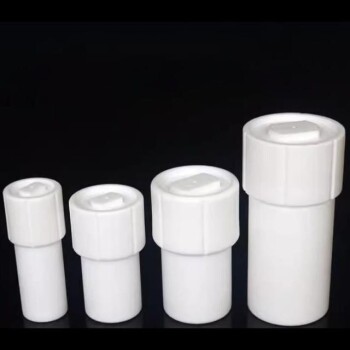
A tool steel reactor cover paired with a PTFE protective cap provides a robust safety mechanism that simultaneously addresses high internal pressure and aggressive chemical corrosion. This dual-material approach utilizes the high mechanical strength of tool steel to contain the reactor's pressure while employing a thin-walled PTFE cap to completely isolate the metal from corrosive internal atmospheres.
By decoupling mechanical strength from chemical resistance, this composite design prevents the structural degradation of the steel cover, ensuring it maintains its pressure-bearing capabilities throughout the lifespan of the equipment.
The Composite Safety Architecture
The Role of Tool Steel
The primary safety challenge in high-pressure digestion is containment. Tool steel is selected for its high mechanical strength.
It serves as the structural backbone of the reactor cover. Its specific function is to withstand the significant internal pressures generated during the heating of samples, preventing catastrophic failure or bursting.
The Function of the PTFE Barrier
While steel handles force, it is vulnerable to chemical attack. The PTFE (polytetrafluoroethylene) protective cap acts as an isolation barrier.
This thin-walled component effectively shields the steel from the reaction chamber. It leverages the chemical stability of fluoroplastics to ensure that corrosive acid vapors never make contact with the structural metal.
Enhancing Structural Longevity
The combination of these materials creates a safety system greater than the sum of its parts.
Without the PTFE cap, the steel would corrode and weaken over time, leading to unpredictable failure risks. Without the steel, the PTFE lacks the rigidity to contain high pressures. This synergy significantly enhances the overall structural safety of the equipment.
Operational Considerations and Trade-offs
Reliance on the Barrier Integrity
The safety of the steel cover is entirely dependent on the condition of the PTFE cap. Because the cap is described as "thin-walled," it is not designed to bear pressure itself, only to seal.
If the PTFE cap is scratched, torn, or improperly seated, corrosive vapors will reach the tool steel. This can lead to unseen corrosion behind the cap, compromising the reactor's pressure rating without immediate visual warning.
Making the Right Choice for Your Goal
To maximize the safety benefits of this composite design, consider the following operational protocols:
- If your primary focus is long-term reliability: Implement a strict inspection routine for the PTFE cap before every run to ensure the isolation barrier is intact.
- If your primary focus is maximum pressure containment: Rely on the tool steel for structural holding, but acknowledge that its strength is only guaranteed as long as the chemical barrier remains uncompromised.
This design proves that in high-pressure digestion, true safety requires treating mechanical strength and chemical resistance as separate, but equally vital, engineering goals.
Summary Table:
| Component | Material | Primary Function | Safety Benefit |
|---|---|---|---|
| Structural Body | Tool Steel | Pressure Containment | Prevents catastrophic failure/bursting |
| Isolation Cap | PTFE | Chemical Shielding | Protects steel from acid vapor corrosion |
| Composite System | Hybrid | Synergistic Protection | Extends equipment lifespan and integrity |
Enhance Your Lab's Safety with KINTEK Expertise
Don't compromise on safety when handling aggressive chemicals and high pressures. KINTEK specializes in advanced laboratory solutions, including high-temperature high-pressure reactors and autoclaves, alongside a comprehensive range of PTFE products, ceramics, and crucibles. Whether you need robust crushing systems or specialized battery research tools, our equipment is engineered for precision and durability.
Ready to upgrade your digestion equipment? Contact us today to consult with our experts and find the perfect high-performance solution for your specific research needs.
References
- Franz Hallwirth, Helmar Wiltsche. An improved digestion coil arrangement for high-pressure microwave-assisted flow digestion. DOI: 10.1039/d3ja00242j
This article is also based on technical information from Kintek Solution Knowledge Base .
Related Products
- Customizable High Pressure Reactors for Advanced Scientific and Industrial Applications
- Stainless High Pressure Autoclave Reactor Laboratory Pressure Reactor
- Mini SS High Pressure Autoclave Reactor for Laboratory Use
- Customizable Laboratory High Temperature High Pressure Reactors for Diverse Scientific Applications
- High Pressure Laboratory Autoclave Reactor for Hydrothermal Synthesis
People Also Ask
- What is the function of high-pressure reactors in the synthesis of MFI-type zeolites? Master Dry Gel Conversion.
- Graphene Fiber Synthesis: Key High-Pressure Reactor Processing Conditions Explained
- What reactor is used for high pressure reactions? Select the Right Autoclave for Your Lab
- What is the primary function of a high-pressure reactor in NiMoO4 preparation? Optimize Hydrothermal Catalyst Synthesis
- What are the hazards of high pressure reactors? A Guide to Managing Explosive Risks