Knowledge laboratory mill What size are the balls in a ball mill? Optimize Your Grinding Process for Peak Efficiency
Author avatar

Tech Team · Kintek Solution

Updated 2 months ago

What size are the balls in a ball mill? Optimize Your Grinding Process for Peak Efficiency


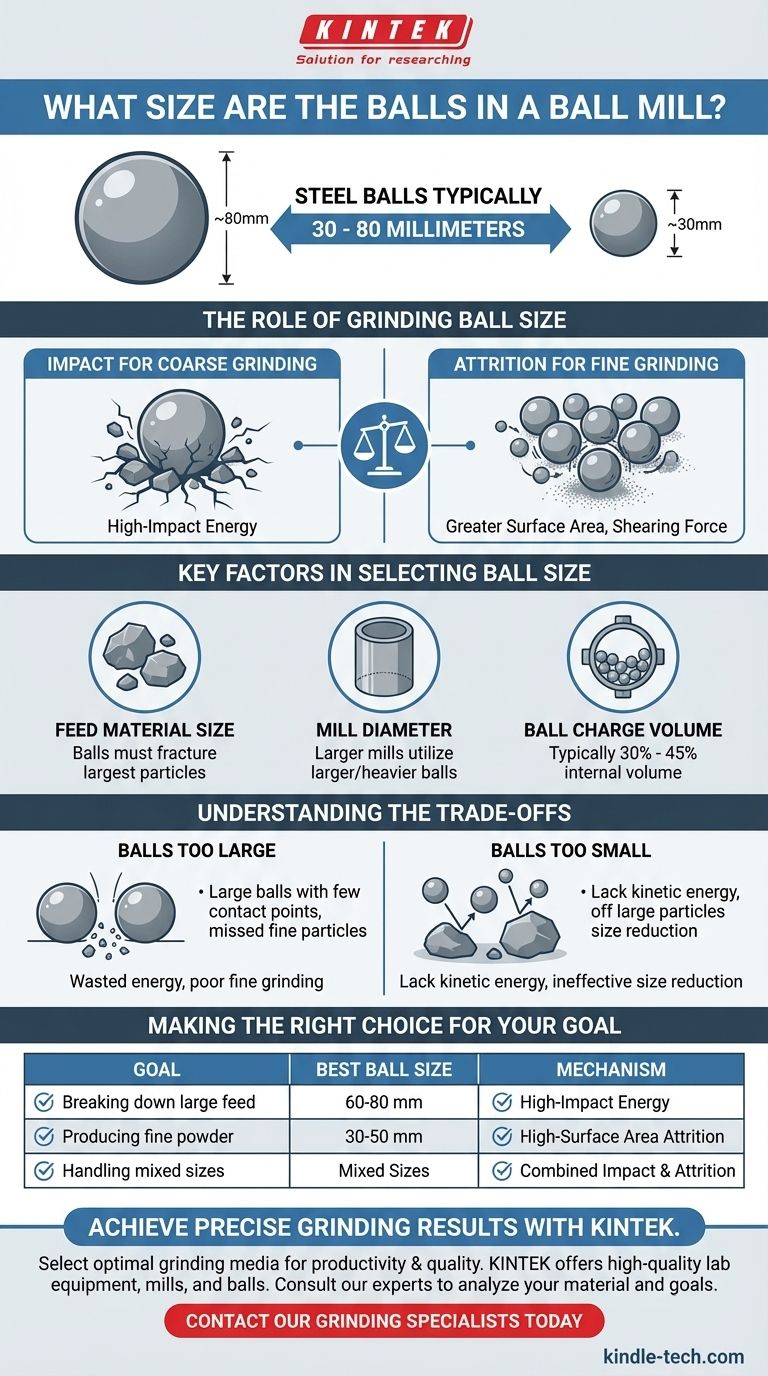
In short, the steel balls used in a ball mill typically have a diameter ranging from 30 to 80 millimeters. This size is not arbitrary; it is a critical variable selected based on the material being processed and the desired final particle size. The effectiveness of the entire grinding operation hinges on choosing the correct size of this grinding media.

The core principle is simple: Larger balls provide powerful impacts to break down large, coarse material, while smaller balls offer a greater surface area for the fine grinding and attrition needed to produce a powder. The optimal choice is always a balance between these two functions.
What size are the balls in a ball mill? Optimize Your Grinding Process for Peak Efficiency

The Role of Grinding Ball Size

A ball mill works by tumbling grinding media (the balls) with the material to be ground. The size reduction happens through two primary mechanisms, both of which are directly dictated by the size and weight of the balls.

Impact for Coarse Grinding

Impact is the primary force responsible for breaking down large feed particles. Larger, heavier balls, when lifted by the rotation of the mill, fall with greater force.

This high-impact energy is essential for the initial stages of grinding, where you need to crack and fracture big, tough pieces of ore or other materials.

Attrition for Fine Grinding

Attrition is the grinding action that occurs from balls rubbing against each other and against the material particles. This shearing and rubbing force is what creates very fine powders.

Smaller balls are more effective at attrition because, for the same total weight, they provide a much greater number of contact points and a larger total surface area within the mill.

Key Factors in Selecting Ball Size

Choosing the right ball size isn't a guess; it's a calculated decision based on the physics of your milling operation. Several factors must be considered to achieve an efficient grind.

The Feed Material Size

The most important rule is that the grinding balls must be large and heavy enough to break the largest particles in the material you are feeding into the mill.

If the balls are too small, they will lack the necessary impact energy and will simply bounce off the larger particles, resulting in an extremely inefficient process.

The Mill Diameter

The diameter of the ball mill cylinder also plays a role. Larger diameter mills lift the balls higher before they tumble, generating more velocity and therefore more impact energy.

Because of this, larger mills can effectively utilize larger and heavier grinding balls than smaller mills.

The Ball Charge Volume

The "ball charge" refers to the total volume occupied by the balls, typically between 30% and 45% of the mill's internal volume.

This charge determines the number of impacts and the amount of attrition that occurs per revolution. It must be optimized alongside the ball size for peak efficiency.

Understanding the Trade-offs

Using the wrong size grinding media is a common and costly mistake. It leads to wasted energy, excessive wear on the equipment, and poor results.

The Problem with Balls That Are Too Large

If your grinding media is excessively large for the task, you will create powerful but infrequent impacts. This wastes energy and is ineffective for producing fine particles.

Furthermore, the limited number of contact points means the attrition process is severely hampered, making it nearly impossible to achieve a fine powder consistently.

The Downside of Balls That Are Too Small

Conversely, if the balls are too small for your feed material, they will lack the kinetic energy to fracture the larger particles.

The mill will run, consuming power, but little to no size reduction will occur. This is the most common reason for a failed or stalled grinding process.

Making the Right Choice for Your Goal

To select the correct grinding media, you must first define the primary objective of your milling process.

  • If your primary focus is breaking down large, coarse feed material: You need larger balls (e.g., in the 60-80 mm range) that provide high impact energy.
  • If your primary focus is producing a very fine, uniform powder: You need a charge of smaller balls (e.g., in the 30-50 mm range) to maximize surface area and attrition.
  • If you are working with a mixed-size feed: An effective strategy is often to use a graded charge with a mix of ball sizes to handle both coarse impact and fine attrition in a single process.

Ultimately, matching the grinding media to the material and the desired outcome is the key to an efficient and successful milling operation.

Summary Table:

Ball Size (Diameter) Primary Grinding Mechanism Best For
60 - 80 mm High-Impact Energy Breaking down large, coarse feed material
30 - 50 mm High-Surface Area Attrition Producing fine, uniform powders
Mixed Sizes Combined Impact & Attrition Handling a wide range of particle sizes

Achieve precise and efficient grinding results with KINTEK.

Selecting the optimal grinding media is critical to your lab's productivity and the quality of your final product. KINTEK specializes in high-quality lab equipment and consumables, including a full range of grinding balls and mills tailored to your specific application—from coarse ore crushing to fine powder production.

Our experts can help you analyze your feed material and grinding goals to recommend the perfect media size and mill configuration, saving you time, energy, and costly trial-and-error.

Contact our grinding specialists today to optimize your milling process and unlock superior performance.

Visual Guide
What size are the balls in a ball mill? Optimize Your Grinding Process for Peak Efficiency Visual Guide

Related Products

People Also Ask

Related Products

Laboratory Ball Mill Jar Mill with Metal Alloy Grinding Jar and Balls

Laboratory Ball Mill Jar Mill with Metal Alloy Grinding Jar and Balls

Grind and mill with ease using metal alloy grinding jars with balls. Choose from 304/316L stainless steel or tungsten carbide and optional liner materials. Compatible with various mills and features optional functions.

Laboratory Jar Ball Mill with Alumina Zirconia Grinding Jar and Balls

Laboratory Jar Ball Mill with Alumina Zirconia Grinding Jar and Balls

Grind to perfection with alumina/zirconia grinding jars and balls. Available in volume sizes from 50ml to 2500ml, compatible with various mills.

High Energy Planetary Ball Mill Milling Machine for Laboratory

High Energy Planetary Ball Mill Milling Machine for Laboratory

The biggest feature is that the high energy planetary ball mill can not only perform fast and effective grinding, but also has good crushing ability

High Energy Planetary Ball Mill Milling Machine for Laboratory

High Energy Planetary Ball Mill Milling Machine for Laboratory

Experience fast and effective sample processing with the F-P2000 high-energy planetary ball mill. This versatile equipment offers precise control and excellent grinding capabilities. Perfect for laboratories, it features multiple grinding bowls for simultaneous testing and high output. Achieve optimal results with its ergonomic design, compact structure, and advanced features. Ideal for a wide range of materials, it ensures consistent particle size reduction and low maintenance.

Laboratory Micro Tissue Grinding Mill Grinder

Laboratory Micro Tissue Grinding Mill Grinder

KT-MT10 is a miniature ball mill with a compact structure design. The width and depth are only 15X21 cm, and the total weight is only 8 kg. It can be used with a minimum 0.2ml centrifuge tube or a maximum 15ml ball mill jar.

Laboratory Jar Mill with Agate Grinding Jar and Balls

Laboratory Jar Mill with Agate Grinding Jar and Balls

Grind your materials with ease using Agate Grinding Jars with Balls. Sizes from 50ml to 3000ml, perfect for planetary and vibration mills.

Laboratory Planetary Ball Mill Rotating Ball Milling Machine

Laboratory Planetary Ball Mill Rotating Ball Milling Machine

KT-P400E is a desktop multi-directional planetary ball mill with unique grinding and mixing capabilities. It offers continuous and intermittent operation, timing, and overload protection, making it ideal for various applications.

High Energy Vibratory Laboratory Ball Mill Grinding Mill Single Tank Type

High Energy Vibratory Laboratory Ball Mill Grinding Mill Single Tank Type

High-energy vibration ball mill is a small desktop laboratory grinding instrument.It can be ball-milled or mixed with different particle sizes and materials by dry and wet methods.

Laboratory Horizontal Planetary Ball Mill Milling Machine

Laboratory Horizontal Planetary Ball Mill Milling Machine

Improve sample uniformity with our Horizontal Planetary Ball Mills. KT-P400H reduces sample deposition and KT-P400E has multi-directional capabilities. Safe, convenient and efficient with overload protection.

Mini Planetary Ball Mill Machine for Laboratory Milling

Mini Planetary Ball Mill Machine for Laboratory Milling

Discover the KT-P400 desktop planetary ball mill, ideal for grinding and mixing small samples in the lab. Enjoy stable performance, long service life, and practicality. Functions include timing and overload protection.

High-Energy Omnidirectional Planetary Ball Mill Milling Machine for Laboratory

High-Energy Omnidirectional Planetary Ball Mill Milling Machine for Laboratory

The KT-P4000E is a new product derived from the vertical high-energy planetary ball mill with a 360° swivel function. Experience faster, uniform, and smaller sample output results with 4 ≤1000ml ball mill jars.

Laboratory Planetary Ball Mill Cabinet Planetary Ball Milling Machine

Laboratory Planetary Ball Mill Cabinet Planetary Ball Milling Machine

The vertical cabinet structure combined with ergonomic design enables users to obtain the best comfortable experience in standing operation. The maximum processing capacity is 2000ml, and the speed is 1200 revolutions per minute.

High Energy Planetary Ball Mill for Laboratory Horizontal Tank Type Milling Machine

High Energy Planetary Ball Mill for Laboratory Horizontal Tank Type Milling Machine

KT-P4000H uses the unique Y-axis planetary motion trajectory, and utilizes the collision, friction and gravity between the sample and the grinding ball to have a certain anti-sinking ability, which can obtain better grinding or mixing effects and further improve the sample output.

Stainless Steel Laboratory Ball Mill for Dry Powder and Liquid with Ceramic Polyurethane Lining

Stainless Steel Laboratory Ball Mill for Dry Powder and Liquid with Ceramic Polyurethane Lining

Discover the versatile stainless steel dry powder/liquid horizontal ball mill with ceramic/polyurethane lining. Ideal for ceramic, chemical, metallurgical, and building materials industries. High grinding efficiency and uniform particle size.

Lab Vibration Mill

Lab Vibration Mill

Vibration Mill for Efficient Sample Preparation, Suitable for Crushing and Grinding a Variety of Materials with Analytical Precision. Supports Dry / Wet / Cryogenic Grinding and Vacuum/Inert Gas Protection.

High-Energy Omnidirectional Planetary Ball Mill Machine for Laboratory

High-Energy Omnidirectional Planetary Ball Mill Machine for Laboratory

The KT-P2000E is a new product derived from the vertical high-energy planetary ball mill with a 360°rotation function. The product not only has the characteristics of the vertical high-energy ball mill, but also has a unique 360°rotation function for the planetary body.

Laboratory High Throughput Tissue Grinding Mill Grinder

Laboratory High Throughput Tissue Grinding Mill Grinder

KT-MT is a high-quality, small, and versatile tissue grinder used for crushing, grinding, mixing, and cell wall breaking in various fields, including food, medical, and environmental protection. It is equipped with 24 or 48 2ml adapters and ball grinding tanks and is widely employed for DNA, RNA, and protein extraction.

Laboratory Hybrid Tissue Grinding Mill

Laboratory Hybrid Tissue Grinding Mill

KT-MT20 is a versatile laboratory device used for rapid grinding or mixing of small samples, whether dry, wet, or frozen. It comes with two 50ml ball mill jars and various cell wall breaking adapters for biological applications such as DNA/RNA and protein extraction.

High Energy Vibratory Ball Mill for Lab Use

High Energy Vibratory Ball Mill for Lab Use

The high-energy vibrating ball mill is a high-energy oscillating and impacting multifunctional laboratory ball mill. The table-top type is easy to operate, small in size, comfortable and safe.

Hybrid High Energy Vibratory Ball Mill for Lab Use

Hybrid High Energy Vibratory Ball Mill for Lab Use

KT-BM400 is used for rapid grinding or mixing of dry, wet and frozen small amount of samples in the laboratory. It can be configured with two 50ml ball mill jars


Leave Your Message