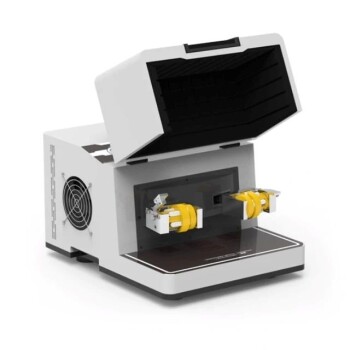
Laboratory ball mills act as high-energy mechanical disruptors that physically alter the structure of lignocellulosic biomass to make it reactive. By applying intense shear and compressive forces, these devices break down the biomass's tough exterior, significantly reducing particle size and lowering cellulose crystallinity to prepare the material for downstream processing.
Core Takeaway The ball mill's primary function is to overcome the natural recalcitrance of biomass by mechanically destroying its robust cell wall structure. This physical alteration exposes the cellulose, making it accessible to enzymes and catalysts for efficient conversion into energy or chemical products.
The Mechanics of Disruption
Shear and Compressive Forces
The fundamental operation of a laboratory ball mill relies on the application of specific mechanical forces. As the mill rotates, grinding media (such as hard alumina balls) generate shear and compressive forces against the biomass.
High-Energy Impact
Beyond simple compression, the process involves high-energy impact and friction. This combination effectively destroys the dense, fibrous structure of the lignocellulose that naturally resists degradation.
Disruption of Cell Walls
The mechanical action targets the robust cell wall structure of the biomass. By physically pulverizing these walls, the mill breaks the material's structural integrity, transforming it from a fibrous mass into a processed powder.
Structural Transformations
Reduction of Particle Size
The most visible physical change is a significant reduction in particle size. Grinding systems aim to achieve specific size ranges, often creating fine particles (e.g., between 0.2 and 2 mm) that are easier to handle and process.
Decreasing Crystallinity
More importantly, ball milling alters the molecular structure by decreasing the crystallinity of the cellulose. The mechanical energy disrupts the orderly crystalline lattice of the cellulose, converting parts of it into a more amorphous (disordered) state.
Increasing Surface Area
As particle size drops and the material fractures, the specific surface area of the biomass increases dramatically. This exposes a much larger percentage of the material to the surrounding environment.
Impact on Downstream Processing
Enhanced Enzyme Accessibility
The increase in surface area and reduction in crystallinity directly improve the accessibility of cellulose to biological reagents. Enzymes can penetrate the disrupted structure much more easily than they can untreated biomass.
Catalyst Contact Frequency
For chemical conversion processes, the physical disruption enhances the contact frequency between the cellulose substrates and solid acid catalysts. This improved physical contact is critical for achieving high conversion rates, which can reach approximately 93 percent in optimized systems.
Process Efficiency and Speed
By mechanically pre-digesting the structure, ball milling shortens the time required for subsequent steps. This is particularly evident in anaerobic digestion and bio-hydrogen fermentation processes, where the "digestibility" of the feedstock is the limiting factor.
Operational Considerations
The Necessity of High Energy
It is important to recognize that this is a high-energy mechanical process. The references emphasize that "high-energy" forces are required to successfully disrupt the dense crystalline structure of cellulose; gentle mixing is insufficient for this level of pretreatment.
Media Selection
The efficiency of the physical disruption often depends on the grinding media employed. Hard materials, such as alumina balls, are necessary to generate the impact forces required to pulverize the lignocellulosic fibers effectively.
Making the Right Choice for Your Goal
Depending on your specific downstream application, the physical roles of the ball mill serve different optimization targets:
- If your primary focus is Enzymatic Hydrolysis: The ball mill's ability to lower cellulose crystallinity is the key factor, as it allows enzymes to attack the substrate more effectively.
- If your primary focus is Chemical Catalysis: The critical outcome is the increase in specific surface area, which maximizes the physical contact frequency between the solid catalyst and the biomass.
- If your primary focus is Anaerobic Digestion: The reduction in particle size is the priority, as it directly shortens digestion times by accelerating the biological breakdown of the material.
The laboratory ball mill transforms lignocellulosic biomass from a resistant, fibrous material into a reactive substrate ready for efficient conversion.
Summary Table:
| Physical Role | Mechanical Action | Impact on Biomass Structure | Primary Research Benefit |
|---|---|---|---|
| Particle Size Reduction | High-energy impact & friction | Breaks down fibrous mass into fine powder (0.2-2 mm) | Shortens digestion times in anaerobic processes |
| Crystallinity Reduction | Intense shear forces | Disrupts crystalline lattice into an amorphous state | Increases cellulose reactivity for enzymatic hydrolysis |
| Surface Area Expansion | Physical pulverization | Dramatically increases specific surface area | Maximizes contact frequency with chemical catalysts |
| Cell Wall Disruption | Compressive force | Destroys robust cell wall structural integrity | Overcomes natural recalcitrance for easier conversion |
Optimize Your Biomass Pretreatment with KINTEK
Maximize your laboratory's output with KINTEK’s industry-leading crushing and milling systems. Whether you are focusing on enzymatic hydrolysis, chemical catalysis, or bio-hydrogen fermentation, our high-energy ball mills provide the precise mechanical disruption needed to transform resistant biomass into reactive substrates.
Beyond milling, KINTEK offers a comprehensive range of laboratory solutions, including high-temperature furnaces, high-pressure reactors, and PTFE consumables, tailored for advanced material science and green energy research.
Ready to achieve superior conversion rates? Contact us today to find the perfect equipment for your lab!
References
- Lukáš Krátký, Jiří Nalezenec. Lab-scale Technology for Biogas Production from Lignocellulose Wastes. DOI: 10.14311/1552
This article is also based on technical information from Kintek Solution Knowledge Base .
Related Products
- Stainless Steel Laboratory Ball Mill for Dry Powder and Liquid with Ceramic Polyurethane Lining
- Laboratory Planetary Ball Mill Rotating Ball Milling Machine
- Laboratory Ball Mill Jar Mill with Metal Alloy Grinding Jar and Balls
- Laboratory Planetary Ball Mill Cabinet Planetary Ball Milling Machine
- Laboratory Jar Ball Mill with Alumina Zirconia Grinding Jar and Balls
People Also Ask
- How do laboratory ball mills facilitate the mechanochemical synthesis of ZIF-8? Solvent-Free Synthesis Explained
- What is the primary function of a laboratory ball mill in the modification of sulfide-based solid electrolytes with LiPO2F2?
- How does a laboratory ball mill ensure the mixing quality of Mn3Zn0.8Sn0.2N and Ti? Achieve Perfect Homogeneity
- What is the function of a laboratory ball mill in the preparation of AMMCs? Optimize Dispersion & Grain Refinement
- In what way does a laboratory ball mill affect material properties when modifying PHBV/pulp fiber composites?