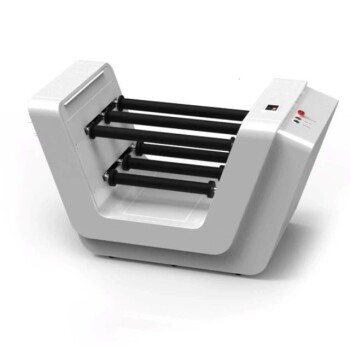
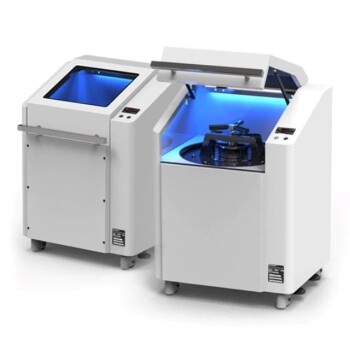
The primary technical problem solved by a micronizing mill is low sintering activity within intermediate phase powders. Following the pre-calcination step, LSTH powders are often too coarse to bond effectively; the micronizing mill mechanically resolves this by drastically reducing particle size and increasing specific surface area to prepare the material for final processing.
Core Takeaway: The micronizing mill acts as a critical activation step. By refining the powder, it creates the necessary surface energy to drive densification and uniform grain growth, solving the issue of porosity in the final solid electrolyte.
The Mechanics of Powder Refinement
Reducing Particle Size
The synthesis of LSTH solid electrolytes involves a pre-calcination step.
The output of this step is typically an "intermediate phase powder" that is coarse and physically resistant to further processing.
The micronizing mill breaks these coarse agglomerates down into fine particles, creating a powder that is physically manageable and reactive.
Increasing Specific Surface Area
The reduction in particle size directly correlates to an increase in specific surface area.
This is the most critical metric for the subsequent steps. Higher surface area exposes more material to the heat and pressure of the final sintering process, facilitating stronger chemical bonding.
Why Refinement Determines Final Quality
Enhancing Sintering Activity
"Sintering activity" refers to how readily a powder consolidates into a solid mass under heat.
Coarse powders have low sintering activity, meaning they resist bonding. By refining the powder, the micronizing mill lowers the energy barrier required for the particles to fuse.
Achieving High Density
For a solid electrolyte to function correctly, it must be dense to facilitate ion transport.
The refinement provided by the mill ensures that the particles pack tightly together. This tight packing minimizes voids and porosity, leading to a higher final density.
Promoting Uniform Grain Growth
Structure is just as important as density.
A micronized powder ensures that grain growth during sintering is uniform and controlled. Without this step, the final ceramic may develop uneven or exaggerated grains, which can compromise the material's mechanical and electrical properties.
The Risks of Inadequate Milling
The "Porosity" Pitfall
If the micronizing step is skipped or insufficient, the specific surface area remains low.
This directly results in poor densification. The final ceramic will likely contain pores/voids because the particles lacked the "activity" required to fuse completely.
Inconsistent Microstructure
Coarse, unrefined powders lead to heterogeneous structures.
Instead of a uniform ceramic, you risk creating a material with varying grain sizes. This structural inconsistency often acts as a bottleneck for performance in solid electrolytes.
Making the Right Choice for Your Goal
To optimize your LSTH synthesis, you must view the micronizing mill not as an optional step, but as a quality control gate.
- If your primary focus is High Density: Ensure the milling process is aggressive enough to maximize specific surface area, as this directly drives the elimination of pores.
- If your primary focus is Microstructural Uniformity: Prioritize a milling duration that achieves a narrow, consistent particle size distribution to ensure even grain growth.
Summary: The micronizing mill transforms a passive, coarse intermediate powder into an active, sinter-ready material capable of achieving high density and structural integrity.
Summary Table:
| Technical Challenge | Micronizing Mill Solution | Impact on LSTH Final Quality |
|---|---|---|
| Coarse Particle Size | Mechanical refinement of pre-calcined powder | High reactivity and manageable powder form |
| Low Specific Surface Area | Drastic increase in surface area exposure | Enhanced energy for fusion and bonding |
| Sintering Resistance | Lowers the energy barrier for consolidation | Faster, more complete densification |
| Porosity & Voids | Improves particle packing and density | Higher ionic conductivity and structural integrity |
| Uneven Microstructure | Ensures uniform particle size distribution | Controlled grain growth and mechanical stability |
Elevate Your Solid-State Battery Research with KINTEK
Precision in particle size is the foundation of high-performance LSTH solid electrolytes. KINTEK specializes in advanced crushing and milling systems designed to eliminate porosity and maximize sintering activity in your materials.
Beyond milling, we provide a complete ecosystem for laboratory excellence, including:
- High-Temperature Muffle & Vacuum Furnaces for precise calcination and sintering.
- Hydraulic Pellet, Hot, & Isostatic Presses to achieve maximum green density.
- High-Temperature High-Pressure Reactors & Autoclaves for advanced synthesis.
- Comprehensive Battery Research Tools and premium consumables like PTFE and ceramics.
Don't let inadequate milling bottleneck your material's performance. Partner with KINTEK for reliable, high-quality laboratory equipment tailored to your research needs. Contact our technical experts today to find the perfect solution!
Related Products
- Laboratory Micro Tissue Grinding Mill Grinder
- Laboratory Micro Horizontal Jar Mill for Precision Sample Preparation in Research and Analysis
- Mini Planetary Ball Mill Machine for Laboratory Milling
- Laboratory Single Horizontal Jar Mill
- Laboratory Four-Body Horizontal Jar Mill
People Also Ask
- What is the function of a laboratory grinding mill? Achieve Precise Sample Preparation for Accurate Results
- What laboratory apparatus is used for grinding? Match the Right Mill to Your Sample Material
- What is the function of a laboratory ball mill in the preparation of AMMCs? Optimize Dispersion & Grain Refinement
- In what way does a laboratory ball mill affect material properties when modifying PHBV/pulp fiber composites?
- What is the function of a laboratory ball mill in the pretreatment of waste tire char (WTC)? Optimize Material Reactivity