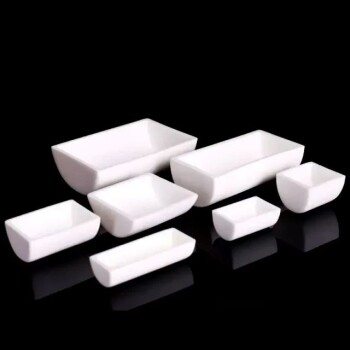
Ceramic boats are the industry standard for phosphorization reactions because they provide a unique combination of extreme thermal stability and chemical neutrality. In a tube furnace environment, these containers ensure that the raw materials—such as sodium hypophosphite or metal oxides—interact only with the intended gas-phase reagents rather than the container itself. Their flat geometry is specifically designed to maximize the surface area of the precursor, facilitating a thorough and uniform conversion into phosphides.
Core Takeaway: Ceramic boats act as non-reactive, high-surface-area platforms that protect sample purity and promote efficient gas-solid interactions during high-temperature phosphorization.
Chemical Inertness and Sample Purity
Resistance to Corrosive Gas Environments
Phosphorization often involves the release of phosphine gas (PH₃) or the use of sodium hypophosphite, both of which can be highly reactive. Ceramic materials, particularly high-purity alumina, are chosen because they do not react with these phosphorus sources or the resulting metal phosphides (e.g., Fe₃O₄@Fe₂P). This inertness ensures that the chemical signature of the final product remains uncontaminated by the container's elements.
Prevention of Cross-Contamination
In a tube furnace, the ceramic boat serves as a physical barrier between the sample and the furnace tube. By using independent boats for different raw materials, researchers can precisely control the spatial distribution of reactants. This prevents unwanted solid-state reactions between different precursors while allowing gas-phase components to diffuse predictably.
Thermal Stability and Structural Integrity
Endurance Under Extreme Temperatures
Phosphorization reactions typically occur between 350°C and 1000°C, levels that would cause many other materials to soften or oxidize. Ceramic boats maintain their structural integrity and do not undergo deformation or structural collapse even at these extreme temperatures. This stability ensures that the sample remains in its intended position throughout the heating cycle.
Thermal Shock Resistance
The transition phases in a tube furnace involve rapid heating and cooling cycles that can stress laboratory hardware. High-quality ceramic or quartz boats possess excellent thermal shock resistance, allowing them to withstand these temperature fluctuations without cracking. This durability makes them a reliable choice for repeatable synthesis processes.
Optimizing Reaction Kinetics Through Geometry
Maximizing Gas-Solid Contact Area
The flat geometry of a ceramic boat is a deliberate design choice to improve reaction efficiency. By spreading the precursor powder into a thin, even layer, the boat increases the contact area between the solid material and the phosphine gas. This layout is conducive to a thorough phosphorization reaction, preventing the core of the sample from remaining unreacted.
Ensuring Uniform Heating and Vapor Gradients
A flat-bottom design promotes uniform heating of the source materials by ensuring consistent contact with the furnace environment. This uniformity is essential for maintaining a stable vapor concentration gradient, which directly influences the morphological consistency of the synthesized products. Without this even heat distribution, the resulting crystals or nanostructures would exhibit high levels of structural variance.
Understanding the Trade-offs
Brittleness and Handling Risks
Despite their thermal strength, ceramics are inherently brittle and susceptible to mechanical failure if dropped or handled roughly. They can also develop micro-cracks over multiple high-temperature cycles, which may eventually lead to unexpected breakage during a reaction.
Porosity and Cleaning Challenges
Some ceramic materials have a degree of porosity that can trap trace amounts of precursors or reaction byproducts. This necessitates rigorous cleaning protocols or the use of dedicated boats for specific chemical families to avoid "memory effects" where remnants from a previous experiment contaminate a new one.
How to Apply This to Your Project
Selecting the Right Container for Your Goal
To achieve the best results in your phosphorization synthesis, consider the specific requirements of your target material and furnace setup.
- If your primary focus is maximum sample purity: Use high-purity alumina ceramic boats (99%+) to eliminate the risk of trace element leaching into your catalyst.
- If your primary focus is structural uniformity: Opt for a wide, flat-bottom boat to ensure the precursor powder is spread as thinly as possible for even gas exposure.
- If your primary focus is high-temperature durability (above 1000°C): Ensure the ceramic material is specifically rated for refractory use to prevent structural sagging or reactions with the furnace tube.
By matching the specific properties of the ceramic boat to your reaction conditions, you ensure a highly controlled, repeatable, and pure synthesis of advanced phosphorus-based materials.
Summary Table:
| Key Property | Advantage in Phosphorization Reactions |
|---|---|
| Chemical Inertness | Prevents contamination from phosphine gas (PH₃) and reactive precursors. |
| Thermal Stability | Maintains structural integrity at extreme temperatures (350°C - 1000°C+). |
| Flat Geometry | Maximizes gas-solid contact area for thorough and uniform conversion. |
| Thermal Shock Resistance | Withstands rapid heating and cooling cycles without cracking or failure. |
| Physical Separation | Prevents cross-contamination and unwanted solid-state side reactions. |
Optimize Your Synthesis with KINTEK Precision
Achieving consistent results in phosphorization requires more than just high temperatures—it demands the right environment and high-quality consumables. KINTEK specializes in providing researchers with the robust tools needed for advanced material science.
Whether you need high-purity alumina ceramic boats and crucibles that ensure zero contamination, or state-of-the-art tube, vacuum, and CVD furnaces for precise thermal control, our portfolio is designed to meet the most rigorous laboratory standards. We also offer specialized solutions including:
- High-temperature high-pressure reactors and autoclaves
- Ceramics and PTFE laboratory consumables
- Advanced crushing, milling, and pelletizing systems
Don't let inferior hardware compromise your data. Contact KINTEK today to discuss your specific research needs and discover how our laboratory equipment can enhance your lab's efficiency and experimental repeatability.
References
- Congcong Lu, Maiyong Zhu. Construction of Fe3O4@Fe2P Heterostructures as Electrode Materials for Supercapacitors. DOI: 10.3390/batteries9060326
This article is also based on technical information from Kintek Solution Knowledge Base .
Related Products
- Aluminized Ceramic Evaporation Boat for Thin Film Deposition
- Alumina Al2O3 Ceramic Crucible Semicircle Boat with Lid for Engineering Advanced Fine Ceramics
- Ceramic Evaporation Boat Set Alumina Crucible for Laboratory Use
- Carbon Graphite Boat -Laboratory Tube Furnace with Cover
- Folding Molybdenum Tantalum Boat With or Without Cover
People Also Ask
- What is the source of evaporation for thin film? Choosing Between Thermal and E-Beam Methods
- Why are high-purity ceramic boats used for lignin activation? Ensure Purity & Thermal Stability
- Why is an alumina boat and Ti3AlC2 powder bed necessary for Ti2AlC sintering? Protect MAX Phase Purity
- Why use an alumina boat for high-temperature carbon activation? Ensure Maximum Material Purity & Thermal Stability
- Why is an alumina boat selected for catalyst precursors? Ensure Sample Purity at 1000 °C