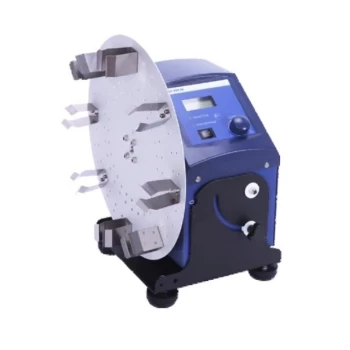
High-power ultrasonic homogenizers are critical for processing liquid metals because these materials possess immense surface tension that standard agitation cannot overcome. The equipment generates strong acoustic waves that provide the necessary energy to shatter the bulk liquid metal, dispersing it into stable, spherical micro- or nano-sized droplets.
Core Takeaway The primary function of high-power ultrasound in this context is to surmount the high surface tension barrier of liquid metals. By doing so, it not only reduces particle size but also facilitates the formation of a stabilizing oxide layer that prevents the droplets from merging, drastically increasing the material's reactive surface area.
The Physics of Dispersion
Overcoming Surface Tension
Liquid metals are characterized by immense surface tension, which naturally pulls the liquid together into a single, cohesive mass.
Low-energy mixing methods fail to disrupt this force. High-power ultrasonic homogenizers are required to generate sufficient energy to break these cohesive bonds and disperse the metal.
The Power of Acoustic Waves
The mechanism relies on the generation of strong acoustic waves.
These waves propagate through the medium, creating intense physical stress on the liquid metal. This energy transfer is the only effective way to transition the metal from a bulk state to a dispersed state.
Achieving Stability and Structure
Creating Spherical Geometry
The ultrasonic process disperses the liquid metal into spherical droplets.
These droplets can range from the micro- to the nanoscale. Crucially, this spherical shape allows the droplets to exist with minimal overlap, ensuring a uniform dispersion.
Preventing Coalescence
Without stabilization, liquid metal droplets would naturally spontaneously coalesce (merge back together) due to surface tension.
High-power homogenization enables the formation of a stabilizing oxide layer on the droplet surface when processed in organic or aqueous media. This "shell" locks the droplet structure in place, ensuring long-term stability.
Why This Matters for Application
Maximizing Surface Area
The transition from bulk metal to nanodroplets significantly increases the effective specific surface area.
This is particularly vital for applications like catalysis. A larger surface area exposes more of the material to the surrounding medium, enhancing its reactivity and efficiency.
Understanding the Trade-offs
Energy Intensity
This process is inherently energy-intensive. Standard homogenizers lacking high-power capabilities will fail to overcome the surface tension threshold, resulting in unstable or insufficient dispersion.
Medium Dependency
While the ultrasound provides the physical force, the chemical stabilization relies on the medium. The formation of the protective oxide layer requires the presence of an appropriate organic or aqueous environment to prevent the droplets from re-merging.
Optimizing Your Nanodroplet Production
To ensure you achieve the desired material properties, align your process with your specific end goals:
- If your primary focus is stability: Ensure your solvent system (aqueous or organic) is compatible with forming the necessary oxide layer to prevent spontaneous coalescence.
- If your primary focus is reactivity: Prioritize high-power input to maximize the acoustic wave intensity, thereby creating smaller droplets and the highest possible specific surface area.
High-power ultrasound is the definitive tool for converting the high surface tension of liquid metals into a stable, high-performance nanomaterial.
Summary Table:
| Key Feature | Impact on Liquid Metal Processing |
|---|---|
| Acoustic Wave Intensity | Overcomes immense surface tension to shatter bulk metal into droplets. |
| Droplet Morphology | Produces uniform, spherical micro- and nano-sized particles. |
| Surface Area | Significantly increases specific surface area for enhanced reactivity. |
| Oxide Layer Formation | Creates a stabilizing shell to prevent spontaneous coalescence. |
| Energy Requirement | High-power input is mandatory for stable, long-term dispersion. |
Elevate Your Material Research with KINTEK Precision
Unlock the full potential of liquid metal nanotechnology with KINTEK’s high-power ultrasonic homogenizers. Whether you are maximizing catalytic surface area or ensuring long-term droplet stability, our advanced systems provide the acoustic intensity required to overcome the toughest material barriers.
Beyond homogenization, KINTEK specializes in a comprehensive range of laboratory equipment including high-temperature furnaces, crushing and milling systems, and specialized hydraulic presses. From battery research tools to high-pressure reactors and autoclaves, we provide the precision instruments your lab needs to innovate.
Ready to optimize your dispersion process? Contact us today to find the perfect solution for your lab!
References
- Karma Zuraiqi, Torben Daeneke. Liquid Metals in Catalysis for Energy Applications. DOI: 10.1016/j.joule.2020.10.012
This article is also based on technical information from Kintek Solution Knowledge Base .
Related Products
- High Performance Lab Homogenizer for Pharma Cosmetics and Food R&D
- High Shear Homogenizer for Pharmaceutical and Cosmetic Applications
- Laboratory High Throughput Tissue Grinding Mill Grinder
- Lab Sterile Slapping Type Homogenizer for Tissue Mashing and Dispersing
- High Performance Laboratory Stirrers for Diverse Applications
People Also Ask
- Why is a high-performance homogenizer essential for Fe3O4@C9 anode slurries? Boost Battery Performance & Stability.
- What is the primary function of high-performance homogenizers for SAPO-34 MMMs? Ensure Superior Gas Separation Efficiency
- How do lab stirrers & homogenizers ensure uniform distribution? Optimize Your Complex Multiphase Chemical Mixing
- What role does a laboratory homogenizer play in radioactive cesium detection? Ensure Accuracy in Wildlife Sampling
- How does a laboratory automatic masticator or homogenizer facilitate the processing of biofilm samples? Optimize Accuracy