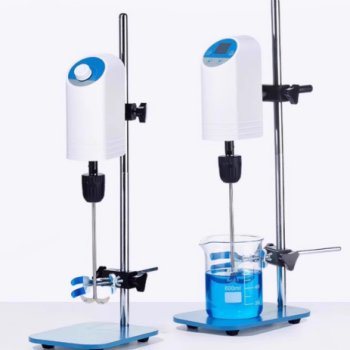
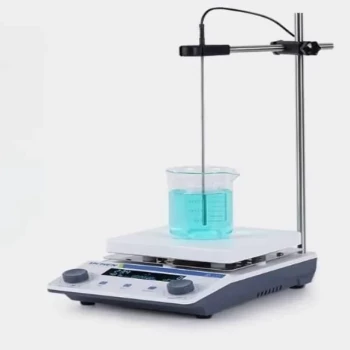
Mechanical stirring and magnetic homogenization are critical for the successful operation of slurry photocatalytic reactors. These devices primarily function to maintain a uniform suspension of titanium dioxide ($\text{TiO}_2$) nanopowders, preventing the catalyst from settling or clumping together, which would otherwise halt the chemical reaction.
Core Takeaway By creating a favorable hydrodynamic environment, these devices solve the dual challenges of physical sedimentation and mass transfer limitations. They ensure that the maximum surface area of the catalyst is exposed to both incident light and pollutant molecules, guaranteeing efficient and reproducible degradation results.
Maximizing Light Exposure and Surface Area
Preventing Sedimentation and Agglomeration
In a static liquid, nanopowders naturally tend to aggregate or settle to the bottom due to gravity and inter-particle forces.
Mechanical shear provided by stirring devices counteracts these forces, keeping the $\text{TiO}_2$ powders in a stable, suspended state throughout the reaction medium.
Eliminating Light-Shielding Effects
When catalyst particles clump together (agglomerate), the outer particles block light from reaching the inner particles.
Homogenization breaks these clumps apart, ensuring that light can uniformly penetrate the liquid phase. This maximizes the effective light-receiving area, allowing more catalyst particles to become excited and participate in the reaction.
Enhancing Hydrodynamics and Mass Transfer
Overcoming Mass Transfer Limitations
For the reaction to occur, pollutant molecules must physically reach the surface of the excited catalyst.
Stirring creates a dynamic flow that drives material exchange, ensuring that pollutants (or dissolved $\text{CO}_2$) come into full, continuous contact with the catalyst, rather than relying on slow diffusion processes.
Improving Oxygen Availability
Effective photocatalysis often requires the presence of electron scavengers, such as oxygen.
A favorable hydrodynamic environment promotes oxygen mass transfer within the reactor. This ensures that the necessary reactants are available at the catalyst surface to sustain high rates of hydrogen production or pollutant degradation.
The Criticality of Experimental Consistency
Ensuring Reproducibility
Scientific data is only valuable if it can be replicated.
By guaranteeing a uniform distribution of reactants and catalysts, stirring devices ensure that degradation experiments are reproducible. Without this control, local variations in concentration would lead to erratic and unreliable data.
Common Pitfalls to Avoid
Inadequate Mixing Intensity
If the stirring speed or homogenization power is too low, "dead zones" may form where the catalyst settles out of suspension.
This leads to a reduced effective reaction surface area, causing the reactor to underperform relative to its theoretical capacity.
Ignoring Hydrodynamic Stability
Inconsistent stirring creates fluctuating reaction conditions.
To maintain stable degradation kinetics, the hydrodynamic environment must remain constant throughout the entire duration of the experiment, ensuring that light penetration and mass transfer rates do not vary.
Making the Right Choice for Your Project
The specific configuration of your stirring system should align with your primary experimental objectives.
- If your primary focus is Maximum Reaction Rate: Prioritize high-shear mixing to eliminate mass transfer limitations and maximize the contact between light, pollutants, and the catalyst.
- If your primary focus is Data Reliability: Focus on establishing a stable, consistent stirring speed that guarantees a uniform suspension to ensure the reproducibility of your degradation experiments.
Ultimately, the success of a slurry reactor relies not just on the chemistry of the catalyst, but on the physics of how well you keep it suspended and accessible.
Summary Table:
| Feature | Function | Impact on Performance |
|---|---|---|
| Suspension Control | Prevents $\text{TiO}_2$ sedimentation | Maintains maximum active surface area |
| Light Penetration | Breaks up particle agglomerates | Ensures uniform photon absorption |
| Mass Transfer | Facilitates material exchange | Overcomes diffusion limits for faster kinetics |
| Hydrodynamics | Creates uniform flow environment | Guarantees experimental reproducibility |
Elevate Your Research with KINTEK’s Precision Laboratory Solutions
Achieve unmatched consistency in your photocatalytic and chemical experiments with KINTEK. As specialists in advanced laboratory equipment, we provide the tools you need for high-performance research, including high-temperature high-pressure reactors, autoclaves, and electrolytic cells.
Our comprehensive portfolio supports every stage of your workflow, from crushing and milling systems for catalyst preparation to high-temperature furnaces (muffle, vacuum, CVD) and hydraulic presses for material synthesis. Whether you are focused on battery research, hydrogen production, or pollutant degradation, KINTEK offers the essential consumables—like ceramics and crucibles—and cooling solutions to ensure your lab operates at peak efficiency.
Ready to optimize your reactor setup? Contact our experts today to find the perfect equipment for your application!
References
- Anastasiya Kutuzova, Witold Kwapiński. Application of TiO2-Based Photocatalysts to Antibiotics Degradation: Cases of Sulfamethoxazole, Trimethoprim and Ciprofloxacin. DOI: 10.3390/catal11060728
This article is also based on technical information from Kintek Solution Knowledge Base .
Related Products
- High Performance Laboratory Stirrers for Diverse Applications
- Custom PTFE Teflon Parts Manufacturer for Magnetic Stirring Bar
- Laboratory Small Constant Temperature Heated Magnetic Stirrer Heater and Stirrer
People Also Ask
- How does a laboratory stirrer influence MOF product quality? Master Precision in Non-Solvothermal Synthesis
- What critical role does a Laboratory Stirrer play during leaching? Enhance Titanium-Magnesium Waste Recovery
- What is the primary function of laboratory stirring equipment in the preparation of compost leachate? Optimize Extraction
- What is a laboratory mixer? A Guide to Achieving Perfect Sample Homogeneity
- What is a laboratory mixer used for? Choose the Right Tool for Liquids or Solids