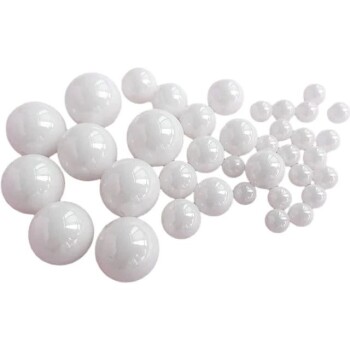
Steel grinding balls are the preferred medium for this specific application due to their exceptional physical density and hardness. These properties allow the balls to generate high-intensity impact forces that are essential for physically breaking apart clusters of nanoparticles within the Ultra-High Molecular Weight Polyethylene (UHMWPE) matrix.
Core Takeaway The effectiveness of a composite material relies on how well its components are mixed. Steel balls provide the necessary impact energy to shatter nanoparticle agglomerates, ensuring the nano-hydroxyapatite (nano-HAP) retains its nanometer scale to successfully reinforce the polymer interface.
The Physics of the Milling Media
High Density Generates Force
The primary reason for selecting steel is its high density. In a ball mill, the kinetic energy transferred to the powder mixture is a function of the mass of the grinding media.
Because steel balls are heavy, they generate significant momentum as they tumble and fall. This translates into powerful impact forces when they collide with the composite powder.
Hardness Ensures Efficiency
In addition to weight, steel possesses high hardness. Soft grinding media would deform or absorb the energy of the collision rather than transferring it to the powder.
Steel acts as a rigid hammer. It delivers maximum energy directly to the material, ensuring the mechanical forces are used effectively to grind and mix rather than being wasted on deforming the ball itself.
The Critical Role of Dispersion
Smashing Nanoparticle Agglomerates
Nanoparticles, such as nano-hydroxyapatite (nano-HAP), have a natural tendency to clump together, or "agglomerate." When they form these clusters, they lose the unique properties associated with their small size.
The intense impact forces generated by the steel balls are strong enough to shatter these agglomerates. This is the only reliable way to mechanically force the particles apart during the dry mixing phase.
Maintaining the Nanoscale
The goal of using "nano" materials is to keep them at the nanometer scale. If the milling media is too light, the agglomerates remain intact, effectively acting as large, macro-scale particles.
By using steel, you ensure the nano-HAP particles are broken down to their original, intended size. This allows them to be distributed evenly throughout the UHMWPE.
Facilitating Interfacial Reinforcement
The ultimate goal of this process is interfacial reinforcement. This refers to the strength of the bond between the polymer (UHMWPE) and the ceramic filler (nano-HAP).
Reinforcement only happens when the surface area of the filler is maximized. By ensuring the particles remain nanoscale and well-dispersed, the steel balls maximize the contact area between the two materials, resulting in a stronger final composite.
Understanding the Trade-offs
Potential for Contamination
While steel is effective for impact, it is not chemically inert. The high-energy collisions that break down agglomerates can also cause microscopic wear on the steel balls themselves.
This can introduce trace amounts of iron contamination into your white UHMWPE/nano-HAP powder. For most structural applications, this is negligible, but for high-purity biomedical applications, it is a factor to monitor.
Heat Generation
The high impact forces of steel balls convert a significant amount of kinetic energy into heat. UHMWPE is a polymer sensitive to temperature.
If the milling process is too aggressive or prolonged without pauses, the heat generated by the steel media could potentially degrade the polymer chains.
Making the Right Choice for Your Goal
To achieve the best results with your composite, consider your specific priorities:
- If your primary focus is mechanical strength: Prioritize the use of steel balls to ensure maximum dispersion and interfacial reinforcement, accepting slight contamination risks.
- If your primary focus is material purity: Monitor the milling time closely to balance the need for de-agglomeration against the risk of iron wear and thermal degradation.
By selecting steel grinding balls, you are choosing mechanical efficiency to ensure your composite performs as a true reinforced material.
Summary Table:
| Feature | Steel Grinding Media Benefit | Impact on Composite |
|---|---|---|
| High Density | Generates superior kinetic energy and momentum | Provides force to shatter nanoparticle clusters |
| High Hardness | Prevents media deformation; transfers energy efficiently | Ensures nano-HAP stays at the nanometer scale |
| Mechanical Action | Delivers high-intensity impact forces | Maximizes surface area for interfacial reinforcement |
| Mixing Efficacy | Superior dry mixing and de-agglomeration | Uniform distribution of filler in polymer matrix |
Elevate Your Materials Research with KINTEK Precision Solutions
Achieving the perfect dispersion in UHMWPE/nano-HAP composites requires high-performance grinding media and reliable processing equipment. KINTEK specializes in advanced laboratory solutions, offering a comprehensive range of crushing and milling systems, high-temperature furnaces, and hydraulic presses (pellet, hot, and isostatic) to transform your research into high-strength materials.
From high-purity ceramic crucibles to cooling solutions and battery research tools, we provide the essential consumables and hardware to ensure your projects meet the highest standards of purity and mechanical performance.
Ready to optimize your composite processing? Contact our technical experts today to find the ideal equipment and consumables for your lab!
Related Products
- Laboratory Ball Mill Jar Mill with Metal Alloy Grinding Jar and Balls
- Stainless Steel Laboratory Ball Mill for Dry Powder and Liquid with Ceramic Polyurethane Lining
- Laboratory Jar Mill with Agate Grinding Jar and Balls
- Laboratory Jar Ball Mill with Alumina Zirconia Grinding Jar and Balls
- High Energy Planetary Ball Mill Milling Machine for Laboratory
People Also Ask
- What is the function of a laboratory ball mill in the preparation of AMMCs? Optimize Dispersion & Grain Refinement
- What is the primary function of a laboratory ball mill in the modification of sulfide-based solid electrolytes with LiPO2F2?
- What is the function of a laboratory ball mill in the pretreatment of waste tire char (WTC)? Optimize Material Reactivity
- What is the primary function of a laboratory ball mill in Rice Husk Ash (RHA) modification? Achieve Peak Densification
- How do laboratory ball mills facilitate the mechanochemical synthesis of ZIF-8? Solvent-Free Synthesis Explained