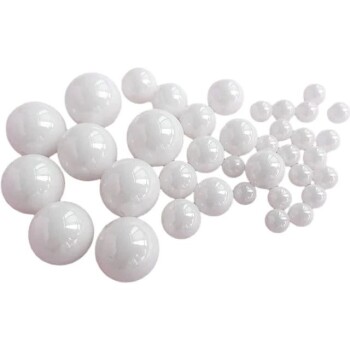
Zirconia beads with diameters of 0.1 to 0.5 mm are selected primarily for their ability to generate high-frequency collisions and penetrate microscopic gaps. These beads provide a high media filling density within the grinding chamber, allowing them to physically enter nanoparticle agglomerates. This facilitates an ultra-fine dispersion that traditional larger grinding media cannot achieve.
The use of 0.1–0.5 mm beads shifts the milling mechanism from simple crushing to high-frequency de-agglomeration. This ensures the breakdown of nanoparticle clusters while simultaneously inhibiting excessive grain growth during the high-energy process.
The Physics of Micro-Media Milling
High Media Filling Density
The diameter range of 0.1 to 0.5 mm allows for a significantly higher packing density within the grinding chamber.
By fitting more individual beads into the same volume, the system maximizes the surface area available for grinding. This creates a dense network of contact points essential for nano-scale processing.
Increasing Contact Frequency
High-energy nano milling relies on the statistical probability of particle impact.
Because of the high number of beads present, the frequency of collisions increases dramatically. This ensures that precursor particles are subjected to constant, uniform stress rather than sporadic high-energy impacts.
Mechanism of Action on Precursors
Penetrating Agglomerate Gaps
LiFePO4/C precursors often form tight nanoparticle agglomerates.
Large grinding media typically strike the exterior of these clusters. In contrast, 0.1–0.5 mm zirconia beads are small enough to physically penetrate the gaps between particles within these agglomerates.
Achieving Ultra-Fine Dispersion
Once inside the agglomerate structure, the high-frequency collisions effectively break the bonds holding the cluster together.
This internal disruption leads to ultra-fine dispersion. The result is a consistent particle size distribution that is critical for the electrochemical performance of the final battery material.
Understanding the Trade-offs
Limitations of Traditional Media
It is crucial to understand why larger beads are rejected for this specific application.
Traditional larger grinding balls lack the geometric capability to enter the interstitial spaces of nano-agglomerates. They tend to crush the material from the outside, which is inefficient for achieving uniform nano-dispersion.
Balancing Energy and Grain Growth
A common pitfall in high-energy milling is the generation of excessive heat or kinetic energy that triggers unwanted grain growth.
The 0.1–0.5 mm beads mitigate this risk. They provide enough energy to disperse particles effectively but distribute that energy across so many contact points that they prevent the localized overheating that leads to excessive grain growth.
Making the Right Choice for Your Goal
When selecting grinding media for LiFePO4/C precursors, your choice dictates the quality of the final cathode material.
- If your primary focus is de-agglomeration: Select 0.1–0.5 mm beads to ensure the media can physically penetrate and break apart nanoparticle clusters.
- If your primary focus is structural integrity: Use this micro-media range to achieve dispersion while preventing the excessive grain growth caused by larger, higher-impact media.
By matching the bead size to the scale of the agglomerates, you transform the milling process from brute force crushing to precise structural refinement.
Summary Table:
| Feature | 0.1 - 0.5 mm Zirconia Beads | Traditional Large Media (>1.0 mm) |
|---|---|---|
| Primary Mechanism | High-frequency de-agglomeration | Brute force crushing |
| Packing Density | High (Dense contact point network) | Low (Sporadic contact points) |
| Gap Penetration | Can enter nanoparticle clusters | Limited to exterior impact |
| Energy Distribution | Uniform (Prevents grain growth) | Concentrated (Risk of overheating) |
| Resulting Dispersion | Ultra-fine, consistent nano-scale | Inconsistent, coarse dispersion |
Elevate Your Nano-Material Processing with KINTEK
Precision milling is the cornerstone of high-performance battery materials. KINTEK provides the specialized equipment and consumables needed to achieve ultra-fine dispersion and consistent results. Whether you are optimizing LiFePO4/C precursors or developing next-gen energy storage, our comprehensive range of crushing and milling systems, high-density zirconia beads, and high-temperature furnaces ensures your lab stays at the cutting edge of research.
Our value to you:
- Comprehensive Solutions: From planetary ball mills and sieving equipment to pellet presses and vacuum furnaces, we supply the entire workflow.
- Material Expertise: High-purity ceramics, crucibles, and PTFE products to prevent contamination.
- Scale-Up Ready: Reliable cooling solutions, homogenizers, and reactors designed for precision and durability.
Ready to transform your milling process from brute force to structural refinement? Contact KINTEK today for expert guidance and high-quality lab solutions!
Related Products
People Also Ask
- What are the applications of zirconia ceramics? Unlock High-Performance Solutions for Extreme Environments
- What is the physical mechanism for selecting hard grinding media? Optimize Your ZrC-Al Matrix Composite Production
- Why are zirconia milling balls preferred for P2-type layered oxides? Ensure High Purity and Grinding Efficiency
- What is the purpose of using zirconia milling balls of different diameters? Optimize Solid Electrolyte Processing
- Why are zirconia grinding jars and balls required for solid-state electrolyte powders? Ensure High Purity & Performance