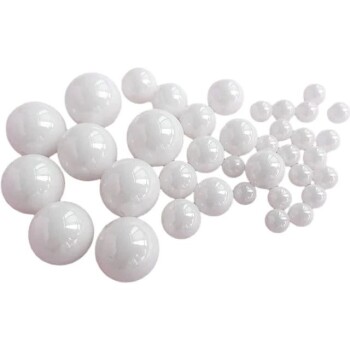
Zirconia grinding jars and zirconia balls are specifically required for processing LAGP electrolyte materials due to their superior hardness, wear resistance, and chemical inertness. These properties are essential to withstand the high-energy impact of ball milling without shedding particulate matter into the mixture, thereby preserving the purity of the electrolyte.
Core Takeaway: The selection of grinding media is not merely about crushing power; it is a chemical purity safeguard. Zirconia serves as a non-reactive barrier that prevents metallic contamination, ensuring the final LAGP electrolyte maintains the high ionic conductivity and electrochemical stability required for optimal battery performance.
Preserving Chemical Purity
The Necessity of Inertness
LAGP electrolytes are chemically sensitive materials. To achieve high performance, the synthesized powder must remain free of foreign contaminants.
Zirconia is chemically inert, meaning it does not react with the active precursors during the milling process. This prevents the introduction of unwanted chemical side reactions that could alter the fundamental composition of the electrolyte.
Eliminating Metallic Contamination
Standard grinding media, such as stainless steel, can introduce metallic impurities like iron or chromium into the powder.
Because zirconia is a ceramic, it eliminates the risk of metallic contamination entirely. This is vital, as metal particles can act as defect sites, severely degrading the material's electrochemical stability.
Withstanding High-Energy Processing
Extreme Hardness for Efficient Reduction
The process of synthesizing LAGP often involves long-duration, high-speed ball milling. This requires grinding media that is harder than the material being processed.
Zirconia provides the extreme hardness necessary to efficiently crush and refine hard ceramic raw materials. It delivers sufficient impact force to pulverize the precursors without suffering structural failure.
Exceptional Wear Resistance
Hardness alone is not enough; the media must also resist surface abrasion over time.
Zirconia exhibits exceptional wear resistance, allowing it to endure hours of high-energy impact. This durability ensures that the grinding balls and jar walls do not erode and mix with the LAGP powder, keeping the sample pure even during extended processing cycles.
Common Pitfalls in Media Selection
The Cost of Impurities
The primary pitfall in selecting grinding media is underestimating the impact of microscopic wear. Even trace amounts of impurities from softer jars can compromise the ionic conductivity of the final product.
If the grinding media degrades, it introduces foreign materials that block lithium-ion pathways. This renders the electrolyte less effective, regardless of how well the raw materials were initially measured.
Maintaining Stoichiometric Precision
Material degradation does not just add impurities; it can upset the delicate chemical balance of the mixture.
Using wear-resistant zirconia ensures the chemical stoichiometric ratio of the product remains accurate. By preventing mass loss from the media or mass addition to the powder, zirconia guarantees the synthesized product matches the theoretical formula.
Making the Right Choice for Your Goal
When setting up your milling protocol for solid-state electrolytes, align your equipment choices with your specific performance metrics.
- If your primary focus is Maximizing Ionic Conductivity: Prioritize zirconia media to strictly eliminate metallic impurities that block ion transport.
- If your primary focus is Long-Term Process Stability: Rely on zirconia’s wear resistance to ensure consistent particle refinement over extended milling durations (e.g., 5+ hours).
Ultimately, zirconia is not just a tool for grinding; it is a critical control variable for ensuring the electrochemical integrity of your LAGP electrolyte.
Summary Table:
| Feature | Zirconia Grinding Media | Impact on LAGP Electrolyte |
|---|---|---|
| Hardness | Superior ceramic hardness | Efficiently reduces particle size of precursors |
| Wear Resistance | Exceptional durability | Prevents particulate shedding into the mixture |
| Chemical Inertness | Non-reactive | Eliminates side reactions and preserves composition |
| Purity Control | Metal-free | Prevents metallic impurities from blocking ion pathways |
| Stability | High-energy resilience | Ensures accurate stoichiometric ratios during milling |
Elevate Your Solid-State Battery Research with KINTEK
Precision in material synthesis starts with the right equipment. At KINTEK, we specialize in providing high-performance laboratory solutions tailored for advanced energy research. Our premium zirconia grinding jars and balls are engineered to withstand rigorous milling cycles, ensuring your LAGP electrolytes maintain the high ionic conductivity and electrochemical stability required for next-generation batteries.
Beyond grinding media, KINTEK offers a comprehensive range of tools for the modern lab, including:
- High-Temperature Furnaces & Reactors: Precise thermal processing for your synthesis.
- Battery Research Tools: Specialized consumables and equipment for cell assembly.
- Milling & Crushing Systems: Reliable planetary ball mills and heavy-duty crushing tools.
Don't let impurities compromise your results. Partner with KINTEK for durable, high-purity laboratory equipment and consumables. Contact our technical team today to find the perfect milling solution for your specific application!
Related Products
- Laboratory Jar Ball Mill with Alumina Zirconia Grinding Jar and Balls
- Laboratory Jar Mill with Agate Grinding Jar and Balls
- Laboratory Ball Mill Jar Mill with Metal Alloy Grinding Jar and Balls
- Precision Machined Zirconia Ceramic Ball for Engineering Advanced Fine Ceramics
- Engineering Advanced Fine Ceramics Head Tweezers with Pointed Elbow Zirconia Ceramic Tip
People Also Ask
- What are the primary functions of using a ball mill for BZCY72 powder? Achieve High Purity and Enhanced Sintering
- In what way does a laboratory ball mill affect material properties when modifying PHBV/pulp fiber composites?
- Why is a laboratory ball mill required for ultra-fine fly ash? Unlock Nano-Scale Adsorption Power
- What is the function of a laboratory ball mill in the preparation of AMMCs? Optimize Dispersion & Grain Refinement
- What is the function of a laboratory ball mill in the pretreatment of waste tire char (WTC)? Optimize Material Reactivity