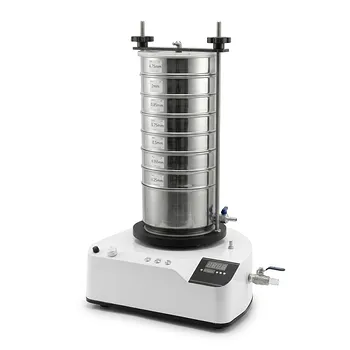
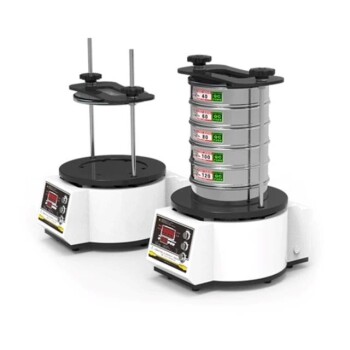
The use of a high-frequency vibration mill is a critical pretreatment step designed to pulverize bulk AlCrFeCoNi alloy into particles smaller than 40 microns. This drastic reduction in particle size maximizes the material's specific surface area, providing the necessary active sites for efficient high-temperature oxidation. Without this mechanical processing, the subsequent conversion into a high-entropy oxide would be slow, uneven, and chemically inconsistent.
A high-frequency vibration mill overcomes the chemical inertia of bulk alloys by increasing their reactivity through surface area expansion. This ensures that the subsequent oxidation process is rapid, uniform, and results in a high-quality, single-phase high-entropy oxide powder.
The Role of Mechanical Pulverization in Oxide Synthesis
Increasing Specific Surface Area
A high-frequency vibration mill utilizes intense impact and friction forces to break down hard as-cast AlCrFeCoNi alloy blocks. By reducing the material to a fine powder—specifically below 40 microns—the total surface area exposed to the environment increases exponentially.
This surface expansion is vital because it creates a high density of active sites. These sites serve as the primary locations where oxygen molecules interact with the metal atoms during the heating phase.
Optimizing Reaction Kinetics
In the preparation of high-entropy oxides, the speed of the reaction is governed by how quickly oxygen can penetrate the metal. Large alloy blocks have a low surface-to-volume ratio, which leads to prolonged and often incomplete oxidation.
The vibration mill effectively shortens oxidation time by ensuring that the distance oxygen must travel to reach the center of any given particle is minimal. This kinetic advantage makes the industrial production of these complex powders much more energy-efficient.
Achieving Structural and Chemical Uniformity
Breaking Down As-Cast Heterogeneity
As-cast AlCrFeCoNi alloys often exhibit "segregation," where different elements cluster together rather than mixing perfectly. The high-frequency milling process mechanically disrupts these clusters, creating a more homogeneous distribution of the five metallic elements.
This mechanical homogenization is a prerequisite for forming a stable high-entropy phase. It ensures that when the powder is oxidized, each particle has the correct stoichiometric balance required for the final oxide structure.
Promoting Uniform Product Quality
Consistency is the most significant challenge when producing multi-component high-entropy oxides. If particle sizes vary too widely, smaller particles may over-oxidize while larger ones remain metallic at the core.
By utilizing the vibration mill to achieve a tight particle size distribution, manufacturers ensure that every grain reacts at the same rate. This leads to a final product with high phase purity and uniform microstructural characteristics.
Understanding the Trade-offs
The Risk of Contamination
While high-frequency milling is highly effective, the intense friction between the grinding media and the alloy can introduce impurities. If the milling jars or balls are made of materials that wear down easily, those contaminants will be integrated into the AlCrFeCoNi powder.
To mitigate this, it is often necessary to use high-hardness media, such as tungsten carbide or zirconia. Selecting the wrong media can compromise the high-entropy effect by introducing unwanted elements into the lattice.
Heat Generation and Cold Welding
The high-frequency nature of the mill generates significant thermal energy during the pulverization process. For certain ductile alloys, this heat can cause particles to "cold weld" back together rather than breaking down further.
Process control is essential here, often requiring process control agents (PCAs) or specific milling intervals. Without these adjustments, the mill may fail to reach the target sub-40-micron threshold.
How to Apply This to Your Process
Making the Right Choice for Your Goal
- If your primary focus is rapid production scaling: Prioritize a high-frequency vibration mill with large-capacity chambers to maximize throughput while maintaining the sub-40-micron limit.
- If your primary focus is extreme phase purity: Use high-hardness grinding media and perform milling in an inert atmosphere to prevent premature, uncontrolled oxidation before the formal heating stage.
- If your primary focus is coating performance (e.g., plasma spraying): Integrate a high-precision sieving step after milling to ensure a narrow size distribution (e.g., 10–30 µm) for optimal flowability.
Mechanical pretreatment via high-frequency milling is the foundational step that transforms inert bulk alloys into the highly reactive, uniform precursors required for high-performance high-entropy oxide powders.
Summary Table:
| Key Milling Function | Impact on AlCrFeCoNi Oxide Preparation |
|---|---|
| Particle Size Reduction | Pulverizes bulk alloy to <40μm to maximize specific surface area. |
| Surface Activation | Creates active sites for rapid and uniform high-temperature oxidation. |
| Homogenization | Mechanically disrupts as-cast segregation for stoichiometric balance. |
| Kinetic Optimization | Shortens oxidation time by minimizing oxygen diffusion distance. |
| Quality Control | Ensures tight particle size distribution for high phase purity. |
Elevate Your Material Synthesis with KINTEK Precision
Achieving the perfect high-entropy oxide begins with superior mechanical pretreatment. KINTEK specializes in high-performance crushing and milling systems, including high-frequency vibration mills, designed to handle even the toughest as-cast alloys. We provide the tools you need to reach sub-40-micron precision while minimizing contamination through our premium tungsten carbide and zirconia grinding media.
Beyond milling, our comprehensive portfolio supports your entire workflow:
- High-Temperature Furnaces: Muffle, tube, and vacuum furnaces for precise oxidation.
- Material Processing: High-precision sieving equipment and hydraulic presses.
- Advanced Lab Solutions: CVD/PECVD systems, high-pressure reactors, and specialized ceramics.
Whether you are a researcher aiming for phase purity or a distributor seeking reliable laboratory equipment, KINTEK delivers the durability and technical support your project demands.
Ready to optimize your powder preparation? Contact KINTEK today to discuss your equipment needs!
References
- Dávid Csík, Karel Saksl. High-Entropy Composite Coating Based on AlCrFeCoNi as an Anode Material for Li-Ion Batteries. DOI: 10.3390/coatings13071219
This article is also based on technical information from Kintek Solution Knowledge Base .
Related Products
- High Energy Vibratory Laboratory Ball Mill Double Tank Type
- High Energy Vibratory Ball Mill for Lab Use
- High Energy Vibratory Laboratory Ball Mill Grinding Mill Single Tank Type
- Hybrid High Energy Vibratory Ball Mill for Lab Use
- Vibrating Disc Mill Small Laboratory Grinding Machine
People Also Ask
- What is the function of a laboratory ball mill in the preparation of AMMCs? Optimize Dispersion & Grain Refinement
- What is the primary function of a laboratory ball mill in the modification of sulfide-based solid electrolytes with LiPO2F2?
- What is the function of a laboratory ball mill in the pretreatment of waste tire char (WTC)? Optimize Material Reactivity
- How do laboratory ball mills facilitate the mechanochemical synthesis of ZIF-8? Solvent-Free Synthesis Explained
- What is the primary function of a laboratory ball mill in Rice Husk Ash (RHA) modification? Achieve Peak Densification