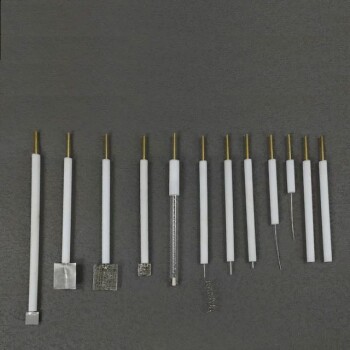
A high-precision Rotating Ring-Disk Electrode (RRDE) is the definitive instrument for characterizing Oxygen Reduction Reaction (ORR) kinetics because it allows for the simultaneous detection of reaction intermediates. While standard rotating electrodes control mass transfer, only the RRDE’s dual-electrode architecture can capture byproducts like hydrogen peroxide in real-time, enabling the precise calculation of electron transfer numbers to determine catalytic efficiency.
Core Takeaway The RRDE goes beyond measuring simple activity; it reveals the specific reaction pathway. By quantifying the ratio of the desired 4-electron reduction to the inefficient 2-electron pathway, researchers can distinguish true catalytic performance from unstable byproduct generation.
Establishing a Stable Reaction Environment
Controlled Hydrodynamics
To evaluate a catalyst effectively, you must eliminate external variables. The RRDE uses controlled, high-speed rotation to generate stable forced convection.
Managing Mass Transfer
This hydrodynamic action ensures a consistent supply of oxygen to the catalyst surface. By removing liquid-phase mass transfer limitations, the system allows you to observe the intrinsic kinetics of the catalyst without diffusion interference.
Decoupling the Reaction Mechanism
The Dual-Electrode Structure
The defining feature of the RRDE is its two independent electrodes: a central disk and a surrounding ring. This structure allows for two distinct electrochemical processes to be monitored simultaneously.
Real-Time Byproduct Monitoring
As the oxygen reduction reaction occurs on the central disk, the rotation sweeps intermediate products outward toward the ring. The ring electrode is set to a specific potential to detect these intermediates, such as hydrogen peroxide ($H_2O_2$).
Distinguishing Reaction Pathways
For ORR, the goal is typically a direct 4-electron pathway to water ($H_2O$). The RRDE allows you to see if your catalyst is achieving this or if it is diverting into a less efficient 2-electron pathway that produces corrosive peroxide.
Precise Kinetic Calculations
Calculating Electron Transfer Numbers
Data from the disk and ring currents allow for the mathematical calculation of the electron transfer number ($n$). This metric is the gold standard for quantifying exactly how efficient the catalyst is at converting oxygen.
Assessing Catalyst Stability
High production of hydrogen peroxide degrades fuel cell membranes and the catalyst itself. By quantifying peroxide generation via the ring current, RRDE provides a predictive metric for the long-term stability of the catalytic system.
Understanding the Trade-offs
Complexity of Operation
Compared to a standard Rotating Disk Electrode (RDE), the RRDE setup is more complex. It requires a bi-potentiostat to control both electrodes independently and precise calibration to determine the "collection efficiency" of the ring.
Sensitivity to Surface Precision
The "high-precision" aspect is critical. Any wobble or surface irregularity in the electrode tip can disrupt the laminar flow required for accurate collection of intermediates at the ring, leading to distorted kinetic data.
Making the Right Choice for Your Goal
To maximize the value of your electrochemical testing, align your equipment choice with your specific data requirements:
- If your primary focus is initial activity screening: A standard RDE is sufficient for determining basic overpotential and Tafel slopes without the added complexity of the ring circuit.
- If your primary focus is mechanistic analysis: The RRDE is non-negotiable, as you must quantify the electron transfer number to prove the reaction pathway is efficient (4-electron) rather than partial (2-electron).
- If your primary focus is catalyst durability: The RRDE is essential for detecting hydrogen peroxide production, which is a primary cause of catalyst and membrane degradation.
True insight into ORR performance comes not just from knowing that a reaction happened, but understanding exactly how it happened.
Summary Table:
| Feature | Rotating Disk Electrode (RDE) | Rotating Ring-Disk Electrode (RRDE) |
|---|---|---|
| Primary Function | Activity screening & mass transfer control | Mechanistic analysis & byproduct detection |
| Electrode Count | Single (Disk) | Dual (Disk & Ring) |
| Data Output | Current density, overpotential | Electron transfer number ($n$), $H_2O_2$ yield |
| Key Benefit | Simple setup for initial screening | Distinguishes 2-e⁻ vs 4-e⁻ reaction pathways |
| Complexity | Moderate | High (Requires bi-potentiostat) |
Elevate Your Electrochemical Research with KINTEK
Precision is the foundation of breakthrough catalyst development. KINTEK specializes in high-performance laboratory equipment, offering a specialized range of electrolytic cells and electrodes, including high-precision RRDE systems designed for rigorous ORR and kinetic studies.
Whether you are optimizing fuel cell catalysts or advancing battery research, our comprehensive portfolio—from high-temperature furnaces and reactors to advanced crushing, milling, and cooling solutions—ensures your lab is equipped for excellence.
Ready to achieve definitive catalytic insights? Contact our technical experts today to find the perfect electrochemical solution for your application!
References
- K. Elangovan, Ramalinga Viswanathan Mangalaraja. Outline of microbial fuel cells technology and their significant developments, challenges, and prospects of oxygen reduction electrocatalysts. DOI: 10.3389/fceng.2023.1228510
This article is also based on technical information from Kintek Solution Knowledge Base .
Related Products
- RRDE rotating disk (ring disk) electrode / compatible with PINE, Japanese ALS, Swiss Metrohm glassy carbon platinum
- Rotating Platinum Disk Electrode for Electrochemical Applications
- Graphite Disc Rod and Sheet Electrode Electrochemical Graphite Electrode
- Metal Disc Electrode Electrochemical Electrode
- Gold Disc Electrode
People Also Ask
- What is the rotating ring disk electrode method? Unlock Real-Time Reaction Analysis
- Role of RRDE & Workstations in Aerogel Catalysis: Master Precise Kinetic Analysis & Electron Transfer Pathways
- What role does the RRDE play in catalyst evaluation for H2O2 synthesis? Enhance Selectivity and Kinetic Precision
- What is the RRDE in electrochemistry? Unlock Detailed Reaction Pathways with Dual-Electrode Analysis
- What is the application of RRDE? Unlock Quantitative Catalyst and Reaction Insights