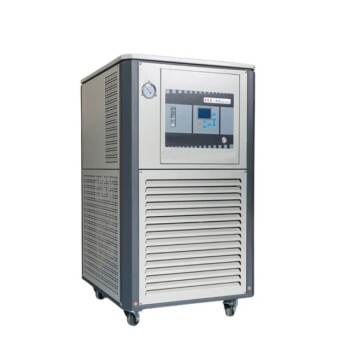
The high-pressure hydrothermal reactor acts as the critical vessel for structural organization.
It provides a sealed environment that maintains high temperatures (typically 120°C) and elevated pressure. This forces the raw slurry to undergo necessary physical and chemical transformations that are impossible under standard atmospheric conditions.
The reactor's primary function is to enhance crystallinity and enforce the orderly stacking of sheet-like structures. This structural precision is what ultimately maximizes the material's anion exchange performance.
The Mechanism of Structural Refinement
Enhancing Material Crystallinity
The primary reference indicates that the specific conditions within the reactor significantly improve the crystallinity of MgAl-LDH. High pressure and temperature increase the solubility and activity of reactants, allowing them to reorganize into a more perfect crystal lattice.
Promoting Orderly Stacking
MgAl-LDH materials rely on a specific layered architecture. The hydrothermal environment promotes the orderly stacking of these sheet-like structures. This prevents the formation of disordered or amorphous clumps that would limit the material's utility.
Stabilizing Anion Arrangement
A critical feature of Layered Double Hydroxides (LDH) is the presence of anions between the metal hydroxide layers. The reactor conditions assist in the stable arrangement of these intercalated anions. This precise internal organization is essential for the material's chemical functionality.
Optimizing Functional Performance
Improving Anion Exchange
The ultimate goal of using this reactor is to optimize the anion exchange performance of the material. By ensuring high crystallinity and orderly stacking, the material can exchange ions more efficiently.
Regulating Morphology
While the primary reference focuses on stacking, supplementary context suggests this environment allows for precise morphology control. The sealed system enables the regulation of crystal growth, ensuring the final particles have the uniform structure required for high-performance applications.
Understanding the Trade-offs
Process Complexity vs. Material Quality
Using a high-pressure reactor introduces complexity compared to open-air synthesis. It requires specialized equipment capable of handling subcritical states and precise temperature regulation. However, this complexity is the "cost" of achieving superior structural order.
Sensitivity to Parameters
The outcome is highly sensitive to the specific temperature and pressure settings (e.g., sticking close to 120°C for this specific material). Deviating from these parameters can alter the crystal planes exposed or the stacking order, potentially degrading the material's anion exchange capability.
Making the Right Choice for Your Goal
To maximize the effectiveness of your MgAl-LDH synthesis, align your process parameters with your specific performance targets:
- If your primary focus is Ion Exchange Efficiency: Prioritize temperature stability around 120°C to ensure the most orderly stacking of sheets and anions.
- If your primary focus is Structural Stability: Ensure the reaction duration is sufficient under high pressure to fully maximize crystallinity and eliminate amorphous defects.
The hydrothermal reactor is not just a heating vessel; it is a tool for forcing chaotic precursors into a highly ordered, high-performance architecture.
Summary Table:
| Feature | Impact on MgAl-LDH Synthesis | Benefit to Material Performance |
|---|---|---|
| High Temperature (120°C) | Increases reactant solubility and activity | Enhanced crystal lattice perfection |
| Elevated Pressure | Forces structural organization of precursors | Prevention of amorphous clumping |
| Sealed Environment | Regulates morphology and crystal growth | Uniform particle structure and stability |
| Structural Control | Promotes orderly sheet-like stacking | Maximized anion exchange efficiency |
Elevate Your Material Research with KINTEK Precision
Achieving the perfect crystal structure in MgAl-LDH synthesis requires uncompromising control over temperature and pressure. KINTEK specializes in high-performance laboratory equipment designed for the most demanding chemical transformations.
Our extensive portfolio includes:
- High-Temperature High-Pressure Reactors & Autoclaves for superior hydrothermal synthesis.
- Muffle, Tube, and Vacuum Furnaces for precise thermal processing.
- Ceramics and Crucibles tailored for high-stability applications.
- Hydraulic Presses & Milling Systems for advanced material preparation.
Whether you are focusing on ion exchange efficiency or structural stability, KINTEK provides the specialized tools needed to transform chaotic precursors into high-performance architectures.
Ready to optimize your synthesis results? Contact our technical experts today to find the ideal solution for your laboratory needs.
References
- Yanhui Cao, Jianchun Liu. Insight into the Preparation of MgAl-Layered Double Hydroxide (LDH) Intercalated with Nitrates and Chloride Adsorption Ability Study. DOI: 10.3390/app12094492
This article is also based on technical information from Kintek Solution Knowledge Base .
Related Products
- Customizable Laboratory High Temperature High Pressure Reactors for Diverse Scientific Applications
- High Pressure Laboratory Autoclave Reactor for Hydrothermal Synthesis
- Customizable High Pressure Reactors for Advanced Scientific and Industrial Applications
- Stainless High Pressure Autoclave Reactor Laboratory Pressure Reactor
- Mini SS High Pressure Autoclave Reactor for Laboratory Use
People Also Ask
- How do high-pressure and high-temperature reactors ensure the effective treatment of lignocellulosic wastewater in WAO?
- What equipment is required for high-pressure high-temperature reactions? Master Extreme Chemistry Safely
- How do you control high pressure in a reactor? A Guide to Safe & Stable Operation
- How does initial oxygen pressure affect the wet oxidation of pharmaceutical sludge? Master Your Oxidation Depth
- Why is argon better than nitrogen for inert atmosphere? Ensure Absolute Reactivity & Stability