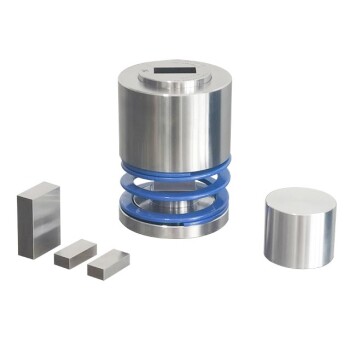
The high-pressure reactor acts as the fundamental control mechanism for consistency. By generating a closed, high-temperature, and high-pressure environment, it allows researchers to synthesize mesoporous hydroxyapatite with the specific physical and chemical properties required for catalysis. This apparatus is essential because it enables the precise regulation of critical variables—such as temperature, reaction time, and molybdate anion concentration—ensuring that the resulting powder has the correct phase composition and particle dispersion every time.
The core value of the high-pressure reactor lies in its ability to guarantee high reproducibility. It transforms the synthesis process from a variable experiment into a controlled engineering feat, producing mesoporous structures with the high specific surface area necessary for superior heterogeneous catalytic activity.
The Mechanics of Control
Achieving Precise Parameter Regulation
The reactor creates a sealed system where thermodynamic conditions can be manipulated with exactness.
This allows researchers to strictly control the temperature and the duration of the reaction.
Managing Chemical Composition
Within this environment, the concentration of additives, such as molybdate anions, can be finely tuned.
This regulation dictates the phase composition of the hydroxyapatite, ensuring the chemical makeup is consistent across different batches.
Engineering the Catalytic Structure
Controlling Particle Dispersion
The reactor's environment allows for the regulation of how particles disperse during formation.
Proper dispersion prevents agglomeration, which is vital for maintaining the desired material properties.
Constructing the Mesoporous Framework
The primary goal of using this reactor is to guide the formation of a mesoporous structure.
This structure is not accidental; it is the direct result of the controlled "subcritical" liquid-phase environment created by the high pressure.
Maximizing Reaction Activity
A well-defined mesoporous structure yields a significantly higher specific surface area.
For a heterogeneous catalyst, this surface area is critical, as it directly enhances the material's reaction activity and efficiency.
Understanding the Trade-offs
The Sensitivity of Reproducibility
While the reactor enables high reproducibility, the process is highly sensitive to parameter inputs.
Slight deviations in temperature or time settings can drastically alter the phase composition and pore size distribution.
Equipment Dependency
Success is entirely dependent on the reactor's ability to maintain a seal under stress.
Any fluctuation in pressure due to equipment capability will compromise the "subcritical" state required for uniform precursor solubility and crystallization.
Making the Right Choice for Your Goal
To maximize the effectiveness of your synthesis, align your reactor protocols with your specific end-goals:
- If your primary focus is Scientific Validity: Prioritize the precise regulation of temperature and time to ensure the high reproducibility of experimental results.
- If your primary focus is Catalytic Performance: Focus on manipulating the molybdate anion concentration to maximize the specific surface area and reaction activity of the powder.
Ultimately, the high-pressure reactor is not just a vessel, but a precision instrument that bridges the gap between raw precursors and high-performance catalytic materials.
Summary Table:
| Key Feature | Impact on Hydroxyapatite Synthesis | Benefit for Heterogeneous Catalysis |
|---|---|---|
| Temperature Control | Ensures uniform subcritical environment | High reproducibility of material phases |
| Pressure Regulation | Maintains precise liquid-phase conditions | Consistent particle dispersion and pore size |
| Chemical Tuning | Regulates molybdate anion concentration | Optimized phase composition and purity |
| Mesoporous Formation | Guides the building of porous structures | Maximized specific surface area for activity |
Elevate Your Materials Research with KINTEK Precision
Consistency is the backbone of groundbreaking research. KINTEK specializes in laboratory equipment and consumables, offering a comprehensive range of high-temperature high-pressure reactors and autoclaves designed to deliver the rigorous control required for synthesizing mesoporous hydroxyapatite and other advanced catalysts.
From our precision crushing and milling systems to specialized PTFE products and crucibles, we provide the tools that bridge the gap between experimental design and high-performance catalytic results. Whether you are optimizing specific surface area or ensuring industrial-grade reproducibility, our team is ready to equip your lab with the industry's most reliable technology.
Ready to achieve high-performance results? Contact KINTEK today to discuss your reactor needs!
References
- Miroslav Vlček. Radiation sensitivity of chalcogenide glasses thin films prepared by spin coating. DOI: 10.21175/rad.abstr.book.2023.19.12
This article is also based on technical information from Kintek Solution Knowledge Base .
Related Products
- Customizable Laboratory High Temperature High Pressure Reactors for Diverse Scientific Applications
- Customizable High Pressure Reactors for Advanced Scientific and Industrial Applications
- Stainless High Pressure Autoclave Reactor Laboratory Pressure Reactor
- Mini SS High Pressure Autoclave Reactor for Laboratory Use
- High Pressure Laboratory Autoclave Reactor for Hydrothermal Synthesis
People Also Ask
- How do high-pressure and high-temperature reactors ensure the effective treatment of lignocellulosic wastewater in WAO?
- What equipment is required for high-pressure high-temperature reactions? Master Extreme Chemistry Safely
- How do you control high pressure in a reactor? A Guide to Safe & Stable Operation
- How does initial oxygen pressure affect the wet oxidation of pharmaceutical sludge? Master Your Oxidation Depth
- Why is argon better than nitrogen for inert atmosphere? Ensure Absolute Reactivity & Stability