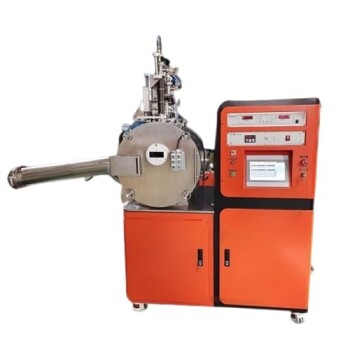
In site-selective Atomic Layer Deposition (ALD), a high-vacuum environment is indispensable for creating the specific surface chemical states required for localized film growth. A high vacuum (typically $10^{-7}$ Torr) at high temperatures (up to 900°C) facilitates the controlled removal of oxygen atoms from the $\text{TiO}_2$ lattice to form oxygen vacancy point defects. These defects serve as the "blueprints" for selective hydration, transforming an insulating substrate into a conductive template with precisely defined active sites.
High-vacuum annealing is a dual-purpose process: it acts as a chemical reductive agent to induce specific oxygen vacancies and as a protective barrier against contamination. This controlled defect engineering is what allows researchers to dictate exactly where the next atomic layer will bond.
Engineering Surface Active Sites through Controlled Defects
The Role of Oxygen Vacancy Formation
A high-vacuum environment allows for the thermal removal of oxygen atoms from the titanium dioxide surface and bulk crystal. This process creates a high concentration of oxygen vacancy point defects, which are otherwise impossible to maintain in atmospheric conditions.
These vacancies are not mere flaws; they are the functional tools used to verify the feasibility of directional atomic layer deposition. By controlling the final temperature of the vacuum, researchers can precisely adjust the density of these surface vacancies.
Transition from Insulator to Conductor
The annealing process fundamentally alters the physical properties of the $\text{TiO}_2$ crystal. It transforms the material from a transparent, insulating state into a conductive blue crystal.
This conductivity is a direct result of the high concentration of defects induced by the vacuum. This transformation is critical for characterizing the material and ensuring it can support the selective hydration required for ALD.
Selective Hydration and Nucleation
Once the vacancies are formed, they serve as the primary locations for selective hydration. This step creates the specific surface active sites where precursors will eventually bind.
Without the vacuum-induced vacancies, the ALD process would lack the necessary "template" to achieve site-selectivity. The vacuum ensures that nucleation occurs only where intended, rather than randomly across the surface.
Maintaining Atomic-Scale Purity and Control
Eliminating Impurity Interference
At the high temperatures required for annealing (up to 900°C), $\text{TiO}_2$ is highly reactive. A high-vacuum environment ensures that oxygen atoms are removed without interference from external impurity gases.
If impurities were present, they would occupy the vacancy sites or react with the surface. This would effectively "poison" the active sites and prevent successful site-selective deposition.
Preventing Unintended Oxidation
A vacuum furnace provides an environment with extremely low oxygen partial pressure (typically below $5.5 \times 10^{-8}$ Torr). This environment is critical to prevent the material from re-oxidizing during the heating cycle.
In an oxygen-rich environment, the surface would naturally stabilize, eliminating the very oxygen vacancies the researcher is trying to create. The vacuum maintains the "reduced" state of the crystal.
Facilitating Atomic Rearrangement
The vacuum environment allows for the rearrangement of atoms within short-range ordered structures. This facilitates the transformation of amorphous coatings into pure crystalline phases at lower temperatures than would be required at atmospheric pressure.
This structural consistency ensures that the resulting thin films exhibit high uniformity and excellent mechanical properties. It also ensures the film remains stable under long-term use.
Understanding the Trade-offs
Temperature and Energy Demands
Achieving the necessary defect density often requires temperatures as high as 900°C. Maintaining a high vacuum at these temperatures is energy-intensive and requires specialized vacuum furnace equipment capable of handling high thermal loads.
Risk of Material Embrittlement
Titanium-based materials are extremely sensitive to oxygen and nitrogen at high temperatures. If the vacuum is not deep enough, residual gases can diffuse into the grain boundaries, acting as alpha stabilizers.
This can lead to surface embrittlement, which may compromise the structural integrity of the substrate. Precision in vacuum levels is therefore not just a matter of chemistry, but of mechanical stability.
How to Apply This to Your Research
Successful site-selective ALD depends on the precise calibration of your vacuum environment and thermal profile.
- If your primary focus is maximizing nucleation sites: Focus on higher annealing temperatures (up to 850°C or 900°C) to increase the density of surface oxygen vacancies.
- If your primary focus is film purity and uniformity: Prioritize achieving the lowest possible base pressure (below $10^{-7}$ Torr) to eliminate by-products and residual gas interference.
- If your primary focus is phase transformation (e.g., Anatase): Use controlled vacuum annealing between 600°C and 800°C to induce crystallinity while maintaining surface bioactivity.
By masterfully controlling the vacuum-thermal relationship, you can turn a passive substrate into a highly active, site-specific template for advanced atomic layer growth.
Summary Table:
| Key Function | Technical Impact | Outcome for ALD Research |
|---|---|---|
| Defect Engineering | Creates oxygen vacancy point defects | Acts as a "blueprint" for selective hydration |
| Impurity Control | Prevents poisoning of active sites | Ensures atomic-scale purity and nucleation control |
| Phase Transition | Facilitates atomic rearrangement | Transforms amorphous layers into pure crystals |
| Property Shift | Induces insulator-to-conductor transition | Enables material characterization and conductivity |
Elevate Your ALD Research with KINTEK Precision
Achieving the perfect vacuum-thermal balance is critical for successful site-selective deposition. KINTEK specializes in high-performance laboratory equipment designed to meet the rigorous demands of advanced materials science.
Whether you require high-temperature vacuum furnaces, CVD/PECVD systems, or high-pressure reactors and autoclaves, our solutions provide the precise atmospheric control needed for oxygen vacancy engineering. We also offer a comprehensive range of crushing systems, hydraulic presses, and essential consumables like PTFE and ceramics to support your entire workflow.
Ready to optimize your thin-film growth? Contact our technical experts today to find the ideal equipment for your laboratory!
References
- Ethan P. Kamphaus, Lei Cheng. Site-Selective Atomic Layer Deposition on Rutile TiO<sub>2</sub>: Selective Hydration as a Route to Target Point Defects. DOI: 10.1021/acs.jpcc.2c06992
This article is also based on technical information from Kintek Solution Knowledge Base .
Related Products
- Vacuum Heat Treat Furnace with Ceramic Fiber Liner
- Vacuum Heat Treat and Sintering Furnace with 9MPa Air Pressure
- Horizontal High Temperature Graphite Vacuum Graphitization Furnace
- Ultra-High Temperature Graphite Vacuum Graphitization Furnace
- 1700℃ Controlled Atmosphere Furnace Nitrogen Inert Atmosphere Furnace
People Also Ask
- What is a vacuum heat treatment furnace? The Ultimate Guide to Controlled Atmosphere Processing
- What is a vacuum heat treatment furnace? Achieve Unmatched Purity and Control
- What is vacuum heat treatment process? Achieve Superior Control, Cleanliness, and Quality
- How does a vacuum heat treatment work? Achieve Superior Material Properties in a Pristine Environment
- What is the temperature of vacuum heat treatment? Achieve Superior Material Properties & Pristine Finishes