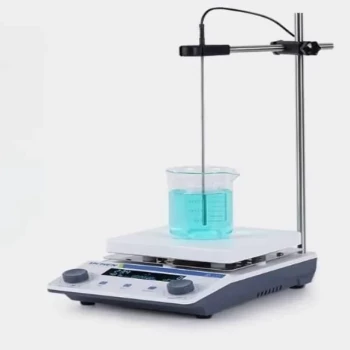
Precision magnetic stirring is the fundamental technique used to achieve molecular-level uniformity in MXene and polymer composite solutions. By maintaining a constant, controlled speed, the stirrer generates precise shear forces necessary to mix (V1/2Mo1/2)2C MXene, silane coupling agents (POTS), and PDMS. This mechanical action is required to overcome the strong van der Waals forces that naturally cause two-dimensional nanomaterials to clump together, ensuring a dispersed, homogeneous state rather than a mixture of aggregates.
The primary function of the precision stirrer is to prevent agglomeration, creating a stable coating solution that guarantees the final composite membrane exhibits consistent photothermal performance.
The Mechanics of Molecular Dispersion
Overcoming Intermolecular Forces
Nanomaterials, particularly two-dimensional ones like MXene, are prone to aggregation due to strong van der Waals forces.
Without active intervention, these particles naturally clump together, compromising the material's structural integrity. A precision magnetic stirrer provides the continuous kinetic energy required to break these attractive forces and keep the particles separated.
Achieving Uniform Distribution
The device ensures the molecular-level dispersion of multiple components, specifically the MXene nanosheets, the silane coupling agents (POTS), and the polymer matrix (PDMS).
By maintaining a constant stirring speed, the system ensures that every part of the solution undergoes the same mixing intensity. This prevents "dead zones" where agglomeration could begin to occur.
Impact on Material Performance
Stability of the Coating Solution
The immediate result of this process is a stable, homogeneous coating solution.
Unlike a poorly mixed solution which might separate or settle over time, a precision-stirred mixture retains its uniformity. This stability is a prerequisite for any subsequent application processes, such as casting or coating.
Consistent Photothermal Output
The ultimate goal of using a precision stirrer in this context is to ensure consistent photothermal performance.
If the MXene particles are agglomerated, the heat generation properties of the final composite membrane will be uneven. A uniform dispersion guarantees that the functional properties are equally distributed across the entire surface of the material.
Understanding the Trade-offs
Viscosity Limitations
While magnetic stirrers are excellent for many polymer solutions, they have limits regarding high-viscosity fluids.
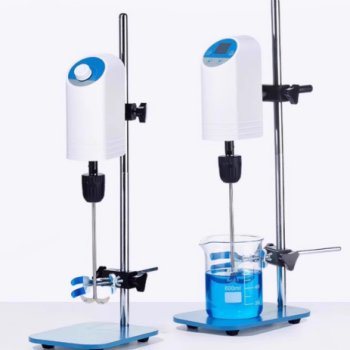
If the polymer matrix is exceptionally thick (similar to high-viscosity sodium alginate pastes), a magnetic stirrer may lack the torque to generate sufficient convection. In these cases, a laboratory mechanical stirrer with an overhead motor is often required to ensure complete dissolution.
The Risk of Decoupling
Precision magnetic stirring relies on the magnetic coupling between the motor and the stir bar.
If the stirring speed is increased too rapidly or the solution becomes too viscous, the stir bar can decouple, resulting in erratic spinning or a complete stop. This interruption can immediately allow van der Waals forces to reassert themselves, leading to rapid particle agglomeration.
Making the Right Choice for Your Goal
Depending on the specific phase of your composite preparation, your equipment needs may shift.
- If your primary focus is preventing agglomeration: Prioritize a stirrer that offers precise speed maintenance to consistently overcome van der Waals forces without decoupling.
- If your primary focus is high-viscosity dissolution: Consider switching to a mechanical stirrer to generate the shear force needed for uniform physical mixing in thick polymer matrices.
Consistency in your stirring process is the single most controllable variable for ensuring the reliability of your final composite material.
Summary Table:
| Feature | Impact on MXene/Polymer Composites | Benefit for Research |
|---|---|---|
| Precise Shear Forces | Overcomes strong van der Waals forces between 2D nanosheets. | Prevents particle agglomeration and clumping. |
| Constant Speed Control | Ensures uniform mixing of MXene, POTS, and PDMS matrix. | Achieves molecular-level dispersion and homogeneity. |
| Stable Kinetic Energy | Maintains suspension of nanomaterials during the coating process. | Guarantees consistent photothermal performance. |
| Magnetic Coupling | Provides a sealed, contact-free mixing environment. | Minimizes contamination in sensitive chemical reactions. |
Elevate your material synthesis with KINTEK’s advanced laboratory solutions. From high-performance precision magnetic stirrers and homogenizers for flawless MXene dispersion to high-temperature furnaces (vacuum, CVD, tube) and crushing systems for precursor preparation, we provide the tools necessary for cutting-edge nanotechnology research. Whether you are developing composite membranes or battery electrodes, our portfolio—including PTFE consumables, ceramic crucibles, and hydraulic presses—is designed to ensure consistency and reliability in every experiment. Enhance your lab's precision—Contact KINTEK experts today!
References
- Ruiqi Xu, Xiaohua Chen. Biomimetic Micro-Nanostructured Evaporator with Dual-Transition-Metal MXene for Efficient Solar Steam Generation and Multifunctional Salt Harvesting. DOI: 10.1007/s40820-024-01612-0
This article is also based on technical information from Kintek Solution Knowledge Base .
Related Products
- Laboratory Small Constant Temperature Heated Magnetic Stirrer Heater and Stirrer
- Custom PTFE Teflon Parts Manufacturer for Magnetic Stirring Bar
- High Performance Laboratory Stirrers for Diverse Applications
- Custom PTFE Teflon Parts Manufacturer for PTFE Stirring Bar Recovery Rod
People Also Ask
- What role does a magnetic stirrer with heating play in ZnO nanoparticle synthesis? Precision Control for Quality Results
- What role does a constant temperature heating magnetic stirrer play in MFC-HAp synthesis? Achieve Material Homogeneity
- What is the function of a laboratory magnetic stirrer in Ni–Cr–P electrodeposition? Optimize Ion Transport & Coating
- Why is a laboratory magnetic stirrer required for benzoic acid esters? Boost Reaction Speed & Yield with High RPM
- What role does a laboratory magnetic stirrer play in TiO2 and TiO2-Ag sol preparation? Master Chemical Kinetics