A three-electrode electrochemical cell is essential for catalyst evaluation because it strictly separates the function of controlling potential from the function of carrying current. This division of labor allows for precise voltage application and unrestricted current flow, ensuring that the data collected reflects the actual performance of the material rather than experimental artifacts or hardware limitations.
By assigning specific tasks to three distinct electrodes, this configuration prevents voltage drift and current bottlenecks. It is the only reliable way to achieve precise potential control and accurate current measurement, ensuring the observed performance is strictly a property of your catalyst.
Isolating Variables Through Task Division
To understand the necessity of this structure, you must look at how it isolates the working electrode (the catalyst) from external interference.
The Reference Electrode Maintains Voltage Precision
The primary role of the reference electrode (RE) is to provide a stable, unchanging potential against which the catalyst's voltage is measured.
A high-stability component, such as a mercury/mercurous sulfate electrode, is often used for this purpose.
Because this electrode is isolated from the main current path, it does not experience polarization. This ensures that the voltage applied to your catalyst has high reference precision, eliminating drift that would otherwise skew your data.
The Counter Electrode Facilitates Unrestricted Current
The counter electrode (CE) acts as the drain or source of electrons to complete the circuit, but it must never be the rate-limiting step.
To achieve this, a large-area platinum wire is typically employed.
The large surface area ensures that the loop current is not limited by the reaction kinetics at the counter electrode. This guarantees that any limit in current you observe is caused by the catalyst you are testing, not the auxiliary equipment.
The Working Electrode Focuses on Intrinsic Activity
The working electrode (WE) holds the material under investigation, such as an IrO2/ATO catalyst.
Because the RE handles voltage stability and the CE handles current load, the WE is free to function purely as the site of the reaction.
This isolation allows the system to reflect the true intrinsic electrocatalytic activity of the material, providing a clean measurement of its efficiency and behavior.
Critical Factors for Experimental Integrity
While the three-electrode setup is superior, its effectiveness relies on the correct implementation of its components.
Avoiding Current Bottlenecks
The system works only if the counter electrode does not impede the flow of electrons.
If the counter electrode does not have a sufficiently large area, it effectively caps the maximum current the system can measure.
This leads to false negatives, where a high-performance catalyst appears mediocre simply because the circuit cannot support its reaction rate.
Preventing Potential Drift
The accuracy of the entire experiment hinges on the stability of the reference electrode.
If the reference electrode degrades or is incompatible with the electrolyte, the "ruler" by which you measure voltage changes length.
This results in a loss of control over the catalyst potential, making it impossible to correlate applied voltage with the resulting current accurately.
Ensuring Accurate Catalyst Evaluation
To ensure your experiments yield valid, publishable data, apply the principles of the three-electrode system as follows:
- If your primary focus is measuring maximum efficiency: Ensure your counter electrode (e.g., Pt wire) has a surface area significantly larger than your working electrode to prevent current limitation.
- If your primary focus is precise kinetic analysis: Select a high-stability reference electrode (e.g., mercury/mercurous sulfate) to guarantee that applied potentials are accurate and drift-free.
The three-electrode system is the fundamental requirement for distinguishing between experimental noise and genuine catalytic capability.
Summary Table:
| Electrode Type | Primary Function | Key Material Example | Impact on Data Accuracy |
|---|---|---|---|
| Working (WE) | Reaction Site | Catalyst (e.g., IrO2/ATO) | Measures true intrinsic catalytic activity. |
| Reference (RE) | Potential Stability | Mercury/Mercurous Sulfate | Prevents voltage drift for precise control. |
| Counter (CE) | Current Completion | Large-area Platinum Wire | Eliminates current bottlenecks and artifacts. |
Elevate Your Electrochemical Research with KINTEK
Precise catalyst evaluation requires more than just a setup; it demands high-quality, reliable hardware. At KINTEK, we specialize in providing researchers with the precision tools needed for reproducible results. Our portfolio features specialized electrolytic cells and electrodes, alongside high-temperature furnaces and pressure reactors, designed to meet the rigorous standards of modern laboratory environments.
Our value to you:
- High-Stability Reference Electrodes: Ensure drift-free potential measurements for kinetic analysis.
- High-Surface Area Counter Electrodes: Guarantee that your system never limits your catalyst's performance.
- Comprehensive Lab Solutions: From battery research tools to ultrasonic homogenizers, we support your entire workflow.
Don't let hardware limitations compromise your data. Contact KINTEK today to optimize your electrochemical setup!
References
- Ziba S. H. S. Rajan, Rhiyaad Mohamed. Organometallic chemical deposition of crystalline iridium oxide nanoparticles on antimony-doped tin oxide support with high-performance for the oxygen evolution reaction. DOI: 10.1039/d0cy00470g
This article is also based on technical information from Kintek Solution Knowledge Base .
Related Products
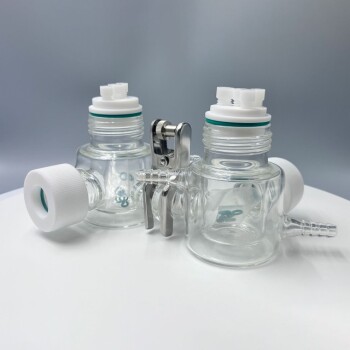
- H Type Electrolytic Cell Triple Electrochemical Cell
- PTFE Electrolytic Cell Electrochemical Cell Corrosion-Resistant Sealed and Non-Sealed
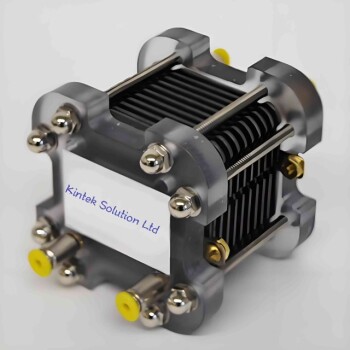
- Electrolytic Electrochemical Cell Gas Diffusion Liquid Flow Reaction Cell
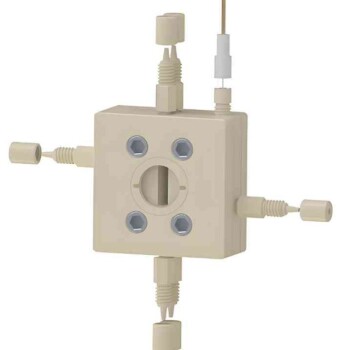
- Electrolytic Electrochemical Cell with Five-Port
- Quartz Electrolytic Electrochemical Cell for Electrochemical Experiments
People Also Ask
- What is a H type cell? A Guide to Divided Electrochemical Cells for Accurate Experiments
- How should the electrolyte be prepared and added to the H-type electrolytic cell? Best Practices for Purity and Safety
- What is the technical necessity of using an H-type electrolytic cell for NO3RR tests? Protect Your Ammonia Yields
- How does the design of an H-type electrolytic cell benefit the neutral water electrolysis process for metal recovery?
- What is the primary function of an H-type electrolytic cell in NitRR? Ensure Accurate Product Yields