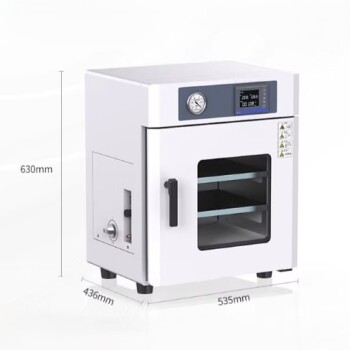
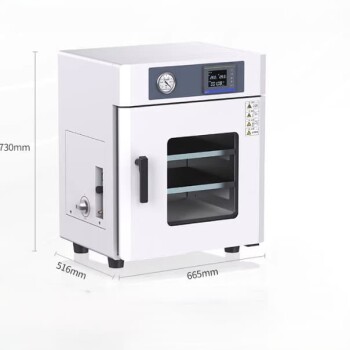
A vacuum oven is a critical processing tool for SiOx anodes because it allows for the precise removal of solvents and moisture without degrading the electrode's metallic components. Specifically, when treating SiOx anodes at temperatures around 80°C, the vacuum environment is required to dry the aqueous binder system while preventing the copper foil current collector from reacting with oxygen.
Core Takeaway The vacuum oven solves two conflicting requirements simultaneously: it provides the thermal energy needed to drive out moisture from the binder, yet it removes the oxygen that would otherwise cause the copper current collector to corrode at those elevated temperatures.
The Critical Role of Oxygen Elimination
Protecting the Current Collector
The primary structural component of a SiOx anode is the copper foil current collector. Copper is highly susceptible to oxidation, a process that accelerates significantly as temperatures rise.
Preventing High-Temperature Corrosion
If you were to dry the anode in a standard oven at 80°C, the atmospheric oxygen would react with the hot copper. This oxidation creates an insulating layer on the foil, severely degrading its electrical conductivity and weakening the adhesion between the foil and the active material.
Creating an Inert Environment
By operating under vacuum, the oven removes the oxygen from the chamber. This allows the system to reach the necessary drying temperatures without chemically altering the copper foil, preserving its structural integrity.
Managing Aqueous Binder Systems
The Challenge of PAA Binders
SiOx anodes often utilize Polyacrylic Acid (PAA) as a binder, which is an aqueous (water-based) system. Unlike organic solvents, water has a high surface tension and enthalpy of vaporization, making it difficult to remove completely.
Lowering the Boiling Point
The vacuum environment significantly lowers the boiling point of water. This means moisture within the PAA binder can be vaporized and removed effectively at 80°C, a temperature that might be insufficient for complete drying at standard atmospheric pressure.
Ensuring Electrochemical Stability
Removing this moisture is not optional; it is mandatory. As noted in broader battery applications, residual moisture in the electrode is a primary cause of electrochemical failure. In SiOx anodes, thorough drying ensures the binder functions correctly and prevents side reactions during battery operation.
Understanding the Trade-offs
The Risk of Residual Moisture
While the vacuum aids drying, the process must be maintained for a sufficient duration. Incomplete drying leaves residual moisture trapped in the PAA binder. In a battery system, this moisture can react with electrolytes (like LiPF6) to form hydrofluoric acid (HF), leading to severe material corrosion and cycle life degradation.
Thermal Constraints
One might assume that raising the temperature above 80°C would dry the anode faster. However, excessive heat can degrade the polymer binder or damage the surface functional groups of the active material. The vacuum oven allows you to stay at a safer, moderate temperature (80°C) while still achieving a drying rate that would usually require much higher heat.
Making the Right Choice for Your Goal
The use of a vacuum oven is not just a procedural step; it is a balance of chemical stability and physical processing.
- If your primary focus is Structural Integrity: The vacuum is necessary to protect the copper foil from oxidation, ensuring the current collector maintains high conductivity and mechanical strength.
- If your primary focus is Electrochemical Performance: The vacuum is necessary to ensure the complete removal of moisture from the PAA binder, preventing fatal side reactions inside the finished battery cell.
Ultimately, the vacuum oven enables the processing of sensitive SiOx materials by decoupling thermal drying from oxidative damage.
Summary Table:
| Feature | Standard Oven (80°C) | Vacuum Oven (80°C) |
|---|---|---|
| Oxygen Levels | High (Atmospheric) | Near Zero |
| Copper Foil Status | Risk of Oxidation/Corrosion | Protected & Conductive |
| Boiling Point of Water | High (100°C) | Significantly Lowered |
| Binder Drying Efficiency | Low for Aqueous Binders | High (Effective for PAA) |
| Electrochemical Risk | High (Residual Moisture) | Low (Thoroughly Dried) |
Elevate Your Battery Research with KINTEK Precision
Don't let oxidation or residual moisture compromise your SiOx anode performance. KINTEK specializes in advanced laboratory solutions designed for the rigorous demands of battery material processing.
Our comprehensive range of vacuum ovens, tube furnaces, and CVD systems provides the precise thermal control and inert environments necessary to protect sensitive current collectors and aqueous binders. Beyond heating, we offer a full suite of battery research tools, including:
- High-temperature vacuum and atmosphere furnaces
- Precision crushing and milling systems
- Hydraulic pellet and isostatic presses
- Specialized electrolytic cells and electrodes
Ensure the structural integrity and electrochemical stability of your next-generation batteries. Contact our technical experts today to find the perfect equipment configuration for your lab's specific needs.
Related Products
- Dental Porcelain Zirconia Sintering Ceramic Vacuum Press Furnace
- 23L Laboratory Vacuum Drying Oven
- Ultra-High Temperature Graphite Vacuum Graphitization Furnace
- 56L Vertical Laboratory Vacuum Drying Oven
- 2200 ℃ Graphite Vacuum Heat Treat Furnace
People Also Ask
- What does sintering do to zirconia? Unlock Its Full Strength and Aesthetic Potential
- What is the shrinkage of zirconia during sintering? Mastering the 20-25% Dimensional Change
- What is the sintering temperature of zirconia ceramic? Mastering the 1400°C-1600°C Thermal Profile
- What is the price of zirconia sintering furnace? Invest in Precision, Not Just a Price Tag
- What factors are important to consider when choosing a dental sintering furnace? Match Your Workflow for Optimal Results