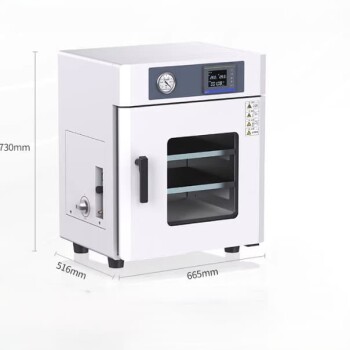
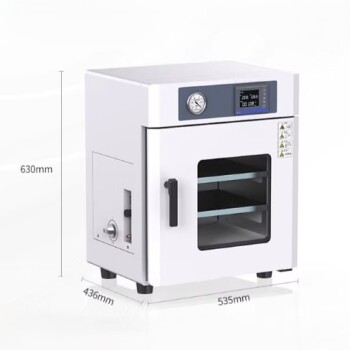
The critical function of using a vacuum oven at 120°C prior to fluorination is to thoroughly eliminate water molecules adsorbed both on the surface and deep within the pores of the carbon aerogel. Because carbon aerogels are highly porous, they act like sponges for moisture, which acts as a contaminant that must be removed to ensure a controlled chemical reaction.
Degassing is a safety and quality control measure. Without it, residual moisture reacts with fluorine gas to produce corrosive hydrofluoric acid (HF), which degrades the aerogel's delicate pore structure and results in uneven chemical modification.
The Chemistry of Contamination
Preventing Corrosive Side Reactions
The primary danger in this process is the high reactivity of fluorine gas. If fluorine encounters water molecules ($H_2O$) trapped in the aerogel, it does not simply displace them.
Instead, it reacts violently to form hydrofluoric acid (HF). This acid is highly corrosive and will attack the carbon framework, potentially collapsing the internal structure you are trying to engineer.
Ensuring Uniform Fluorination
For the fluorination process to be effective, fluorine atoms must bond directly with carbon atoms.
Adsorbed moisture creates a barrier, blocking these active sites. By removing the water, you ensure the fluorine reacts strictly with the carbon surface, leading to a homogeneous and predictable material coating.
Why Vacuum and Heat are Both Required
Overcoming Porous Traps
Carbon aerogels have complex, deep pore structures that trap volatiles physically.
Applying heat alone is often insufficient to drive moisture out of these micropores. The vacuum environment lowers the boiling point of water and creates a pressure differential that physically pulls gas molecules out of the deep internal structure.
The Role of Thermal Energy
The 120°C temperature setting provides the kinetic energy necessary to break the weak bonds holding water molecules to the carbon surface.
While higher temperatures (e.g., 150°C) are sometimes used for industrial carbon black to remove stubborn organic impurities, 120°C is generally the "sweet spot" for removing water without risking thermal damage to the aerogel's specific morphology.
Common Pitfalls and Trade-offs
Incomplete Degassing
The most common error is rushing this step. If the duration (typically overnight) is shortened, moisture may remain in the deepest pores.
Even trace amounts of water can generate enough HF to etch the pore walls, altering the surface area and pore volume data in your final analysis.
Vacuum Pump Efficiency
The effectiveness of the 120°C treatment is entirely dependent on the quality of the vacuum.
If the vacuum pressure is not low enough, the water will simply vaporize and redeposit elsewhere in the chamber or the material, rather than being evacuated from the system entirely.
Making the Right Choice for Your Goal
To maximize the quality of your fluorinated carbon aerogels, consider your specific priorities:
- If your primary focus is Structural Integrity: Ensure the degassing runs overnight at 120°C under high vacuum to prevent HF formation, which causes pore collapse.
- If your primary focus is Surface Chemistry: Prioritize this step to remove volatile impurities, ensuring the fluorine bonds only with carbon for a stable, high-performance interface.
The success of the fluorination process is determined before the gas is even introduced; it relies on the purity of the substrate established during degassing.
Summary Table:
| Feature | Degassing Role in Fluorination |
|---|---|
| Temperature (120°C) | Provides kinetic energy to break water-carbon bonds without damaging morphology. |
| Vacuum Environment | Lowers boiling point and pulls moisture from deep micropores via pressure differential. |
| Contaminant Removal | Eliminates adsorbed water to prevent the formation of corrosive hydrofluoric acid (HF). |
| Process Outcome | Ensures uniform chemical modification and prevents collapse of the delicate pore structure. |
Elevate Your Material Research with KINTEK Precision
Achieving the perfect porous structure requires uncompromising thermal and vacuum control. KINTEK specializes in advanced laboratory solutions, including high-performance vacuum ovens, muffle furnaces, and tube furnaces designed for precise degassing and heat treatment.
Whether you are working on carbon aerogel fluorination or complex battery research, our comprehensive range of high-temperature reactors, crushing systems, and specialized ceramics provides the reliability your lab demands. Don't let moisture contamination compromise your results—contact KINTEK today to find the ideal equipment for your research goals!
References
- Yasser Ahmad, Katia Guérin. Advances in tailoring the water content in porous carbon aerogels using RT-pulsed fluorination. DOI: 10.1016/j.jfluchem.2020.109633
This article is also based on technical information from Kintek Solution Knowledge Base .
Related Products
- 56L Vertical Laboratory Vacuum Drying Oven
- 23L Laboratory Vacuum Drying Oven
- Dental Porcelain Zirconia Sintering Ceramic Vacuum Press Furnace
- Vacuum Heat Treat Sintering Brazing Furnace
- Ultra-High Temperature Graphite Vacuum Graphitization Furnace
People Also Ask
- Why is a laboratory vacuum drying oven recommended for rice straw residues? Protect Your Biomass Integrity
- What role does a laboratory vacuum drying oven play in the preparation of modified multi-walled carbon nanotubes?
- What is the importance of using a laboratory vacuum drying oven? Preserving Slow-Release Microcapsule Integrity
- Why is a Laboratory Vacuum Drying Oven recommended for PBAT microspheres? Protect Sensitive Polymer Integrity
- What role does a laboratory vacuum drying oven play in processing nanoparticle powder samples? Protect Sample Integrity