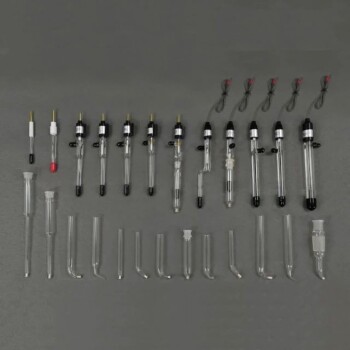
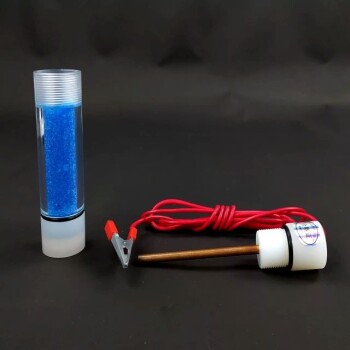
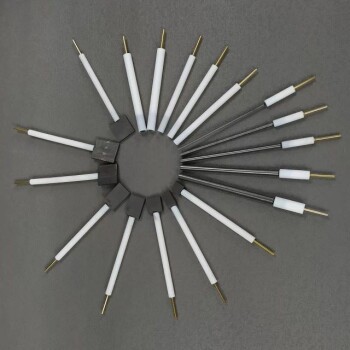
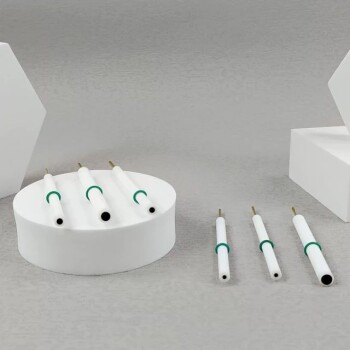
Ag/AgCl reference electrodes are used in MXene electrochemical testing because they provide a highly stable, reproducible, and constant potential baseline. This stability allows researchers to precisely monitor the working electrode's potential relative to the electrolyte, effectively eliminating errors caused by internal circuit resistance. By providing a fixed "zero point," these electrodes ensure that measurements like onset potentials and overpotentials for Hydrogen Evolution Reactions (HER) are accurate and scientifically valid.
The Ag/AgCl reference electrode serves as an immutable benchmark, isolating the electrochemical behavior of the MXene from system-wide variables. This ensures that the data collected reflects the material's true catalytic performance rather than experimental drift or resistance.
Ensuring Precise Potential Control
Stability and Reproducibility
The primary reason for selecting an Ag/AgCl electrode is its ability to maintain a known reference potential over time. During complex tests like Cyclic Voltammetry (CV) or Linear Sweep Voltammetry (LSV), any drift in the reference potential would lead to false data regarding the material's activity.
Elimination of Circuit Resistance
In MXene testing, especially for energy applications, internal circuit resistance can mask the true performance of the material. The Ag/AgCl electrode allows for the monitoring of the working electrode independently, ensuring that the measured overpotential is a result of the MXene’s chemistry, not the experimental setup.
Defining Thermodynamic Baselines
By providing a known thermodynamic baseline, researchers can accurately set the potential ranges where specific redox reactions occur. This is critical for identifying the exact moment an MXene material begins to catalyze a reaction, such as the oxidation of electroactive species.
Isolating Material Performance
Three-Electrode Configuration
In a three-electrode system, the Ag/AgCl electrode acts as a probe that monitors the solution potential without drawing significant current itself. This configuration prevents the "measurement bias" that occurs in two-electrode systems where the total system potential is lumped together.
Independent Component Analysis
Using an Ag/AgCl electrode allows researchers to separate the performance of the anode from the cathode. This is vital for determining if improvements in a system are due to the MXene's catalytic efficiency or other factors like microbial attachment or electrolyte conductivity.
Performance in Diverse Electrolytes
Ag/AgCl electrodes maintain high stability even in strong alkaline electrolytes, such as 1 M KOH, which are frequently used in MXene-based water splitting tests. This durability ensures that the reference potential remains constant even under harsh chemical conditions.
Understanding the Trade-offs
Internal Solution Leakage
The Ag/AgCl electrode functions by allowing a small amount of internal fill solution (typically KCl) to leak through a junction into the sample. While this maintains electrical contact, this leakage can occasionally introduce interfering ions into the test environment if not carefully managed.
Junction Clogging and Maintenance
The porous junction (made of ceramic, cotton, or Teflon) is a common point of failure. If the junction becomes clogged or the internal saturated KCl solution is depleted, the electrode will exhibit potential drift, leading to inaccurate qualitative and quantitative analysis.
Selection of Fill Solutions
The internal electrolyte must be chosen to avoid reactions with the sample. If the chloride ions from the 3 M KCl solution react with the MXene or the specific ions being studied, it can create artifacts in the data that look like chemical reactions but are actually contamination.
How to Apply This to Your Testing
Optimizing Your Experimental Setup
- If your primary focus is precise HER/OER overpotential measurement: Use a high-purity Ag/AgCl electrode with a saturated KCl filling to ensure the most stable baseline for calculating onset potentials.
- If your primary focus is long-term stability in alkaline media: Regularly check the junction for clogs and ensure the internal silver chloride dip is not stripped to maintain a constant reference in KOH environments.
- If your primary focus is preventing sample contamination: Select a reference electrode with a "double junction" or a non-interfering fill solution to prevent chloride ions from interacting with your MXene sample.
The Ag/AgCl reference electrode is the cornerstone of reliable electrochemical data, transforming raw measurements into precise insights into MXene performance.
Summary Table:
| Feature | Benefit for MXene Testing | Key Consideration |
|---|---|---|
| Stable Potential | Provides a fixed "zero point" for accurate CV and LSV measurements. | Requires regular refill of KCl solution. |
| 3-Electrode Setup | Isolates MXene catalytic performance from system-wide resistance. | Avoid current draw through the reference. |
| Alkaline Durability | Remains stable in harsh 1 M KOH electrolytes for water splitting. | Monitor for junction clogging in high-molarity media. |
| Reproducibility | Ensures reliable data for onset potentials and HER overpotentials. | Guard against chloride ion leakage into samples. |
Elevate your material science research with KINTEK’s professional-grade electrochemical solutions. We specialize in high-stability reference electrodes, electrolytic cells, and electrodes designed to deliver the precision required for advanced MXene and battery research. Beyond electrochemical tools, our portfolio includes high-temperature reactors, vacuum furnaces, and hydraulic presses to support your entire synthesis and testing workflow. Whether you are optimizing HER catalytic performance or developing next-gen energy storage, KINTEK provides the reliable equipment and high-quality consumables you need to ensure reproducible results. Contact our experts today to find the perfect setup for your lab!
References
- Bilal Sarfraz, Khalid Mahmood. Bifunctional CuS/Cl-terminated greener MXene electrocatalyst for efficient hydrogen production by water splitting. DOI: 10.1039/d3ra02581k
This article is also based on technical information from Kintek Solution Knowledge Base .
Related Products
- Reference Electrode Calomel Silver Chloride Mercury Sulfate for Laboratory Use
- Electrolytic Electrochemical Cell Gas Diffusion Liquid Flow Reaction Cell
- Copper Sulfate Reference Electrode for Laboratory Use
- Graphite Disc Rod and Sheet Electrode Electrochemical Graphite Electrode
- Glassy Carbon Electrochemical Electrode
People Also Ask
- What is the function of a reference electrode? Master Precision in Three-Electrode Reactor Reconstruction
- What is the recommended maintenance for the filling solution of a reference electrode? A Guide to Stable & Accurate Readings
- Which electrode is used as a ground reference? Master the Key to Accurate Electrochemical Measurements
- What is the reference electrode in potentiometry? The Key to Stable & Accurate Measurements
- Which electrode is used as a reference? A Guide to Accurate Electrochemical Measurements