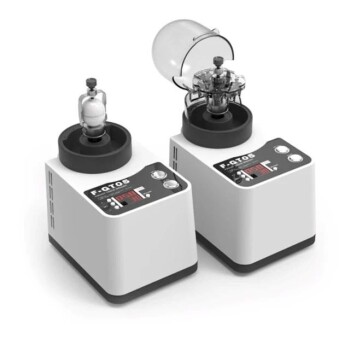
High-energy ball milling is utilized primarily to drive mechanochemical fusion through intense physical force. By applying substantial impact and shear forces to metal precursors and graphite powder, this equipment physically embeds metal atoms into the support matrix. This technique is essential for achieving the uniform, single-atom dispersion required to create effective catalysts for methane oxidation.
This process transcends simple mixing by using mechanical energy to construct unique active structures that significantly lower the energy barrier for breaking methane C-H bonds.
The Mechanochemical Synthesis Process
Utilizing Impact and Shear Forces
The core function of high-energy ball milling is the generation of intense impact and shear forces. As the grinding media collides with precursors (such as iron phthalocyanine) and graphite, it delivers substantial mechanical energy to the materials.
Achieving Single-Atom Dispersion
This mechanical action facilitates the uniform dispersion of metal atoms onto graphene nanosheets. Unlike standard mixing, this results in a single-atom level distribution, preventing the aggregation of metal particles that can reduce catalytic efficiency.
Mechanical Alloying of Components
The process acts as a form of mechanical alloying. It drives the deep fusion of metal components and supports, effectively integrating them into a cohesive material rather than a simple surface coating.
Optimizing for Methane Oxidation
Constructing Unique Active Centers
The primary goal of this synthesis is to construct unique active center structures, such as embedding FeN4 centers directly into the graphene matrix. These specific geometric and electronic structures are difficult to achieve through thermal or wet chemical methods alone.
Lowering the Activation Energy Barrier
Methane oxidation is challenging due to the stability of the methane molecule. The active centers created by ball milling effectively lower the energy barrier required for the activation of methane C-H bonds, making the reaction thermodynamically more feasible.
Operational Advantages and Trade-offs
Eliminating Solvent Dependencies
A major operational advantage is the ability to operate under solvent-free conditions. This solves common challenges associated with solvent handling and waste disposal found in traditional wet chemical synthesis.
The Necessity of Precursor Dilution
While powerful, this method relies on a specific precursor dilution strategy to be effective. To achieve deep fusion and high metal loading capacities, the ratio of precursors to support must be carefully managed to ensure the mechanical impact translates into atomic integration.
Scalability vs. Complexity
Ball milling offers a pathway to scaling up production that is often hindered in wet chemistry by liquid volume handling. However, the process shifts the complexity from chemical management to mechanical parameter control, requiring precise calibration of energy input and milling time.
Making the Right Choice for Your Goal
To determine if high-energy ball milling is the correct approach for your catalyst preparation, consider your primary objectives:
- If your primary focus is catalytic efficiency: Utilize this method to achieve single-atom dispersion, which maximizes the density of active sites available for C-H bond activation.
- If your primary focus is environmental compliance and safety: Adopt this technique to eliminate volatile solvents, utilizing a mechanochemical approach that is cleaner and safer to scale.
- If your primary focus is material stability: Leverage the mechanical alloying capability to physically embed active centers into the graphene lattice for robust, long-term performance.
By replacing chemical solvents with mechanical force, you create a more robust, scalable, and highly active catalyst specifically engineered for difficult oxidation tasks.
Summary Table:
| Feature | High-Energy Ball Milling Benefit |
|---|---|
| Dispersion Level | Achieves uniform single-atom distribution |
| Synthesis Type | Solvent-free mechanochemical fusion |
| Active Centers | Creates unique FeN4-like embedded structures |
| Reaction Kinetics | Lowers C-H bond activation energy barriers |
| Scalability | Simplifies production by eliminating liquid waste |
Elevate Your Material Research with KINTEK
Ready to achieve precision single-atom dispersion for your next-generation catalysts? KINTEK specializes in high-performance laboratory equipment designed for the most demanding research applications. Whether you need advanced crushing and milling systems for mechanochemical synthesis or high-temperature furnaces and vacuum reactors for material characterization, our comprehensive portfolio has you covered.
Our Value to You:
- Precision Engineering: High-energy ball mills and hydraulic presses tailored for uniform material integration.
- Versatile Solutions: From graphene-based research tools to PTFE consumables and ceramic crucibles.
- Scalable Innovation: Equipment designed to transition your findings from the lab bench to pilot production.
Maximize your catalytic efficiency and streamline your solvent-free processes today. Contact our experts at KINTEK to find the perfect equipment for your lab!
References
- Jongkyu Kang, Eun Duck Park. Liquid-Phase Selective Oxidation of Methane to Methane Oxygenates. DOI: 10.3390/catal14030167
This article is also based on technical information from Kintek Solution Knowledge Base .
Related Products
- High Energy Planetary Ball Mill Milling Machine for Laboratory
- High-Energy Omnidirectional Planetary Ball Mill Milling Machine for Laboratory
- High Energy Planetary Ball Mill for Laboratory Horizontal Tank Type Milling Machine
- High Energy Planetary Ball Mill Milling Machine for Laboratory
- High-Energy Omnidirectional Planetary Ball Mill Machine for Laboratory
People Also Ask
- What role do planetary ball mills and zirconia media play in LLZT preparation? Optimize Your Solid Electrolyte Research
- What is the primary function of a planetary ball mill? Mastering SiC/Al Composite Mixing for Homogeneity
- What is the primary purpose of using a planetary ball mill for LAGP? Achieve High-Purity Solid-State Electrolytes
- What role does a planetary ball mill play in the preparation of LGVO powders? Precision Refinement for Aerosol Deposition
- What is the function of a planetary ball mill in the preparation of high-entropy rare earth silicate multi-phase ceramics?