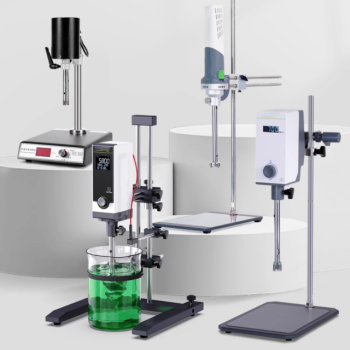
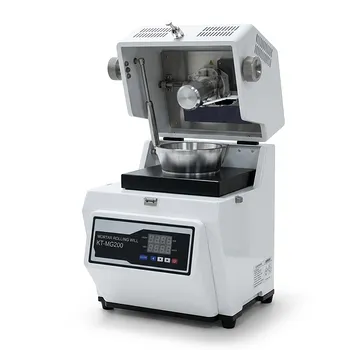
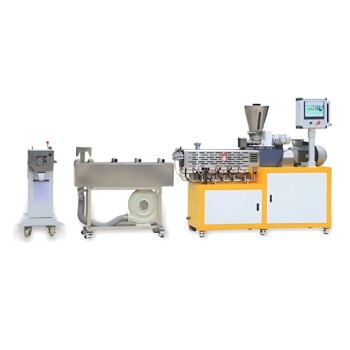
High-performance mixing is the prerequisite for structural integrity in wide-gap brazing. It serves as the critical mechanism to physically blend brittle eutectic filler metal powder with base metal filler powder. Without the microscopic uniformity achieved by this specific equipment, the metallurgical reactions required to bridge large gaps effectively cannot occur.
Wide-gap brazing relies on the interaction between two distinct powder types to form a strong joint. High-performance mixing ensures these powders are distributed evenly enough to allow the base metal to absorb melting point depressants, preventing brittle failure points and ensuring dense, high-strength connections.
The Mechanics of the Powder Blend
Combining Distinct Components
Wide-gap brazing is unique because it requires the physical blending of two specific materials: brittle eutectic filler metal powder and base metal filler powder. These components are not pre-alloyed; they must exist as separate particles until the brazing cycle begins.
Achieving Microscopic Uniformity
Simple agitation is often insufficient for this process. High-performance mixing equipment is necessary to achieve a uniform distribution of these particles at the microscopic level. This level of precision ensures that every particle of filler metal is adequately surrounded by base metal powder.
The Role of the Diffusion Sink
Managing Melting Point Depressants (MPDs)
The eutectic filler contains melting point depressant (MPD) elements that allow the alloy to flow. However, if these elements are allowed to pool or concentrate, they can be detrimental to the final joint.
The Base Metal Function
The base metal filler powder acts as a diffusion sink. Its primary job is to absorb the MPD elements from the liquid filler during the heating process.
The Necessity of Proximity
For this diffusion to work, the base metal particles must be in immediate proximity to the melting filler. High-performance mixing guarantees this proximity throughout the entire volume of the joint.
Risks of Inadequate Mixing
Accumulation of Intermetallics
If the powders are not mixed with high-performance equipment, MPDs will not diffuse evenly. This leads to the accumulation of brittle intermetallic compounds within the joint.
Compromised Joint Density
Brittle compounds create weak points and reduce the density of the final braze. To achieve dense, high-strength joints—especially in large gaps where stress is higher—uniform mixing is the only way to suppress these defects.
Optimizing Wide-Gap Brazing Results
To ensure your brazing process yields the strongest possible components, consider how your mixing stage influences the final metallurgy:
- If your primary focus is Joint Strength: Prioritize mixing equipment that guarantees a homogenous blend to maximize the diffusion of MPD elements.
- If your primary focus is Gap Filling: Ensure your mixing process achieves microscopic uniformity to prevent segregation that leads to porous or brittle repairs in large gaps.
Precision mixing transforms a mixture of loose powders into a cohesive, durable metallurgical bond.
Summary Table:
| Feature | Importance in Wide-Gap Brazing | Impact of Poor Mixing |
|---|---|---|
| Powder Distribution | Achieves microscopic uniformity of eutectic and base powders. | Leads to segregation and porous joint structures. |
| MPD Management | Facilitates absorption of melting point depressants by the base metal. | Causes pooling of MPDs and brittle failure points. |
| Diffusion Sink | Ensures base metal particles are in immediate proximity to liquid filler. | Incomplete diffusion resulting in weak intermetallics. |
| Joint Density | Creates a cohesive, durable metallurgical bond across large gaps. | Compromised density and reduced mechanical strength. |
Elevate Your Brazing Precision with KINTEK
Don't let inadequate mixing compromise the structural integrity of your high-stakes brazing projects. KINTEK specializes in advanced laboratory equipment and consumables designed to meet the rigorous demands of material science. From high-performance crushing and milling systems that ensure microscopic uniformity to high-temperature vacuum furnaces and hydraulic presses, we provide the tools necessary to achieve dense, high-strength results in every cycle.
Whether you are refining powder blends for wide-gap brazing or conducting advanced battery research, our expert team is ready to support your lab with premium PTFE products, ceramics, and crucibles.
Maximize your joint strength and metallurgical precision today. Contact our specialists to find the perfect equipment solution!
References
- Milena Penyaz, B.A. Kalin. Overview of nickel-based filler metals for brazing of austenitic stainless steels. DOI: 10.17580/nfm.2021.01.06
This article is also based on technical information from Kintek Solution Knowledge Base .
Related Products
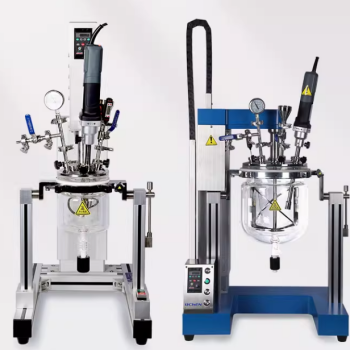
- High Performance Laboratory Stirrers for Diverse Applications
- High Performance Lab Homogenizer for Pharma Cosmetics and Food R&D
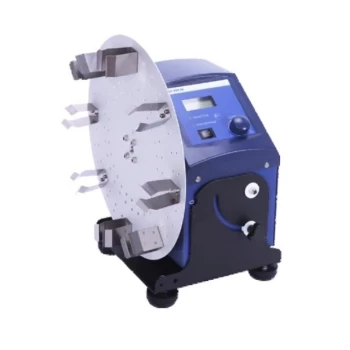
- Laboratory Disc Rotary Mixer for Efficient Sample Mixing and Homogenization
- Laboratory Vortex Mixer Orbital Shaker Multifunctional Rotation Oscillation Mixer
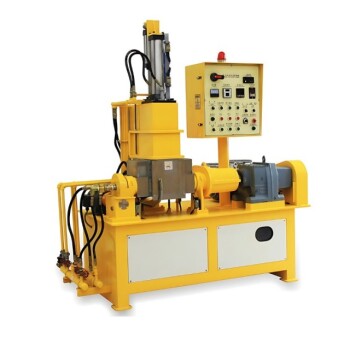
- Lab Internal Rubber Mixer Rubber Kneader Machine for Mixing and Kneading
People Also Ask
- How does a laboratory stirrer influence MOF product quality? Master Precision in Non-Solvothermal Synthesis
- What critical role does a Laboratory Stirrer play during leaching? Enhance Titanium-Magnesium Waste Recovery
- What is the primary function of laboratory stirring equipment in the preparation of compost leachate? Optimize Extraction
- What is a laboratory mixer? A Guide to Achieving Perfect Sample Homogeneity
- What is a laboratory mixer used for? Choose the Right Tool for Liquids or Solids