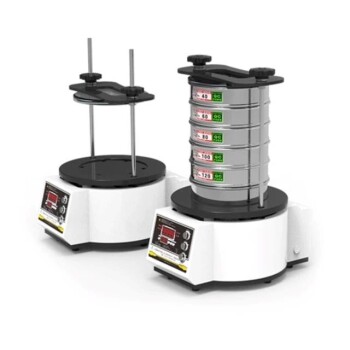
High-standard sieving equipment is the foundation of experimental accuracy in co-combustion studies. By utilizing precise tools like 200-mesh standard sieves, researchers ensure that coal and sorghum biomass particles achieve a highly consistent and fine particle size, typically around 75 microns. This level of uniformity is essential to maximize the reactive specific surface area and ensure physical homogeneity when mixing these two distinct fuel types.
Central Takeaway: High-standard sieving eliminates particle size as a variable, ensuring that thermal and kinetic data reflect the chemical properties of the fuel blend rather than physical inconsistencies. This precision is mandatory for obtaining repeatable results in ash fusion determination and thermogravimetric analysis.
Optimizing Reactive Surface Area and Mixing
Maximizing Specific Surface Area
High-standard sieving reduces coal and sorghum to a fine powder, significantly increasing the specific surface area available for reaction. A larger surface area allows for more efficient heat transfer and oxygen contact during combustion.
This is critical in co-combustion because it ensures that the biomass and coal components react at their theoretical potential. Without this surface area optimization, larger particles would burn slower, skewing the data on combustion efficiency.
Ensuring Physical Homogeneity
Mixing two materials with different densities and textures, such as coal and sorghum, requires identical particle sizes to prevent stratification. High-precision sieving ensures that the fuel blend remains homogeneous throughout the testing process.
Consistent granularity prevents the "sifting effect," where smaller particles settle at the bottom of a feeder or crucible. This homogeneity is the only way to guarantee that the samples used in compositional analysis are truly representative of the entire batch.
Controlling Kinetic and Thermal Variables
Eliminating Internal Temperature Gradients
In laboratory-scale reactors, large or inconsistent particles can develop internal temperature gradients, where the core of the particle is cooler than the surface. This leads to inaccurate readings of devolatilization and ignition temperatures.
Sieving fuel to a narrow range, such as 40–63 μm or 75–90 μm, ensures that heat penetrates the particle almost instantaneously. This allows researchers to isolate the chemical kinetics of the fuel from the physical limitations of heat mass transfer.
Standardizing Volatile Matter Release
The rate at which volatile matter is released from sorghum biomass is highly sensitive to particle size. Fine sieving ensures that the volatile release profile is consistent across all test runs.
By controlling this variable, scientists can accurately simulate the environment of industrial power plant boilers. This consistency is vital for developing reliable kinetic models that predict how different coal-sorghum ratios will perform in full-scale operations.
Understanding the Trade-offs
Material Loss and Preparation Time
The primary downside of high-standard sieving is the significant time required for sample preparation. Achieving a 200-mesh consistency with fibrous biomass like sorghum often requires multiple grinding and sieving cycles.
Furthermore, over-processing can lead to the loss of specific components or the introduction of moisture if not handled in a controlled environment. Researchers must balance the need for extreme fineness with the risk of altering the sample's chemical integrity.
The Risk of Sieve Blinding
Biomass particles are often elongated or fibrous, which can lead to sieve blinding, where particles clog the mesh openings. This requires the use of specialized vibrating sieves or manual cleaning to maintain the accuracy of the size classification.
If blinding occurs and is not addressed, the resulting sample may have a wider size distribution than intended. This undermines the reproducibility of thermogravimetric (TGA) and ash fusion tests.
How to Apply This to Your Project
Recommendations for Sample Preparation
- If your primary focus is Kinetic Modeling: Prioritize a narrow particle size distribution, such as 40–63 μm, to eliminate heat and mass transfer variables.
- If your primary focus is Ash Fusion Determination: Use a 200-mesh sieve (75 μm) to ensure the physical homogeneity of the coal and biomass ash precursors.
- If your primary focus is Industrial Simulation: Target a size range that mirrors pulverized coal (typically 75–90 μm) to maintain relevance to large-scale boiler conditions.
- If your primary focus is Pyrolysis Yields: Use a No. 60 sieve (0.25 mm) to provide a high surface area that ensures uniform heating and maximizes volatile byproduct recovery.
Precise particle size control is the only way to transform raw biomass and coal into a standardized fuel capable of yielding definitive scientific data.
Summary Table:
| Feature | Impact on Co-Combustion | Scientific Benefit |
|---|---|---|
| Particle Uniformity | Ensures consistent ~75μm sizing | Maximizes specific surface area for reaction |
| Physical Homogeneity | Prevents fuel stratification | Guarantees representative compositional analysis |
| Thermal Gradient Control | Eliminates internal temperature lags | Accurate devolatilization and ignition data |
| Kinetic Standardization | Stabilizes volatile matter release | Reliable modeling for industrial boiler simulation |
Elevate Your Research Precision with KINTEK
High-accuracy co-combustion data starts with flawless sample preparation. KINTEK provides the high-standard sieving equipment, crushing and milling systems, and high-temperature furnaces necessary to eliminate physical variables and isolate true chemical kinetics.
Whether you are conducting ash fusion determination, thermogravimetric analysis, or kinetic modeling, our comprehensive range of laboratory tools—including muffle furnaces, hydraulic presses, and specialized consumables—ensures your results are repeatable and industry-ready.
Ready to optimize your lab's workflow? Contact KINTEK today for professional equipment solutions!
References
- Fairuz Milkiy Kuswa, Satryo Pringgo Sejati. Experimental Investigation of Ash Deposition during Co-Firing of Coal with Sorghum Pellet Using Drop Tube Furnace. DOI: 10.24912/ijaste.v1.i1.225-231
This article is also based on technical information from Kintek Solution Knowledge Base .
Related Products
- Three-dimensional electromagnetic sieving instrument
- Laboratory Vibratory Sieve Shaker Machine for Dry and Wet Three-Dimensional Sieving
- Laboratory Test Sieves and Sieving Machines
- Laboratory Wet Three-Dimensional Vibratory Sieve Shaker Machine
- Laboratory Test Sieves and Vibratory Sieve Shaker Machine
People Also Ask
- Why is sieving equipment essential for the classification of processed bio-activated carbon? Optimize Performance
- What are the limitations of sieving? Understanding the Constraints of Particle Size Analysis
- What are advantages and disadvantages of sieving method? A Guide to Reliable & Cost-Effective Particle Sizing
- How is sieving important? The Critical Role of Particle Size Analysis in Quality Control
- What is sieving and how does it work? A Guide to Accurate Particle Size Analysis