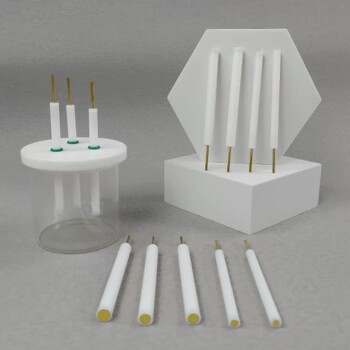
Industrial-grade platinum mesh is the preferred choice for the counter electrode because it acts as an inert, highly conductive anchor for the electrochemical circuit. In acidic copper sulfate electrolytes, it resists oxidative dissolution, preventing contamination, while its mesh geometry ensures a uniform current distribution essential for even copper deposition.
Core Takeaway In a three-electrode system, the counter electrode must sustain current without interfering with the chemistry. Platinum mesh solves the dual challenge of chemical aggression and electrical uniformity: it survives the harsh acidic environment without dissolving and provides a large surface area to prevent polarization, ensuring the copper coating’s purity and structural integrity.
Maintaining Electrolyte and Coating Purity
Resisting Oxidative Dissolution
In an acidic copper sulfate solution, the counter electrode functions as the anode. Under these conditions, most standard metals would undergo anodic dissolution, breaking down and releasing metallic ions into the electrolyte.
Industrial-grade platinum is chemically inert. It resists this oxidation, ensuring that no foreign metallic impurities are introduced into the bath. This is critical because impurities can co-deposit with the copper, compromising the conductivity and mechanical properties of the final coating.
Eliminating Signal Interference
In a three-electrode setup, the goal is to isolate the behavior of the working electrode. If the counter electrode reacts or degrades, it introduces "noise" into the system.
Platinum’s inertness ensures it does not participate in redox reactions other than charge transfer. This guarantees that the electrochemical characteristics measured—such as current response and potential—originate solely from the copper deposition at the working electrode, not from side reactions at the counter electrode.
Optimizing Electrical Dynamics
The Advantage of Mesh Geometry
The geometric form of the electrode is as important as the material. A mesh structure offers a significantly larger effective surface area compared to a simple wire or sheet.
This increased surface area lowers the local current density at the counter electrode. By spreading the current load over a wider area, the mesh prevents the counter electrode from becoming a limiting factor in the cell, allowing for high-current applications without significant voltage loss.
Ensuring Uniform Current Distribution
Uniformity is the defining factor of a high-quality copper deposit. A point source (like a wire) can create uneven electric field lines, leading to thicker deposits in some areas and thinner ones in others.
The platinum mesh creates a broad, distributed current path. This facilitates a uniform electric field throughout the electrolyte, ensuring the copper ions deposit evenly across the entire surface of the working electrode.
Understanding the Trade-offs
Cost vs. Performance
While technically superior, platinum is a precious metal with a high market cost. Using industrial-grade platinum mesh represents a significant upfront investment compared to graphite or stainless steel alternatives.
Mechanical Fragility
Platinum mesh is highly conductive but mechanically delicate. It requires careful handling to maintain its geometric integrity; if the mesh is bent or crinkled significantly, it can alter the distance between electrodes, potentially disrupting the uniformity of the current distribution it was meant to preserve.
Making the Right Choice for Your Goal
To ensure your electrochemical setup yields valid results, align your electrode choice with your specific experimental needs:
- If your primary focus is coating purity: The chemical inertness of platinum is essential to prevent anodic dissolution from contaminating your copper lattice with foreign metals.
- If your primary focus is deposition uniformity: The mesh geometry is required to minimize current density at the counter electrode and ensure even field lines across the sample surface.
By utilizing industrial-grade platinum mesh, you effectively remove the counter electrode as a variable, ensuring that your data reflects only the intrinsic properties of the copper deposition process.
Summary Table:
| Feature | Advantage of Platinum Mesh | Impact on Copper Deposition |
|---|---|---|
| Chemical Stability | Inert in acidic sulfate electrolytes | Prevents contamination and maintains coating purity |
| Electrode Geometry | High surface area mesh structure | Ensures uniform current distribution and even thickness |
| Electrical Behavior | High conductivity with low polarization | Provides stable, noise-free electrochemical measurements |
| System Role | Non-consumable anodic behavior | Eliminates side reactions and electrolyte degradation |
Elevate Your Electrochemical Research with KINTEK
Precision in copper deposition starts with high-quality components. At KINTEK, we specialize in providing premium electrolytic cells and electrodes, including industrial-grade platinum mesh designed for demanding laboratory and industrial environments. Our solutions ensure your research is free from contamination and electrical interference.
Beyond electrodes, KINTEK offers a comprehensive range of lab equipment:
- High-Temperature Furnaces (Muffle, Vacuum, CVD, and more)
- Hydraulic Presses (Pellet, Hot, Isostatic)
- Battery Research Tools & High-Pressure Reactors
- Precision Consumables (PTFE, Ceramics, and Crucibles)
Achieve superior uniformity and purity in your results today. Contact our technical experts for a custom quote!
References
- Mohammad B. Kassim. Copper Nanoparticles Coating on FTO with Improved Adhesion Using Direct and Pulse Electrodeposition Techniques from a Simple Copper Sulphate Solution. DOI: 10.17576/jsm-2023-5208-04
This article is also based on technical information from Kintek Solution Knowledge Base .
Related Products
- Platinum Auxiliary Electrode for Laboratory Use
- Platinum Sheet Electrode for Laboratory and Industrial Applications
- Rotating Platinum Disk Electrode for Electrochemical Applications
- Platinum Sheet Electrode for Battery Lab Applications
- High Purity Gold Platinum Copper Iron Metal Sheets
People Also Ask
- What is the function of a platinum electrode as an auxiliary electrode? Ensure Precise Nickel Coating Corrosion Testing
- Why is platinum typically selected as the auxiliary electrode for electrochemical testing of oxazoline inhibitors?
- What does the auxiliary electrode do? Ensuring Accurate Electrochemical Measurements
- What are the roles of Pt counter and reference electrodes in nitrided steel testing? Optimize Your Electrochemical Data
- What are the advantages of using a platinum counter electrode? Ensure Purity in Photocatalytic Coating Deposition