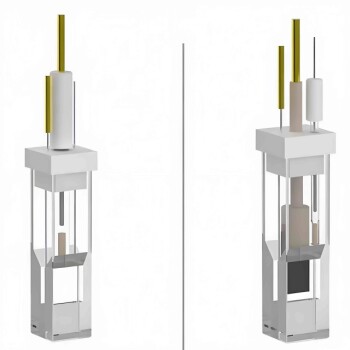
Customized pressure test cells are indispensable for all-solid-state battery (ASSB) research because they provide a mechanism to apply continuous, regulated external stack pressure. Unlike conventional batteries using liquid electrolytes, ASSBs rely on this mechanical pressure to maintain physical contact between solid components, which is critical for counteracting the significant volume fluctuations that occur during charge and discharge cycles.
The fundamental challenge in solid-state batteries is maintaining a stable interface between solid particles. Customized test cells solve this by applying sustained pressure to prevent delamination caused by volume expansion, thereby ensuring low impedance and preventing premature failure.
The Mechanics of the Solid-Solid Interface
Establishing Physical Contact
In liquid batteries, the electrolyte naturally wets the electrode, ensuring ion transport. In ASSBs, the contact is purely physical.
Customized pressure cells force the electrode and electrolyte layers together. This mechanical compression is vital to establish and maintain the tight contact required for ions to move between the cathode, electrolyte, and anode.
Reducing Interfacial Impedance
Poor contact between solid layers creates high resistance (impedance), which severely hampers performance.
By applying continuous pressure, typically ranging from 1.5 MPa to over 150 MPa depending on the chemistry, the test cell minimizes these gaps. This ensures efficient ion transport channels are maintained throughout the testing process.
Managing Volume Changes During Cycling
Counteracting Active Material "Breathing"
Active materials in batteries do not remain static; they expand and contract as lithium ions enter and leave the structure.
This is particularly pronounced in high-nickel cathodes and sulfur cathodes, which undergo significant anisotropic volume changes. Without a customized cell to apply confining pressure, these volume changes would disrupt the structural integrity of the cell.
Accommodating Lithium Plating and Stripping
For ASSBs using lithium metal anodes, the volume changes are drastic due to the physical deposition and stripping of lithium metal.
Pressure test cells compensate for this displacement. They ensure that as lithium is plated or stripped, the stack remains compressed, preventing the formation of voids that would otherwise break the ionic circuit.
Preventing Delamination and Cracking
The expansion and contraction described above create mechanical stress. Without external pressure, this stress leads to interfacial separation (delamination) and crack propagation within the materials.
Customized cells act as a clamp, holding the layers together against these internal forces. This prevents physical separation at the solid-solid interface, which is the primary cause of cycle life degradation in these batteries.
Critical Considerations in Pressure Application
Precision is Mandatory
Applying pressure is not a "one-size-fits-all" solution; it must be calibrated to the specific chemistry.
While some setups require only 7–17 MPa, others dealing with massive volume expansion may require pressures up to 150 MPa. Using incorrect pressure settings can either fail to prevent delamination (too low) or mechanically damage the electrolyte structure (too high).
The Necessity of "Continuous" Application
It is not enough to apply pressure only during assembly.
The test cell must be capable of dynamic pressure retention. As the battery breathes during cycling, the fixture must maintain constant force to adapt to the changing internal volume, ensuring the interface never loosens.
Making the Right Choice for Your Goal
When designing experiments for all-solid-state batteries, the selection of the test cell hardware is as critical as the material chemistry itself.
- If your primary focus is High-Nickel Cathodes: Ensure your test cell can handle anisotropic expansion to prevent particle isolation and crack propagation.
- If your primary focus is Lithium Metal Anodes: Prioritize cells that can compensate for large, dynamic volume changes (plating/stripping) to maintain a stable interface between the metal and the electrolyte.
- If your primary focus is Sulfur Cathodes: Select fixtures capable of maintaining ion transport channels despite significant expansion, focusing on preventing poor contact during discharge.
Success in all-solid-state battery testing relies not just on the chemistry, but on the mechanical environment you create to support it.
Summary Table:
| Feature | Requirement in ASSBs | Role of Customized Pressure Cells |
|---|---|---|
| Interface Type | Solid-Solid Contact | Forces layers together to ensure continuous ion transport |
| Volume Change | 10% to >100% expansion | Counteracts "breathing" to prevent delamination and cracks |
| Impedance | High at loose interfaces | Minimizes gaps to maintain low interfacial resistance |
| Pressure Range | 1.5 MPa to 150+ MPa | Provides regulated, continuous pressure for specific chemistries |
| Anode Stability | Li Plating/Stripping | Prevents void formation during lithium metal deposition |
Elevate Your Battery Research with KINTEK Precision
Unlock the full potential of your all-solid-state battery research by ensuring stable mechanical environments and precise interface control. KINTEK specializes in advanced laboratory equipment, providing high-performance pressure test cells and electrolytic cells specifically designed for the rigorous demands of battery cycling.
Whether you are working with high-nickel cathodes, lithium metal anodes, or sulfur chemistries, our team offers the expertise and high-pressure hardware—including hydraulic presses, high-temperature reactors, and specialized consumables—to ensure your tests yield accurate, reproducible results.
Ready to optimize your electrochemical testing? Contact KINTEK today to discuss our customized solutions and discover how we can enhance your lab's efficiency.
Related Products
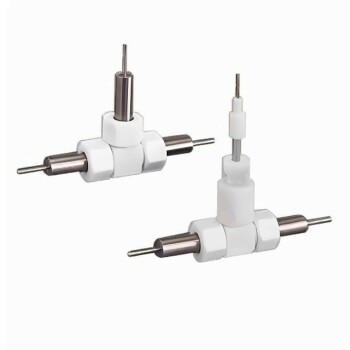
- Customizable Swagelok Type Test Cells for Advanced Battery Research Electrochemical Analysis
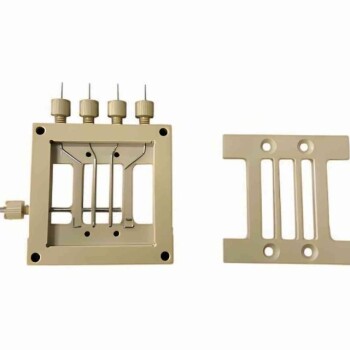
- Custom Ion Conductivity Test Fixtures for Fuel Cell Research
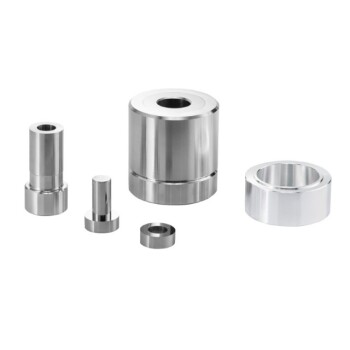
- Ring Press Mold for Lab Applications
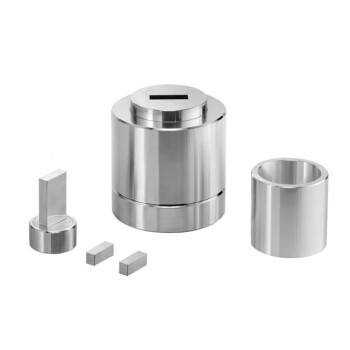
- Assemble Square Lab Press Mold for Laboratory Applications
- Cylindrical Press Mold for Lab Applications
People Also Ask
- How does a standardized electrochemical test cell assist in MOx/CNTf electrode screening? Optimize Material Ratios
- Why is a dedicated electrochemical test cell necessary for carbon steel? Ensure Precise Geothermal Corrosion Data
- What is the difference between a voltaic cell and an electrochemical cell? Understand the Two Types of Energy Conversion
- How do the electrochemical cell and three-electrode testing system collaborate? Optimize Zinc Anode Deposition Control
- Why must the electrochemical cell be continuously purged with nitrogen? Ensure Precision in Ni-Cr Corrosion Tests