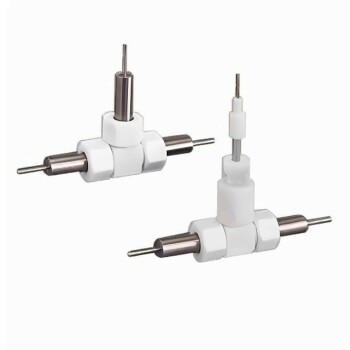
Swagelok-type cell molds primarily address the challenges of maintaining mechanical integrity and environmental isolation during electrochemical testing. By utilizing a robust design featuring stainless steel components and insulating sleeves, these molds solve the critical issues of unstable contact resistance and electrolyte containment, which are frequent sources of error in material performance data.
The core advantage of this mold design is the elimination of variable contact resistance through uniform compression. By stabilizing internal pressure and sealing the environment, the mold ensures that observed performance metrics result from the NVPF material itself, not mechanical inconsistencies in the test setup.
Mechanisms of Stabilization
Ensuring Consistent Electrical Contact
One of the most significant challenges in cell testing is maintaining a continuous electrical path between the cathode, separator, and anode.
Swagelok-type molds address this by tightly compressing the internal stack.
This compression ensures that the cathode material and sodium metal anode maintain firm contact with the current collectors and separator throughout the testing cycle.
Preventing Environmental Contamination
Standardizing the chemical environment is essential for accurate electrochemical data.
These molds provide a "well-sealed" environment that isolates the active materials.
This sealing prevents the leakage of volatile electrolytes and protects sensitive components like the sodium anode from exposure to external air or moisture.
Controlling Internal Pressure
Electrochemical reactions can induce volume changes in electrode materials during charge and discharge.
If the cell structure is not rigid, these changes can lead to a loss of contact or mechanical failure.
The rigid stainless steel construction of the mold maintains stable internal pressure, accommodating these physical changes without compromising the structural integrity of the cell.
Material Compatibility and Durability
Resisting Chemical Degradation
The internal environment of a battery cell is chemically aggressive.
Swagelok-type molds utilize stainless steel components to create a corrosion-resistant environment.
This durability is critical for long-term cycling, as it prevents the hardware from reacting with the electrolyte or NVPF material, which would otherwise skew results.
The Role of Insulating Sleeves
Direct contact between the anode and cathode housing would cause a short circuit.
The inclusion of insulating sleeves within the mold assembly prevents this electrical failure.
These sleeves guide the compression force while ensuring that the electrical current flows exclusively through the active materials and electrolyte.
Understanding the Operational Trade-offs
Assembly Precision is Critical
While the detachable nature of these molds is advantageous for research, it introduces a variable: manual assembly.
The "stable internal pressure" mentioned in the reference relies entirely on the user correctly tightening the components.
Inconsistent assembly torque between different cells can lead to variations in pressure, potentially affecting the reproducibility of the data.
Making the Right Choice for Your Goal
To maximize the effectiveness of Swagelok-type cells in your NVPF testing, consider the following focus areas:
- If your primary focus is data reproducibility: Standardize your assembly process to ensure the "tight compression" is identical across all cells, guaranteeing consistent internal pressure.
- If your primary focus is long-term cycling stability: Rely on the corrosion-resistant stainless steel components to maintain a contamination-free environment over extended periods.
Success with this hardware depends on leveraging its rigid construction to remove mechanical variables from your electrochemical analysis.
Summary Table:
| Challenge in NVPF Testing | Swagelok-Type Cell Solution | Benefit to Electrochemical Data |
|---|---|---|
| Unstable Contact Resistance | Uniform mechanical compression | Consistent electrical path & repeatable results |
| Electrolyte Leakage/Evaporation | High-precision stainless steel sealing | Stable chemical environment for long-term cycling |
| Atmospheric Contamination | Air-tight environmental isolation | Protects sensitive sodium anodes from moisture/O2 |
| Volume Change during Cycling | Rigid stainless steel construction | Maintains internal pressure despite material expansion |
| Internal Short-Circuiting | Integrated insulating sleeves | Ensures current flows only through active materials |
Elevate Your Battery Research with KINTEK Precision
Precision is the backbone of reliable electrochemical data. KINTEK specializes in high-performance laboratory equipment designed for the most demanding research environments. From our robust Swagelok-type cell molds and electrolytic cells to our advanced battery research tools and consumables, we provide the stability your NVPF and sodium-ion studies require.
Our extensive portfolio also includes:
- High-Temperature Solutions: Muffle, tube, and vacuum furnaces for material synthesis.
- Processing Equipment: Crushing, milling systems, and hydraulic pellet presses.
- Advanced Reactors: High-temperature high-pressure reactors and autoclaves.
Don't let mechanical inconsistencies compromise your breakthroughs. Let KINTEK provide the durable, corrosion-resistant hardware your lab needs. Contact us today to find the perfect testing solution for your project!
Related Products
- Customizable Swagelok Type Test Cells for Advanced Battery Research Electrochemical Analysis
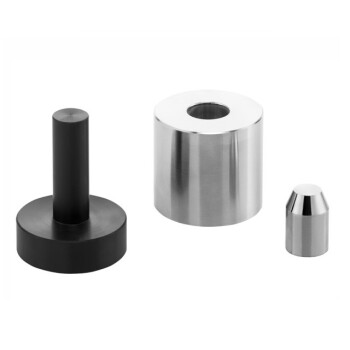
- Button Battery Tablet Press Sealing Mold for Lab Use
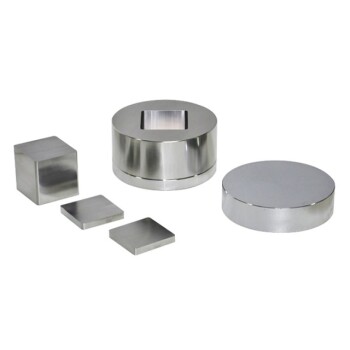
- Square Lab Press Mold for Laboratory Applications
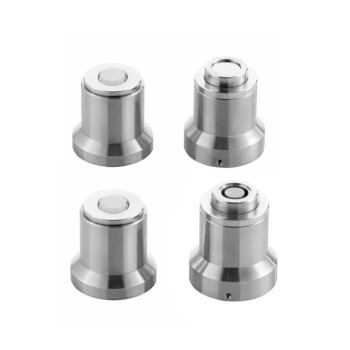
- Button Battery Disassembly and Sealing Mold for Lab Use
People Also Ask
- How does a standardized electrochemical test cell assist in MOx/CNTf electrode screening? Optimize Material Ratios
- Why is a dedicated electrochemical test cell necessary for carbon steel? Ensure Precise Geothermal Corrosion Data
- What is the difference between a voltaic cell and an electrochemical cell? Understand the Two Types of Energy Conversion
- How do the electrochemical cell and three-electrode testing system collaborate? Optimize Zinc Anode Deposition Control
- Why must the electrochemical cell be continuously purged with nitrogen? Ensure Precision in Ni-Cr Corrosion Tests