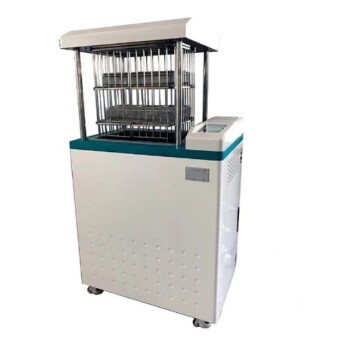
Zirconium is preferred for High-Pressure Acid Leaching (HPAL) autoclaves primarily due to its exceptional chemical stability in extreme environments. While standard alloys fail when exposed to the combination of strong sulfuric acid and high temperatures (100-180°C), zirconium remains inert. This unique property allows it to protect the structural integrity of the autoclave while ensuring the chemical purity of the nickel being processed.
In the harsh, acidic, and oxygen-rich environment of nickel ore processing, zirconium ensures equipment longevity and product purity by completely resisting corrosion that would destroy metals like stainless steel or titanium.
Surviving the Hostile HPAL Environment
Resisting Sulfuric Acid at High Heat
The HPAL process subjects equipment to strong sulfuric acid at temperatures ranging from 100°C to 180°C.
Most metals react violently or corrode rapidly under these conditions.
Zirconium provides a necessary barrier, resisting corrosion in these highly acidic solutions where other materials would dissolve.
Withstanding High Oxygen Pressure
In addition to heat and acidity, the system operates under high oxygen pressures, typically around 1.0 MPa.
This creates a highly oxidative environment that accelerates degradation in lesser materials.
Zirconium linings are specifically selected to ensure safe, long-term operation despite this intense pressurization.
Comparative Advantage Over Other Metals
Outperforming Stainless Steel and Titanium
Standard industrial metals are insufficient for HPAL applications.
The primary reference notes that zirconium’s corrosion resistance far surpasses that of stainless steel or titanium alloys.
While titanium is often used in chemical processing, it struggles in the specific aggressive environment required for nickel ore leaching.
Protecting Product Purity
A major risk in leaching is metal ion contamination.
When a lining corrodes, it releases ions into the leachate, contaminating the nickel ore solution.
By utilizing a zirconium-lined autoclave, operators prevent this cross-contamination, ensuring a cleaner final product.
The Critical Consequence of Material Failure
The Risks of Reductive and Oxidative Solutions
HPAL environments can fluctuate between highly oxidative and reductive states.
Zirconium is unique because it maintains resistance in both oxidative and reductive acidic solutions.
Failing to use a material with this dual capability can lead to rapid catastrophic failure of the vessel lining.
Making the Right Choice for Your Goal
Selecting the correct autoclave lining is a decision driven by safety margins and product quality requirements.
- If your primary focus is Equipment Longevity: Choose zirconium to ensure safe operation against sulfuric acid at temperatures up to 180°C and pressures of 1.0 MPa.
- If your primary focus is Product Quality: Rely on zirconium linings to prevent metal ion contamination and maintain the purity of the leachate.
Zirconium stands alone as the material capable of balancing extreme corrosion resistance with the structural safety required for high-pressure acid leaching.
Summary Table:
| Feature | Zirconium Lining | Standard Stainless Steel / Titanium |
|---|---|---|
| Acid Resistance | Exceptional in H2SO4 (100-180°C) | Rapid corrosion and degradation |
| Oxidation Stability | High resistance at 1.0 MPa oxygen pressure | Susceptible to oxidative failure |
| Chemical Environment | Stable in both oxidative & reductive states | Limited stability ranges |
| Product Purity | Prevents metal ion contamination | High risk of leachate contamination |
| Equipment Life | Long-term operational safety | Frequent maintenance or catastrophic failure |
Maximize Your Nickel Recovery with KINTEK Precision Engineering
Don't let corrosive environments compromise your research or production. At KINTEK, we specialize in high-performance laboratory solutions, including high-temperature high-pressure reactors and autoclaves designed to withstand the most aggressive chemical processes like HPAL.
Our expert-grade zirconium-lined systems provide the structural integrity and chemical purity required for nickel ore leaching, battery research, and advanced metallurgy. From high-temperature furnaces and crushing systems to specialized PTFE and ceramic consumables, KINTEK delivers the reliability your lab demands.
Ready to upgrade your processing capabilities? Contact our technical team today to discuss custom autoclave solutions tailored to your specific pressure and temperature requirements.
References
- Yuqing Chang, Batrić Pešić. Selective leaching of nickel from prereduced limonitic laterite under moderate HPAL conditions- part I: Dissolution. DOI: 10.2298/jmmb151102023c
This article is also based on technical information from Kintek Solution Knowledge Base .
Related Products
- High Pressure Laboratory Autoclave Reactor for Hydrothermal Synthesis
- Stainless High Pressure Autoclave Reactor Laboratory Pressure Reactor
- Laboratory High Pressure Horizontal Autoclave Steam Sterilizer for Lab Use
- Mini SS High Pressure Autoclave Reactor for Laboratory Use
- Portable High Pressure Laboratory Autoclave Steam Sterilizer for Lab Use
People Also Ask
- What role does a high-pressure reactor (autoclave) play in the synthesis of NiCuFe-LDH? Master Hydrothermal Growth
- What Role Does a High-Pressure Reactor or Autoclave Play in HA Catalyst Synthesis? Achieve High Surface Area Materials
- What equipment is required for hydrothermal synthesis of Ga0.25Zn4.67S5.08? Optimize Your Semiconductor Production
- What is the function of a high-pressure reactor in the hydrothermal synthesis of boehmite? Expert Process Insights
- What role does an autoclave play in the synthesis of MnO2 nanofibers? Mastering Hydrothermal Growth