Plasma Electrolytic Oxidation (PEO) requires precise environmental control to maintain process stability and coating quality. A constant temperature cooling system is mandatory to counteract the significant Joule heat generated during the discharge process, preventing electrolyte decomposition and ensuring the bath remains below 25°C. Simultaneously, a stirring device is essential to create uniform temperature and ion concentration fields, which prevents coating ablation and guarantees consistent microstructural features across the workpiece.
Core Takeaway The PEO process involves high-energy micro-discharges that create extreme localized heat; successful coating requires active cooling to prevent chemical breakdown and vigorous stirring to ensure the electrochemical reactions occur uniformly across the entire surface.
Managing Thermal Energy
Counteracting Joule Heat
The PEO process is inherently high-energy, generating significant Joule heat within the discharge zone.
Without intervention, this heat accumulation would rapidly raise the overall temperature of the system. A cooling system is the primary defense against this thermal runaway.
Preventing Electrolyte Decomposition
If the heat is not removed, the rising temperature can lead to localized electrolyte decomposition.
Maintaining the bath temperature, typically below 25°C (and often as low as 5°C), preserves the chemical integrity of the electrolyte. This prevents chemical deterioration and excessive evaporation that would otherwise alter the bath's composition.
Ensuring Discharge Stability
The stability of the film formation process relies on a consistent thermal environment.
By mitigating the effects of instantaneous micro-discharge temperatures—which can exceed 4000K locally—the cooling system prevents excessive local thermal stress. This helps avoid the formation of cracks in the growing ceramic layer.
Ensuring Homogeneity via Stirring
Uniform Ion Distribution
A static electrolyte bath leads to concentration gradients where reactants are depleted near the workpiece surface.
A stirring device maintains constant hydrodynamic conditions, ensuring that essential components like diphosphates, citrates, and metal cations are uniformly distributed. This eliminates diffusion layer thickness gradients, allowing for even doping and growth.
Regulating Temperature Fields
Cooling alone is not enough; the cooled electrolyte must be circulated effectively to reach the hot zones near the workpiece.
Stirring ensures the uniform distribution of the temperature field, preventing hot spots where the electrolyte might locally overheat despite the cooling system.
Controlling Microstructure and Defects
The physical properties of the coating, such as pore size and distribution, are directly influenced by local environmental conditions.
Adequate stirring prevents coating ablation, a defect caused by localized overheating and stagnation. By keeping conditions uniform, the system ensures consistent microstructural features across the entire surface area.
Common Pitfalls to Avoid
Inadequate Cooling Capacity
A common error is underestimating the thermal load of the PEO process.
If the cooling system cannot keep up with the Joule heat generation, the electrolyte temperature will drift upward. This results in unstable film formation and unpredictable changes in coating thickness and porosity.
Inconsistent Hydrodynamics
Merely having a stirrer is insufficient; it must provide thorough circulation without dead zones.
Poorly designed stirring can lead to "shadow effects" where certain areas of the workpiece receive less fresh electrolyte. This results in uneven oxide growth and variations in the catalytic activity of the surface.
Making the Right Choice for Your Goal
To optimize your PEO setup, consider the following priorities:
- If your primary focus is Coating Integrity: Prioritize a high-capacity cooling system to keep the bath near 5°C, minimizing thermal stress and preventing chemical decomposition.
- If your primary focus is Microstructural Uniformity: Ensure your stirring mechanism eliminates all diffusion gradients, guaranteeing an even distribution of ions and consistent pore size.
By synchronizing aggressive cooling with active stirring, you transform a volatile high-energy reaction into a controlled, precision manufacturing process.
Summary Table:
| Feature | Primary Function | Impact on PEO Process |
|---|---|---|
| Cooling System | Counteracts Joule heat | Prevents electrolyte decomposition & maintains bath <25°C |
| Stirring Device | Ensures hydrodynamic flow | Eliminates concentration gradients & prevents coating ablation |
| Temperature Control | Thermal stabilization | Mitigates micro-discharge thermal stress to avoid cracks |
| Ion Distribution | Homogeneity | Ensures even doping and consistent microstructural growth |
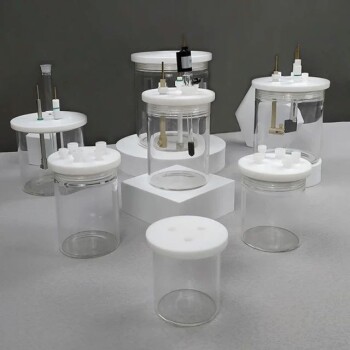
Optimize your surface engineering with KINTEK’s precision laboratory solutions. From advanced electrolytic cells and electrodes specifically designed for stable PEO processes to high-performance cooling systems and shakers, we provide the tools necessary for consistent coating integrity. Whether you are conducting battery research or developing ceramic coatings, our comprehensive range of high-temperature furnaces and hydraulic presses ensures your lab is equipped for excellence. Contact KINTEK today to enhance your research stability and achieve uniform results!
References
- N. Sakhnenko, Alexander Galak. A study of synthesis and properties of manganese-containing oxide coatings on alloy VT1-0. DOI: 10.15587/1729-4061.2016.69390
This article is also based on technical information from Kintek Solution Knowledge Base .
Related Products
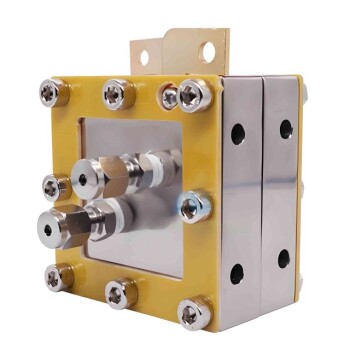
- Customizable PEM Electrolysis Cells for Diverse Research Applications
- Electrolytic Electrochemical Cell Gas Diffusion Liquid Flow Reaction Cell
- Electrolytic Electrochemical Cell with Five-Port
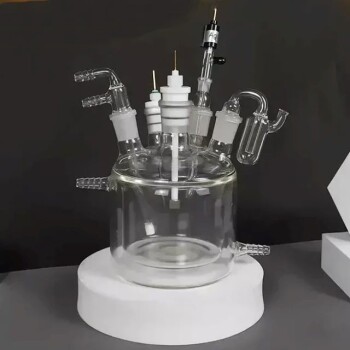
- Double Layer Five-Port Water Bath Electrolytic Electrochemical Cell
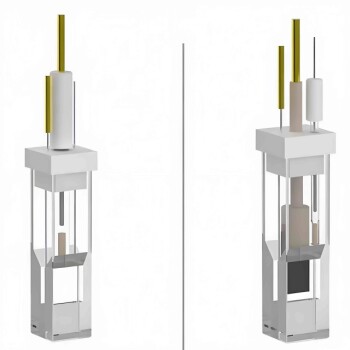
- Thin-Layer Spectral Electrolysis Electrochemical Cell
People Also Ask
- What are the risks of improper voltage control in an electrolysis cell? Avoid Costly Damage and Inefficiency
- What are the opening configurations for the non-sealed and sealed versions of the electrolysis cell? Optimize Your Electrochemical Setup
- What is an electrolysis cell? A Guide to Driving Chemical Reactions with Electricity
- What parameters must be strictly controlled during the electrolysis process? Ensure Precision and Efficiency
- What are the precautions for heating or sterilizing an electrolysis cell? Avoid Damaging Sensitive Components