Thermal stability is the prerequisite for data integrity in fluoride ion battery research. You must use a constant temperature oven because the ion transport mechanisms within solid electrolytes are extremely sensitive to even minor thermal fluctuations. By maintaining a precisely controlled environment (commonly 30°C), the oven isolates the battery from ambient temperature shifts, ensuring that the electrochemical kinetics you measure are intrinsic to the material and not artifacts of the environment.
Solid electrolytes possess high thermal sensitivity, meaning unregulated temperature changes will directly skew conductivity and reaction data. A constant temperature oven is essential to eliminate environmental variables, ensuring that critical measurements—such as electrolyte decomposition potential and interfacial reaction rates—are accurate and reproducible.
The Critical Role of Thermal Stability
Controlling Ion Transport Mechanisms
The primary reason for using a constant temperature oven is the sensitivity of solid electrolytes. The ion transport mechanisms in these materials react significantly to temperature changes.
Without strict thermal regulation, the conductivity of the electrolyte will fluctuate. This introduces noise into your data that creates a false representation of the battery's actual performance.
Eliminating Ambient Interference
Long-term tests, such as Electrochemical Impedance Spectroscopy (EIS) and Cyclic Voltammetry (CV), often span hours or days. During this time, the ambient temperature of a laboratory can shift due to HVAC cycles or day-night transitions.
A constant temperature oven creates a precisely controlled thermal environment (e.g., 30°C). This barrier eliminates the interference of ambient changes on your measurements.
Ensuring Kinetic Accuracy
Electrochemical kinetics are inherently tied to heat. The rate at which chemical reactions occur at the electrode-electrolyte interface changes with temperature.
By locking the temperature, you ensure that any changes observed in interfacial reaction rates are due to the chemistry of the battery, not external heating or cooling.
Understanding the Risks of Uncontrolled Environments
The "Room Temperature" Fallacy
A common pitfall in electrochemical testing is assuming "room temperature" is a stable baseline. In reality, room temperature is a variable, not a constant.
Relying on ambient conditions can lead to incorrect conclusions regarding the electrolyte decomposition potential. If the temperature spikes, the decomposition behavior may appear different than it actually is.
Compromising Reproducibility
The scientific standard relies on the ability to repeat an experiment and get the same result. If thermal conditions are not controlled, reproducing specific transport property measurements becomes nearly impossible.
This lack of reproducibility renders long-term study data unreliable. It prevents valid comparisons between different electrolyte formulations or battery designs.
Optimizing Your Experimental Setup
To ensure valid data in fluoride ion battery testing, apply the following principles:
- If your primary focus is characterizing new electrolytes: Use the oven to isolate intrinsic ion transport properties from environmental noise, ensuring the conductivity data is pure.
- If your primary focus is long-term stability (CV/EIS): Rely on the oven to maintain a constant baseline, so any degradation observed is strictly electrochemical and not thermal.
Control the temperature to control the chemistry.
Summary Table:
| Feature | Impact of Thermal Control | Benefit to Research |
|---|---|---|
| Ion Transport | Eliminates conductivity fluctuations | Accurate material characterization |
| Ambient Temperature | Shields from HVAC/Day-Night cycles | Stable, noise-free long-term data |
| Reaction Kinetics | Locks interfacial reaction rates | Precise electrochemical analysis |
| Reproducibility | Standardizes testing environment | Valid comparative study results |
Elevate Your Battery Research Precision with KINTEK
Don't let ambient temperature fluctuations compromise your long-term EIS and CV datasets. KINTEK specializes in high-performance laboratory solutions tailored for advanced battery research. Our comprehensive range of constant temperature ovens, high-temperature furnaces, and specialized battery research tools ensures the thermal stability required for fluoride ion and solid-state battery testing.
From precise cooling solutions and ULT freezers to robust high-temperature reactors and electrolytic cells, KINTEK provides the infrastructure necessary to eliminate environmental variables and secure reproducible results.
Ready to optimize your experimental setup? Contact our laboratory specialists today to discover how KINTEK’s precision equipment can enhance your data integrity and research efficiency.
Related Products
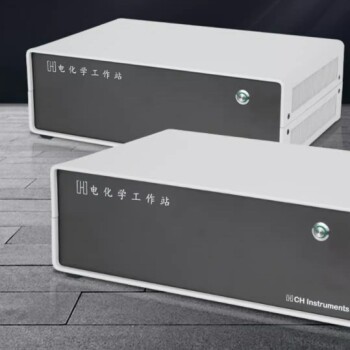
- Lab Electrochemical Workstation Potentiostat for Laboratory Use
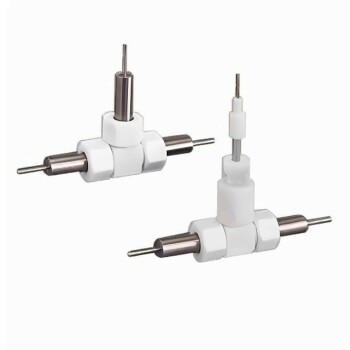
- Sample Support Body for Electrochemical Tests
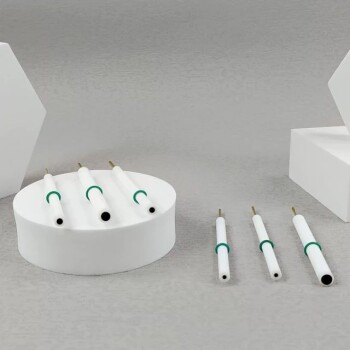
- Electrode Fixture for Electrochemical Experiments
- Customizable Swagelok Type Test Cells for Advanced Battery Research Electrochemical Analysis
- Electrolytic Electrochemical Cell for Coating Evaluation
People Also Ask
- How does an electrochemical workstation assist in assessing corrosion resistance? Quantify Laser-Remelted Steel Performance
- How does an electrochemical testing system evaluate mesoporous oxide electrodes? Precision Analysis for Battery Research
- What are the primary functions of an electrochemical workstation (Potentiostat)? Expert Titanium Alloy Corrosion Analysis
- What is the primary function of a high-precision electrochemical workstation? Optimize Your Reactor Performance
- What role do electrochemical workstations play in researching the corrosion resistance of carbon coatings? Expert Guide