Imagine a perfectly machined ceramic component. It looks flawless.
But under the immense heat of the sintering furnace, a microscopic crack appears, branching out until the entire part is ruined. The cause isn't a surface defect. It's a hidden flaw born at the moment of its creation: an unevenness in its internal density.
This is the ghost in the machine that haunts material scientists and engineers.
The Flaw in Our Intuition
Our instinct when forming something is to apply force directly. We push from the top, maybe from the sides. This is the logic of a blacksmith's hammer or a simple die press. It’s linear, intuitive, and for many tasks, perfectly effective.
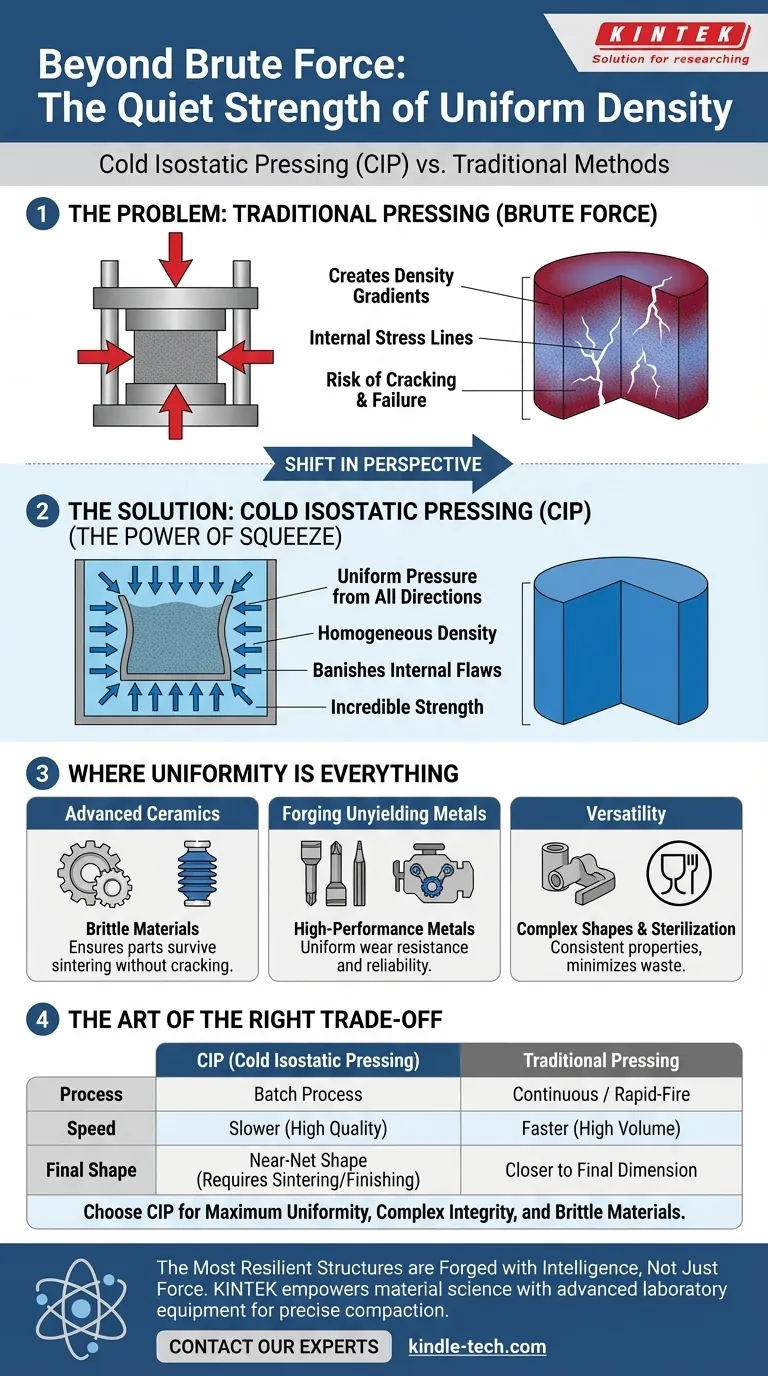
But this "brute force" approach has a fundamental limitation. It creates gradients.
The material closest to the press is compacted more than the material shielded in the center. This creates internal stress lines—invisible fault lines waiting for a trigger. For simple parts, this may not matter. For high-performance components, it’s a critical point of failure.
A Shift in Perspective: The Power of Squeeze
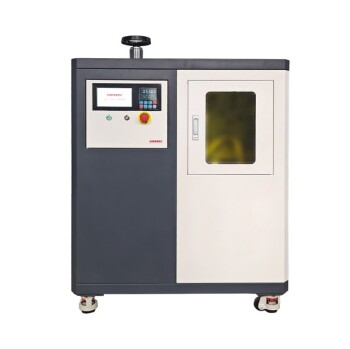
Cold Isostatic Pressing (CIP) operates on a profoundly different, almost counter-intuitive principle. Instead of pushing, it squeezes.
Equally, from every direction, at the exact same time.
Picture a flexible mold filled with powder submerged deep in a chamber of liquid. As the liquid is pressurized, the force is transmitted perfectly and uniformly to every single point on the mold's surface. There is no "top" or "bottom," no center that gets less pressure.
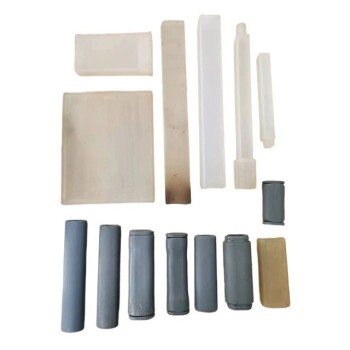
The result is a "green" part with incredibly uniform density. The internal ghosts of stress and unevenness are banished before they can even form. This homogeneity is the source of its quiet, incredible strength.
Where Uniformity is Everything
This principle isn't just a novelty; it's a necessity in fields where material failure is not an option.
The Brittle and the Beautiful: Advanced Ceramics
Materials like silicon carbide, silicon nitride, or boron carbide are incredibly hard but unforgivingly brittle. For an electrical insulator, a cutting tool, or a medical implant, a single internal void can lead to catastrophic failure.
CIP isn’t just a forming method here; it’s an insurance policy against that failure, ensuring the part survives the intense heat of sintering without cracking.
Forging Unyielding Metals
For tool steels, cemented carbides, and other high-performance metals used in extreme-wear applications, longevity is a direct function of material integrity.
Uniform density means uniform wear resistance, predictable performance, and unparalleled reliability under stress, part after part.
The Versatility of a Fundamental Principle
The logic of isostatic pressure is so fundamental that it finds use in surprising places. It’s used to create isotropic graphite with consistent properties in all directions, form complex near-net shapes that minimize wasteful machining, and even sterilize food and pharmaceuticals with immense pressure instead of heat.
The Art of the Right Trade-Off
This elegant solution isn't a universal one. It requires a conscious choice—a trade-off between speed and perfection.
- Speed vs. Integrity: CIP is a batch process, inherently slower than the rapid-fire stamping of a die press. You trade mass-production throughput for unparalleled material quality.
- Shape vs. Final Dimension: The flexible molds that enable complex geometries also mean the pre-sintered part isn't dimensionally perfect. Final precision is achieved in subsequent sintering and finishing steps. CIP is about creating the perfect internal foundation.
Choosing the right compaction technology comes down to your primary goal.
| If your primary goal is... | ...then CIP is likely your answer because... |
|---|---|
| Maximum Uniform Density | It eliminates internal density variations, the root cause of failure. |
| Integrity in a Complex Shape | Fluid pressure conforms perfectly to geometries impossible for rigid dies. |
| Processing Brittle Materials | It creates defect-free "green" parts that can withstand high-temp sintering. |
The leap from traditional pressing to isostatic pressing is more than a technical upgrade; it’s a shift in mindset. It's about recognizing that the most resilient structures are often forged not with the most force, but with the most intelligence.
This pursuit of material perfection starts in the laboratory, where theories are tested and processes are refined. Achieving the precise, uniform pressure required by CIP demands specialized equipment designed for control and reliability. KINTEK provides the advanced laboratory equipment and consumables that empower scientists and engineers to harness these fundamental principles, turning powdered potential into high-integrity components.
If your work demands the ultimate in material uniformity and performance, let's explore the right solution for your lab. Contact Our Experts
Visual Guide
Related Products
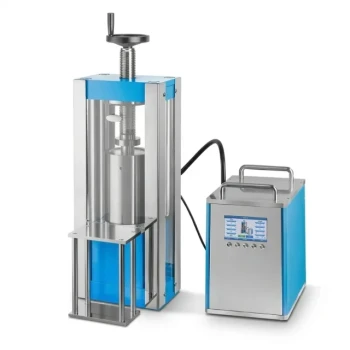
- Electric Split Lab Cold Isostatic Press CIP Machine for Cold Isostatic Pressing
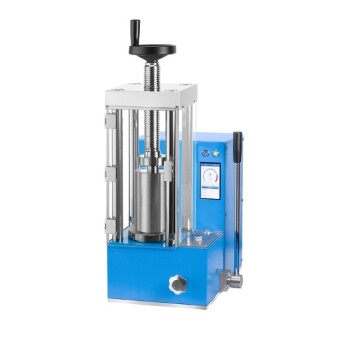
- Electric Lab Cold Isostatic Press CIP Machine for Cold Isostatic Pressing
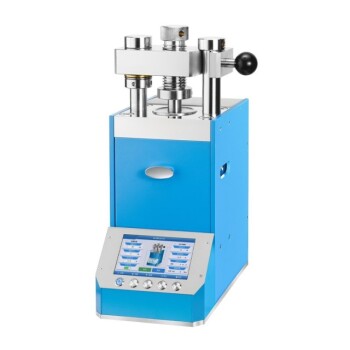
- Automatic Lab Cold Isostatic Press CIP Machine Cold Isostatic Pressing
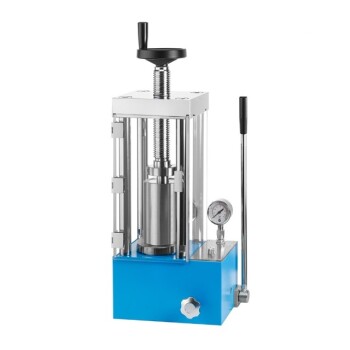
- Manual Cold Isostatic Pressing Machine CIP Pellet Press
- Warm Isostatic Press for Solid State Battery Research