The Ghost in the Component
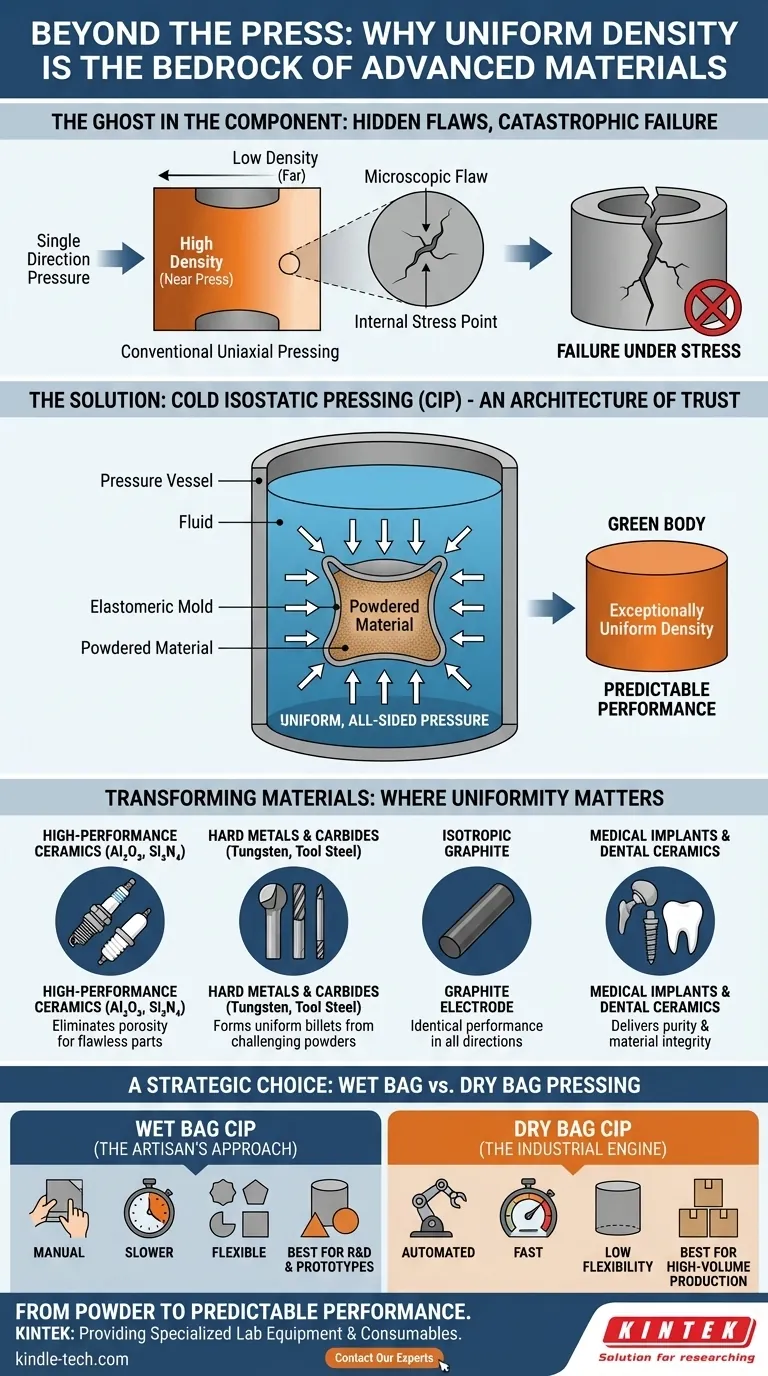
Imagine a high-performance ceramic insulator, precision-engineered for a critical aerospace application. It looks perfect. It passes every surface inspection. But deep within its structure lies a microscopic region of lower density—a ghost left behind by uneven pressure during its formation.
Under extreme electrical or thermal stress, this hidden flaw becomes the epicenter of failure. A crack propagates. The component fails.
This isn't a failure of the material itself. It's a failure of the process. It’s a stark reminder that in the world of advanced materials, what you can't see can absolutely break you.
The Psychology of Uniformity
Engineers obsess over uniformity for a reason that goes beyond simple specifications. It’s about predictability. It’s about trust.
When you apply pressure from a single direction, as in conventional uniaxial pressing, you create gradients. The particles closest to the press are compacted tightly, while those further away are less so. This introduces internal stress and unpredictable weak points. It embeds uncertainty into the very core of the component.
The desire for uniform, all-sided pressure is a desire to eliminate that uncertainty. It is a commitment to creating a part that is as strong on the inside as it appears on the outside.
Cold Isostatic Pressing: An Architecture of Trust
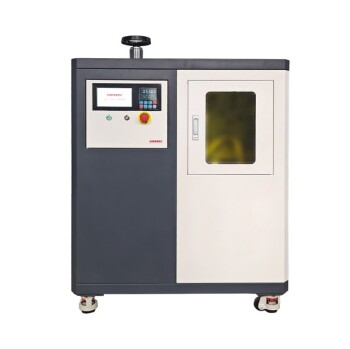
Cold Isostatic Pressing (CIP) is the elegant solution to this fundamental problem. The principle is simple, yet its impact is profound.
The Mechanism of Perfection
- Powdered material is sealed inside a flexible, elastomeric mold.
- This mold is submerged in a fluid-filled pressure chamber.
- The fluid is pressurized—often to thousands of times atmospheric pressure.
Because the pressure is transmitted through a liquid, it exerts itself equally on every single point of the mold's surface. The result is a pre-sintered part, or "green body," with exceptionally uniform density. There are no hidden gradients, no built-in weaknesses.
Where This Principle Transforms Materials
This method isn't a niche technique; it's a foundational process for materials where failure is not an option.
-
High-Performance Ceramics (Al₂O₃, Si₃N₄): For components like spark plug shells or electrical insulators, porosity is the enemy. CIP ensures the green body is uniformly dense, which is essential for creating a flawless, void-free final part after firing.
-
Hard Metals & Carbides (Tungsten, Tool Steel): These materials resist conventional pressing. CIP is used to form uniform billets from these challenging powders, often as the critical first step before a final high-temperature process like Hot Isostatic Pressing (HIP).
-
Isotropic Graphite: For applications like high-purity electrodes, performance must be identical in all directions. CIP compacts graphite particles without creating a preferential grain direction, ensuring predictable thermal and electrical conductivity.
-
Medical Implants & Dental Ceramics: In biocompatible components, material integrity is non-negotiable. CIP delivers the purity and structural uniformity required for parts that will exist inside the human body.
A Strategic Choice: Wet Bag vs. Dry Bag
The philosophy of uniform pressure is applied through two distinct methods, representing a classic trade-off between versatility and scale.
The Artisan's Approach: Wet Bag Pressing
In the wet bag method, each sealed mold is manually submerged in the pressure vessel. This process is slower and more labor-intensive.
However, its strength is its immense flexibility. It's ideal for prototypes, small production runs, and creating a wide variety of complex shapes. It is the tool for research and development.
The Industrial Engine: Dry Bag Pressing
In the dry bag method, the flexible mold is an integrated part of the pressure vessel itself. Powder is loaded, the system is sealed, and pressure is applied in a rapid, repeatable cycle.
This approach is built for speed and automation, making it the standard for high-volume manufacturing of standardized parts, like the millions of spark plug insulators produced every year.
| Feature | Wet Bag CIP | Dry Bag CIP |
|---|---|---|
| Process | Manual loading of mold into vessel | Integrated mold, automated powder loading |
| Speed | Slower, lower throughput | Fast, high throughput |
| Flexibility | High; ideal for various shapes & sizes | Low; designed for specific, repeated parts |
| Best For | R&D, prototypes, small & complex runs | High-volume, standardized production |
From Powder to Predictable Performance
Achieving perfect uniformity is not just a technical goal; it's the foundation of reliability. The choice of process—and the equipment that enables it—is therefore one of the most critical decisions in manufacturing advanced components.
At KINTEK, we provide the specialized lab equipment and consumables that turn powdered potential into solid, reliable reality. Understanding the subtle yet critical differences between methods and materials is what allows for true innovation.
If your work depends on creating components you can trust, ensuring you have the right process is the first and most critical step. For expertise in selecting and implementing the right equipment for your application, Contact Our Experts.
Visual Guide
Related Products
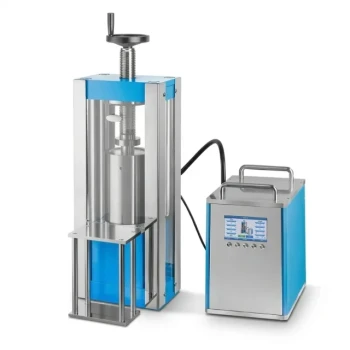
- Electric Split Lab Cold Isostatic Press CIP Machine for Cold Isostatic Pressing
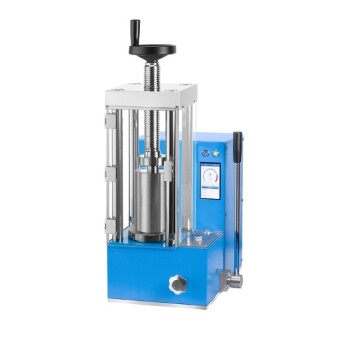
- Electric Lab Cold Isostatic Press CIP Machine for Cold Isostatic Pressing
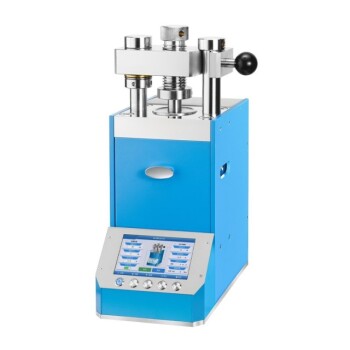
- Automatic Lab Cold Isostatic Press CIP Machine Cold Isostatic Pressing
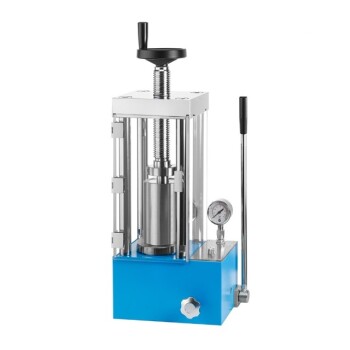
- Manual Cold Isostatic Pressing Machine CIP Pellet Press
- Warm Isostatic Press for Solid State Battery Research