Blog How To Use A Rotary Evaporator
How To Use A Rotary Evaporator

How To Use A Rotary Evaporator

3 years ago

Rotary evaporators (also called "rotavaps") are used to remove solvents from reaction mixtures and can accommodate volumes as large as 3 liters.

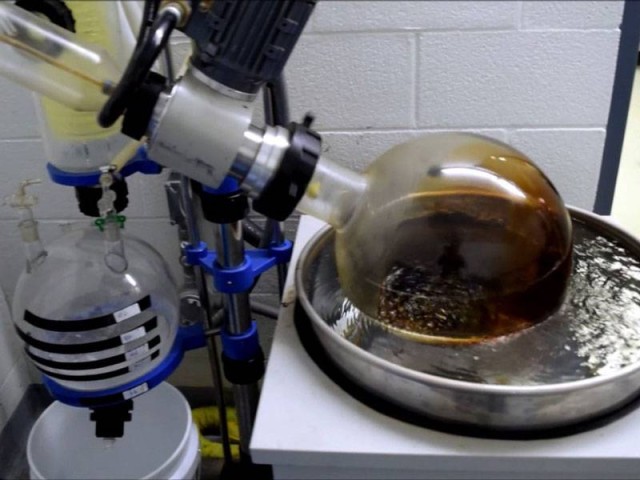
They are found in almost every organic laboratory, since they allow performing this task very quickly. A typical rotary evaporator has a water bath that can be heated in either a metal container or crystallization dish. This keeps the solvent from freezing during the evaporation process.

The solvent is removed under vacuum, is trapped by a condenser and is collected for easy reuse or disposal.

Most labs use a simple water aspirator vacuum on their rotavaps, so a rotavap cannot be used for air and water-sensitive materials unless special precautions are taken i.e. additional traps are used. In the lab, the house vacuum line, a circulation bath or a membrane pump are used as source for the vacuum (40-50 torr).

The fact that a vacuum is usually applied to the setup means that the boiling points of the solvents are going to be significantly lower than at ambient pressure (see table below).

Solvent b.p. (760 torr) b.p. (40 torr)
acetonitrile 81.8 oC 7.7 oC
diethyl ether 34.6 oC -27.7oC
ethanol 78.4 oC 19 oC
ethyl acetate 77.1 oC 9.1 oC
hexane 68.7 oC -2.3 oC
heptane 98.4 oC 22.3 oC
methanol 64.7 oC 5.0 oC
water 100 oC 34.0 oC

Since the flask is rotated during the evaporation process, the surface area is larger than normal which increases the evaporation rate significantly.

The solvent is collected in a flask and can properly be disposed off afterwards (organic solvent waste). In addition, this method also avoids overheating of the target compound i.e. oxidation because lower temperatures are used. The same rules like for vacuum filtrations apply here in terms of the glassware and other precautions i.e no cracks on the flask, etc.

General rules for usage of a rotary evaporator

  1. The solvent collection flask of the unit should always be emptied prior use to prevent accidentally mixing of incompatible chemicals. SAFETY FIRST! 
  2. The flask with the solution is placed on the rotary evaporator. The use of a bump trap prevents the solution from accidentally splashing into the condenser (and being contaminated). It is highly advisable to start with a clean bump bulb in case something bumps over after all! This would allow the experimenter to recover the solution or solid.
  3. A metal or Keck clip is used to secure the flask and the bump trap. The green one shown below fits 24/40 ground glass joints. Similar blue clips fit 19/22 joints and the yellow ones fit 14/20 joints, which will most likely used in the lab. If you break the bump trap, you will have to pay for it!
  4. The dial on the motor is used for speed control of the flask rotation. A typical rotavap uses a variable speed sparkless induction motor that spins at 0-220 rpm and provides high constant torque. A good setting here is 7-8. 
  5. The aspirator vacuum is turned on. On most models, the vacuum on/off control is managed by turning a stopcock at the top of the condenser (left side of the above diagram). This stopcock is later also used to vent the setup after the solvent is removed.
  6. The flask is lowered into the water bath (or the water bath is raised to immerse the flask in the warm water. (On most models, a convenient handle (with height locking mechanism) moves the entire condenser/motor/flask assembly up and down. Often the tilt of the condenser assembly can also be adjusted. The water bath temperature should not exceed the boiling point of the solvent!! For small amounts of common solvents the bath heater is not needed.
  7. The solvent should start collecting on the condenser and drip into the receiving flask. Some solvents (such as diethyl ether or dichloromethane) are so volatile that they will also evaporate from the receiving flask and be discharged down the drain. To prevent this, a cooling bath on the receiver or (on some models) use a dry-ice condenser can be used. In addition, an additional trap (with dry-ice or liquid nitrogen) can be placed between the vacuum source and the condenser unit. This is particularly important of a membrane pump is used as vacuum source.
  8. Once all the solvent evaporated (or whatever is desired at this point), the vacuum is released,. The flask is raised out of the water bath and the spinning is discontinued. 
  9. The bump trap has to be cleaned and the receiving flask is emptied upon completion of the evaporation.

Tips and Tricks

Distilled water should be used in the heating bath to minimize the scale build up in the bath which coats the thermistor and heating coils. It is very difficult to remove and reduces the efficiency of the bath. In addition, regular tap water will promote the growth of spectacularly disgusting algae colonies, particularly during the summer months. The best protocol is a regular exchange of the water.

To remove algae gunk from the inside of a coiled water condenser, the condenser has to be removed from the rotavap and the coil is soaked in a dilute nitric acid solution for a few hours. After carefully rinsing the insides, the rotavap is reassembled. All standard safety precautions should be followed when working with nitric acid!

The ground glass joint holding the flask does not need to be greased, but on rare occasions it (or the bump bulb) may get "frozen". Some companies sell special joint clips that can free frozen joints simply by screwing them in one direction. If you are not lucky enough to have these and cannot release the joint you probably want to ask your teaching assistant for advice. 

If a mechanical pump is used instead of an aspirator to produce a vacuum, a secondary trap has to be used to prevent that the solvent destroys the membrane or is absorbed in the oil.
Related Products

Related Articles

Related Products

Electric Rotary Kiln Small Rotary Furnace for Activated Carbon Regeneration

Electric Rotary Kiln Small Rotary Furnace for Activated Carbon Regeneration

Revitalize your activated carbon with KinTek's Electric Regeneration Furnace. Achieve efficient and cost-effective regeneration with our highly automated rotary kiln and intelligent thermal controller.

Inclined Rotary Plasma Enhanced Chemical Vapor Deposition PECVD Equipment Tube Furnace Machine

Inclined Rotary Plasma Enhanced Chemical Vapor Deposition PECVD Equipment Tube Furnace Machine

Upgrade your coating process with PECVD coating equipment. Ideal for LED, power semiconductors, MEMS and more. Deposits high-quality solid films at low temps.

Electric Rotary Kiln Small Rotary Furnace Biomass Pyrolysis Plant

Electric Rotary Kiln Small Rotary Furnace Biomass Pyrolysis Plant

Learn about Rotary Biomass Pyrolysis Furnaces & how they decompose organic material at high temps without oxygen. Use for biofuels, waste processing, chemicals & more.

Inclined Rotary Plasma Enhanced Chemical Vapor Deposition PECVD Equipment Tube Furnace Machine

Inclined Rotary Plasma Enhanced Chemical Vapor Deposition PECVD Equipment Tube Furnace Machine

Introducing our inclined rotary PECVD furnace for precise thin film deposition. Enjoy automatic matching source, PID programmable temperature control, and high accuracy MFC mass flowmeter control. Built-in safety features for peace of mind.

Laboratory Vacuum Tilt Rotary Tube Furnace Rotating Tube Furnace

Laboratory Vacuum Tilt Rotary Tube Furnace Rotating Tube Furnace

Discover the versatility of Laboratory Rotary Furnace: Ideal for calcination, drying, sintering, and high-temperature reactions. Adjustable rotating and tilting functions for optimal heating. Suitable for vacuum and controlled atmosphere environments. Learn more now!

Rotary Tube Furnace Split Multi Heating Zone Rotating Tube Furnace

Rotary Tube Furnace Split Multi Heating Zone Rotating Tube Furnace

Multi zone rotary furnace for high-precision temperature control with 2-8 independent heating zones. Ideal for lithium ion battery electrode materials and high-temperature reactions. Can work under vacuum and controlled atmosphere.

Electric Rotary Kiln Continuous Working Small Rotary Furnace Heating Pyrolysis Plant

Electric Rotary Kiln Continuous Working Small Rotary Furnace Heating Pyrolysis Plant

Efficiently calcine and dry bulk powder and lump fluid materials with an electric heating rotary furnace. Ideal for processing lithium ion battery materials and more.

Vacuum Sealed Continuous Working Rotary Tube Furnace Rotating Tube Furnace

Vacuum Sealed Continuous Working Rotary Tube Furnace Rotating Tube Furnace

Experience efficient material processing with our vacuum-sealed rotary tube furnace. Perfect for experiments or industrial production, equipped with optional features for controlled feeding and optimized results. Order now.

Electric Rotary Kiln Pyrolysis Furnace Plant Machine Calciner Small Rotary Kiln Rotating Furnace

Electric Rotary Kiln Pyrolysis Furnace Plant Machine Calciner Small Rotary Kiln Rotating Furnace

Electric rotary kiln - precisely controlled, it's ideal for calcination and drying of materials like lithium cobalate, rare earths, and non-ferrous metals.

Hemispherical Bottom Tungsten Molybdenum Evaporation Boat

Hemispherical Bottom Tungsten Molybdenum Evaporation Boat

Used for gold plating, silver plating, platinum, palladium, suitable for a small amount of thin film materials. Reduce the waste of film materials and reduce heat dissipation.

Molybdenum Tungsten Tantalum Evaporation Boat for High Temperature Applications

Molybdenum Tungsten Tantalum Evaporation Boat for High Temperature Applications

Evaporation boat sources are used in thermal evaporation systems and are suitable for depositing various metals, alloys and materials. Evaporation boat sources are available in different thicknesses of tungsten, tantalum and molybdenum to ensure compatibility with a variety of power sources. As a container, it is used for vacuum evaporation of materials. They can be used for thin film deposition of various materials, or designed to be compatible with techniques such as electron beam fabrication.

Molybdenum Tungsten Tantalum Special Shape Evaporation Boat

Molybdenum Tungsten Tantalum Special Shape Evaporation Boat

Tungsten Evaporation Boat is ideal for vacuum coating industry and sintering furnace or vacuum annealing. we offers tungsten evaporation boats that are designed to be durable and robust, with long operating lifetimes and to ensure consistent smooth and even spreading of the molten metals.

Ceramic Evaporation Boat Set Alumina Crucible for Laboratory Use

Ceramic Evaporation Boat Set Alumina Crucible for Laboratory Use

It can be used for vapor deposition of various metals and alloys. Most metals can be evaporated completely without loss. Evaporation baskets are reusable.1

Evaporation Boat for Organic Matter

Evaporation Boat for Organic Matter

The evaporation boat for organic matter is an important tool for precise and uniform heating during the deposition of organic materials.

Laboratory Vertical Water Circulating Vacuum Pump for Lab Use

Laboratory Vertical Water Circulating Vacuum Pump for Lab Use

Looking for a reliable water circulating vacuum pump for your lab or small-scale industry? Check out our Vertical Water Circulating Vacuum Pump with five taps and a larger air sucking amount, perfect for evaporation, distillation, and more.

Circulating Water Vacuum Pump for Laboratory and Industrial Use

Circulating Water Vacuum Pump for Laboratory and Industrial Use

Efficient circulating water vacuum pump for labs - oil-free, corrosion-resistant, quiet operation. Multiple models available. Get yours now!

Evaporation Crucible for Organic Matter

Evaporation Crucible for Organic Matter

An evaporation crucible for organic matter, referred to as an evaporation crucible, is a container for evaporating organic solvents in a laboratory environment.

Twin Screw Extruder Plastic Granulation Machine

Twin Screw Extruder Plastic Granulation Machine

Twin screw extruder plastic granulation machine is designed for the mixing and processing experiments of engineering plastics, modified plastics, waste plastics and masterbatches.

Laboratory Benchtop Water Circulating Vacuum Pump for Lab Use

Laboratory Benchtop Water Circulating Vacuum Pump for Lab Use

Need a water circulating vacuum pump for your lab or small-scale industry? Our Benchtop Water Circulating Vacuum Pump is perfect for evaporation, distillation, crystallization, and more.

10L Heating Chilling Circulator Cooling Water Bath Circulator for High and Low Temperature Constant Temperature Reaction

10L Heating Chilling Circulator Cooling Water Bath Circulator for High and Low Temperature Constant Temperature Reaction

Experience efficient lab performance with KinTek KCBH 10L Heating Chilling Circulator. Its all-in-one design offers reliable heating, chilling, and circulating functions for industrial and lab use.


Leave Your Message