Blog The Geometry of Truth: Why the Electrolytic Cell Dictates Experimental Success
The Geometry of Truth: Why the Electrolytic Cell Dictates Experimental Success

The Geometry of Truth: Why the Electrolytic Cell Dictates Experimental Success

3 hours ago

The Silent Variable in the Lab

In scientific research, we obsess over the variables we can see. We scrutinize the purity of the catalyst. We calibrate the voltage to the microvolt. We obsess over the reaction mechanism.

But we often ignore the environment where these interactions happen.

The electrolytic cell is often treated as a mere bucket—a passive container for fluids. This is a mistake. In electrochemistry, the geometry of the vessel is not just a container; it is a component of the circuit.

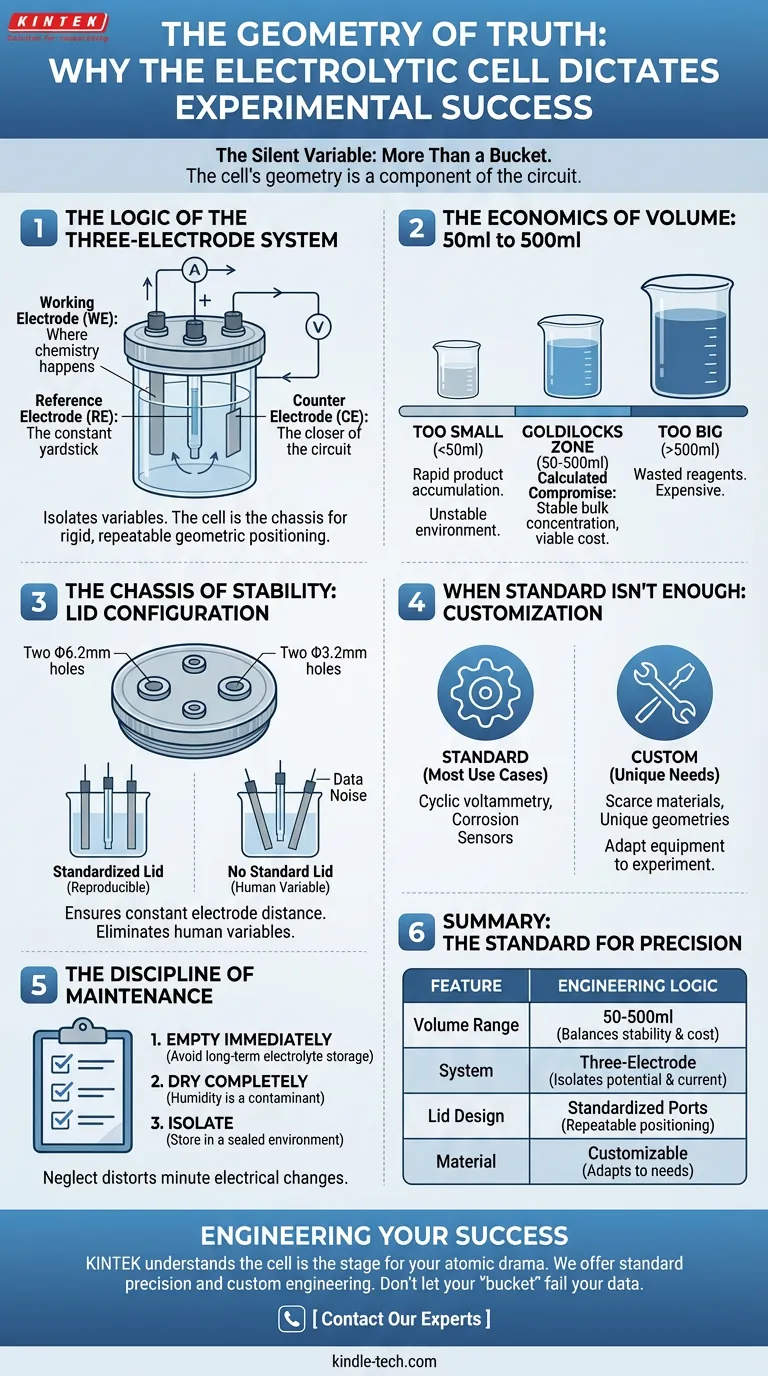
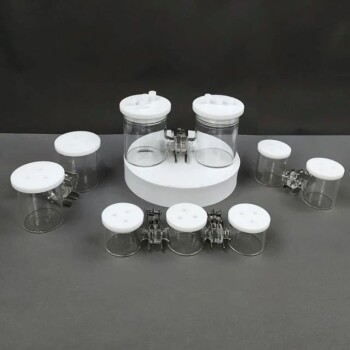
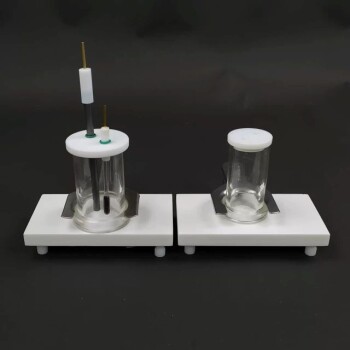
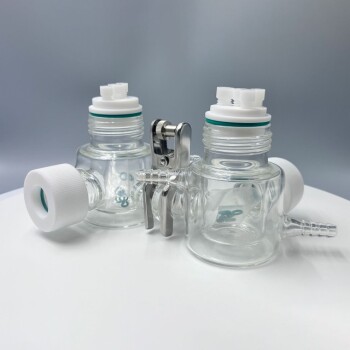
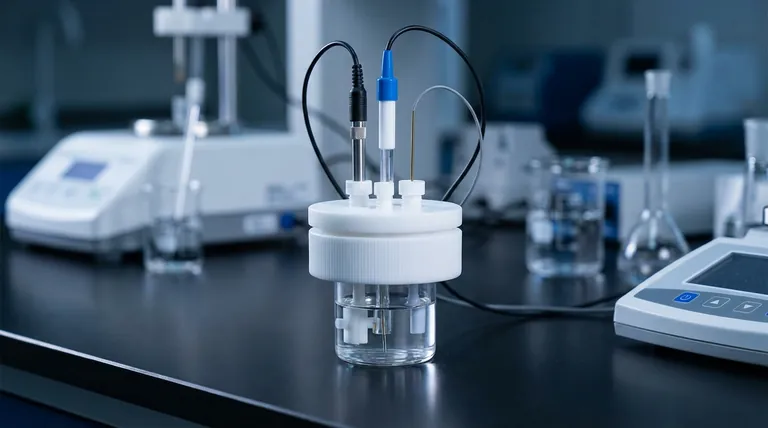
The standard multifunctional electrolytic cell is designed to solve a specific problem: how to create a controlled, reproducible environment for the three-electrode system. It is the invisible baseline upon which reliable data is built.

The Logic of the Three-Electrode System

To understand the cell, you must understand what it protects.

Modern electrochemistry relies on the three-electrode setup. It is a brilliant system designed to isolate variables.

  • The Working Electrode: Where the chemistry happens.
  • The Reference Electrode: The constant yardstick against which potential is measured.
  • The Counter Electrode: The closer of the circuit, allowing current to flow without disturbing the reference.

If these three components are not held in a rigid, repeatable geometric relationship, your data becomes noise. The multifunctional cell is the chassis that holds this system in place.

The Economics of Volume: 50ml to 500ml

Why is the standard volume range between 50ml and 500ml?

It isn't an arbitrary number. It is a calculated compromise between chemical stability and economic reality.

The Risk of "Too Small": If a cell is too small, the reaction products accumulate rapidly. The concentration of the electrolyte shifts within seconds. The environment changes faster than you can measure it, rendering steady-state experiments impossible.

The Risk of "Too Big": If the cell is massive, you waste reagents. In modern research, electrolytes and catalysts are often exotic and expensive. A 500ml limit allows for a "Goldilocks" zone—large enough to maintain a stable bulk concentration, but small enough to be viable for routine lab work.

The Chassis of Stability: Lid Configuration

The most underrated component of the cell is the lid.

In a standard configuration, you will find specific apertures:

  • Two Φ6.2mm holes
  • Two Φ3.2mm holes

These are not random drill holes. They are standardized docking ports. They ensure that the distance between the working electrode and the counter electrode remains constant from Experiment A to Experiment B.

Without a standardized lid, electrode placement becomes a human variable. And human variables are the enemy of reproducibility.

When Standard Isn't Enough

While the 50-500ml range covers 90% of use cases—cyclic voltammetry, corrosion testing, sensor development—science is rarely one-size-fits-all.

Sometimes you are working with a material so scarce that 50ml is too much. Sometimes your electrode geometry is unique.

This is where the distinction between a commodity and a tool becomes clear. High-quality lab equipment providers allow for customization. You can alter the cell volume or request custom aperture sizes to fit non-standard probes. The equipment should adapt to the experiment, not the other way around.

The Discipline of Maintenance

The greatest threat to an electrolytic cell is not breakage; it is neglect.

Because these cells measure minute electrical changes, even a trace of dried salt or a microscopic layer of corrosion can act as a resistor or a capacitor, distorting your data.

The protocol is simple but strict:

  1. Empty immediately: Never leave electrolytes in the cell for long-term storage.
  2. Dry completely: Humidity is a contaminant.
  3. Isolate: Store in a sealed environment.

Summary: The Standard for Precision

Feature Typical Specification Engineering Logic
Volume Range 50ml to 500ml Balances chemical stability with reagent costs.
System Three-Electrode Isolates potential control from current flow.
Lid Design Φ6.2mm & Φ3.2mm ports Ensures repeatable geometric positioning.
Material Customizable Adapts to unique chemical compatibility needs.

Engineering Your Success

At KINTEK, we understand that an electrolytic cell is more than glass and Teflon. It is the stage where your atomic drama unfolds.

We provide standard 50ml-500ml cells for routine precision, but we also possess the engineering capability to customize vessels for your specific constraints. Whether you need to conserve expensive materials or accommodate unique electrode geometries, we build the vessel that fits your science.

Don't let your "bucket" be the reason your data fails.

Contact Our Experts

Visual Guide

The Geometry of Truth: Why the Electrolytic Cell Dictates Experimental Success Visual Guide

Related Products

Related Articles

Related Products

Super Sealed Electrolytic Electrochemical Cell

Super Sealed Electrolytic Electrochemical Cell

Super-sealed electrolytic cell offers enhanced sealing capabilities, making it ideal for experiments that require high airtightness.

Quartz Electrolytic Electrochemical Cell for Electrochemical Experiments

Quartz Electrolytic Electrochemical Cell for Electrochemical Experiments

Looking for a reliable quartz electrochemical cell? Our product boasts excellent corrosion resistance and complete specifications. With high-quality materials and good sealing, it's both safe and durable. Customize to meet your needs.

Double-Layer Water Bath Electrolytic Electrochemical Cell

Double-Layer Water Bath Electrolytic Electrochemical Cell

Discover the temperature-controllable electrolytic cell with a double-layer water bath, corrosion resistance, and customization options. Complete specifications included.

H Type Electrolytic Cell Triple Electrochemical Cell

H Type Electrolytic Cell Triple Electrochemical Cell

Experience versatile electrochemical performance with our H-type Electrolytic Cell. Choose from membrane or non-membrane sealing, 2-3 hybrid configurations. Learn more now.

PTFE Electrolytic Cell Electrochemical Cell Corrosion-Resistant Sealed and Non-Sealed

PTFE Electrolytic Cell Electrochemical Cell Corrosion-Resistant Sealed and Non-Sealed

Choose our PTFE Electrolytic Cell for reliable, corrosion-resistant performance. Customize specifications with optional sealing. Explore now.

H-Type Double-Layer Optical Electrolytic Electrochemical Cell with Water Bath

H-Type Double-Layer Optical Electrolytic Electrochemical Cell with Water Bath

Double-layer H-type optical water bath electrolytic cells, with excellent corrosion resistance and a wide range of specifications available. Customization options are also available.

Electrolytic Electrochemical Cell for Coating Evaluation

Electrolytic Electrochemical Cell for Coating Evaluation

Looking for corrosion-resistant coating evaluation electrolytic cells for electrochemical experiments? Our cells boast complete specifications, good sealing, high-quality materials, safety, and durability. Plus, they're easily customizable to meet your needs.

Electrolytic Electrochemical Cell Gas Diffusion Liquid Flow Reaction Cell

Electrolytic Electrochemical Cell Gas Diffusion Liquid Flow Reaction Cell

Looking for a high-quality gas diffusion electrolysis cell? Our liquid flow reaction cell boasts exceptional corrosion resistance and complete specifications, with customizable options available to suit your needs. Contact us today!

Customizable PEM Electrolysis Cells for Diverse Research Applications

Customizable PEM Electrolysis Cells for Diverse Research Applications

Custom PEM test cell for electrochemical research. Durable, versatile, for fuel cells & CO2 reduction. Fully customizable. Get a quote!

Double Layer Five-Port Water Bath Electrolytic Electrochemical Cell

Double Layer Five-Port Water Bath Electrolytic Electrochemical Cell

Experience optimal performance with our Water Bath Electrolytic Cell. Our double-layer, five-port design boasts corrosion resistance and longevity. Customizable to fit your specific needs. View specs now.

Multifunctional Electrolytic Electrochemical Cell Water Bath Single Layer Double Layer

Multifunctional Electrolytic Electrochemical Cell Water Bath Single Layer Double Layer

Discover our high-quality Multifunctional Electrolytic Cell Water Baths. Choose from single or double-layer options with superior corrosion resistance. Available in 30ml to 1000ml sizes.

Side Window Optical Electrolytic Electrochemical Cell

Side Window Optical Electrolytic Electrochemical Cell

Experience reliable and efficient electrochemical experiments with a side window optical electrolytic cell. Boasting corrosion resistance and complete specifications, this cell is customizable and built to last.

Thin-Layer Spectral Electrolysis Electrochemical Cell

Thin-Layer Spectral Electrolysis Electrochemical Cell

Discover the benefits of our thin-layer spectral electrolysis cell. Corrosion-resistant, complete specifications, and customizable for your needs.

Electrolytic Electrochemical Cell with Five-Port

Electrolytic Electrochemical Cell with Five-Port

Streamline your laboratory consumables with Kintek's Electrolytic Cell with five-port design. Choose from sealed and non-sealed options with customizable electrodes. Order now.

Customizable CO2 Reduction Flow Cell for NRR ORR and CO2RR Research

Customizable CO2 Reduction Flow Cell for NRR ORR and CO2RR Research

The cell is meticulously crafted from high-quality materials to ensure chemical stability and experimental accuracy.

Customizable Swagelok Type Test Cells for Advanced Battery Research Electrochemical Analysis

Customizable Swagelok Type Test Cells for Advanced Battery Research Electrochemical Analysis

The KINTEK Swagelok-type test cell is a modular, T-shaped device constructed from high-quality, chemically inert materials.

Flat Corrosion Electrolytic Electrochemical Cell

Flat Corrosion Electrolytic Electrochemical Cell

Discover our flat corrosion electrolytic cell for electrochemical experiments. With exceptional corrosion resistance and complete specifications, our cell guarantees optimal performance. Our high-quality materials and good sealing ensure a safe and durable product, and customization options are available.

FS Electrochemical Hydrogen Fuel Cells for Diverse Applications

FS Electrochemical Hydrogen Fuel Cells for Diverse Applications

KINTEK's FS Electrochemical Cell: Modular PEM fuel cell stack for R&D and training. Acid-resistant, scalable, and customizable for reliable performance.

Glassy Carbon Electrochemical Electrode

Glassy Carbon Electrochemical Electrode

Upgrade your experiments with our Glassy Carbon Electrode. Safe, durable, and customizable to fit your specific needs. Discover our complete models today.

Platinum Sheet Electrode for Laboratory and Industrial Applications

Platinum Sheet Electrode for Laboratory and Industrial Applications

Elevate your experiments with our Platinum Sheet Electrode. Crafted with quality materials, our safe and durable models can be tailored to fit your needs.


Leave Your Message