Science is often portrayed as a quest for discovery. But in the laboratory, it is primarily a battle against noise.
In electrochemistry, that noise is the atmosphere itself.
You set up an experiment to measure a specific redox reaction. But if your electrolyte evaporates, your concentration shifts. If oxygen sneaks in, it competes for electrons. Suddenly, you aren't measuring your sample; you are measuring the weather in the lab.
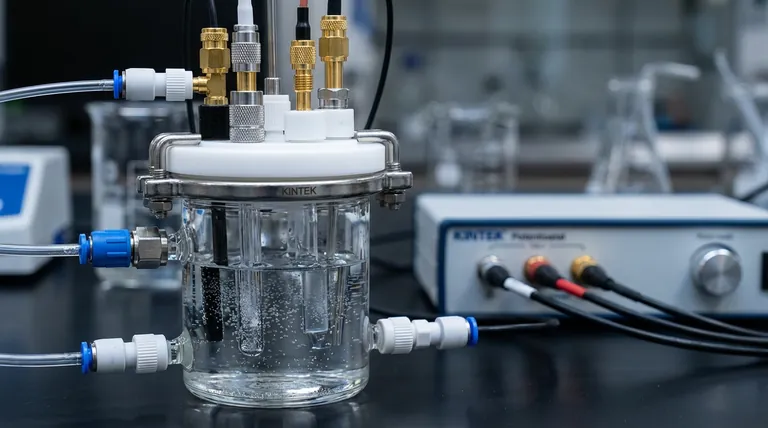
The super-sealed electrolytic cell is not just a glass vessel. It is an engineering response to the chaos of the outside world. It is a sanctuary designed to ensure that the only chemistry happening is the chemistry you intended.
The Architecture of Isolation
The difference between a standard beaker and a super-sealed cell is the difference between a door that is shut and a door that is bolted.
The defining innovation here is the flange seal.
In standard setups, we rely on ground glass joints or rubber stoppers. They are convenient, but they breathe. They allow the slow, insidious exchange of gases.
The super-sealed cell replaces this with a Polytetrafluoroethylene (PTFE) lid clamped mechanically to a glass body flange. This creates a gas-tight environment. It allows you to purge the cell with inert gas (like argon or nitrogen) and keep it that way.
The Material Matters
The choice of PTFE (Teflon) is deliberate. It is the diplomat of materials—completely indifferent.
- Chemical Inertness: It refuses to react with aggressive solvents.
- Purity: It introduces no contaminants into your sensitive electrolyte.
The Geometry of Truth
In data analysis, context is everything.
A measurement of "10 milliamperes" is meaningless if you don't know the size of the electrode. Was it a pinhead? Was it a dinner plate?
To solve this, the super-sealed cell employs a rigid design philosophy: The Fixed Reaction Area.
At the bottom of the cell, an O-ring seals the sample against a precise aperture, typically 1 square centimeter. This forces the reaction to occur on exactly that amount of surface area, every single time.
This transforms your data from raw Current (Amps) to Current Density (Amps/cm²).
Why does this matter?
- Normalization: It makes your results comparable to a paper published in Tokyo, Berlin, or Boston.
- Reproducibility: It removes the human error of manually masking electrodes.
The Choreography of Electrons
Inside this sealed environment, a specific dance occurs, governed by the Three-Electrode System.
While the seal protects the stage, these three actors perform the play:
- The Working Electrode (WE): The stage where the oxidation or reduction actually happens.
- The Reference Electrode (RE): The observer. It provides a stable potential baseline, never participating, only watching.
- The Counter Electrode (CE): The balancer. As electrons move at the working electrode, the counter electrode passes an equal and opposite current to maintain charge neutrality.
An external potentiostat acts as the director, applying voltage to drive these reactions. But without the super-sealed environment, the director is shouting over the noise of atmospheric interference.
The Trade-Off: Speed vs. Fidelity
Morgan Housel often notes that everything has a price, but not all prices appear on price tags.
The price of the super-sealed cell is complexity.
A simple beaker is easy to clean and quick to set up. It is perfect for rough drafts. The super-sealed cell, with its flanges, O-rings, and clamps, requires assembly time. It demands patience.
This creates a decision matrix for the researcher:
| Experimental Goal | Recommended Setup | Why? |
|---|---|---|
| Rapid Screening | Open Beaker | Speed is the priority; minor noise is acceptable. |
| Air-Sensitive Chemistry | Super-Sealed Cell | Oxygen is a contaminant; isolation is non-negotiable. |
| Volatile Electrolytes | Super-Sealed Cell | Prevents evaporation from altering concentrations. |
| Quantitative Publishing | Super-Sealed Cell | The fixed 1 cm² area ensures data integrity. |
Engineering Your Success
At KINTEK, we understand that an experiment is only as good as its weakest seal.
We don't just sell glass and plastic; we sell the assurance that your variable is actually your variable. Our super-sealed electrolytic cells are crafted for those who have moved beyond rough drafts and require the fidelity of a final publication.
Whether you are battling oxygen ingress or struggling with reproducible current densities, our equipment provides the controlled environment your chemistry deserves.
Are you ready to silence the noise and hear the data?
Visual Guide

Related Products
- H-Type Double-Layer Optical Electrolytic Electrochemical Cell with Water Bath
- Electrolytic Electrochemical Cell for Coating Evaluation
- PTFE Electrolytic Cell Electrochemical Cell Corrosion-Resistant Sealed and Non-Sealed
- Electrolytic Electrochemical Cell with Five-Port
- Side Window Optical Electrolytic Electrochemical Cell
Related Articles
- H-Type Electrochemical Cells vs. Flow-Cells
- Applications of H-Type Electrolytic Cell in Metal Extraction
- Overcoming Challenges with H-Type Electrolytic Cell Operation
- The Silent Deformation: Why Good Intentions Break Precision Glassware
- The Architecture of Control: Why Thermal Stability Defines Electrolysis Success