Blog The Invisible Variable: Why Electrolytic Cell Hygiene Defines Your Data
The Invisible Variable: Why Electrolytic Cell Hygiene Defines Your Data

The Invisible Variable: Why Electrolytic Cell Hygiene Defines Your Data

1 week ago

The Hidden Cost of Neglect

In the laboratory, we often obsess over the purity of our reagents and the precision of our power supplies. We treat the experiment itself as the main event.

But the cleanup? That is often treated as a chore. An afterthought.

This is a dangerous psychological blind spot.

An electrolytic cell is not merely a container; it is an active participant in your electrochemical process. Its physical integrity and surface cleanliness are variables that directly feed into your data. If you ignore the maintenance, you aren't just making a mess. You are introducing noise into your results.

More importantly, you are introducing risk to your life.

The Two Cardinal Sins

When maintaining these delicate instruments, most failures stem from two specific behaviors: impatience and aggression.

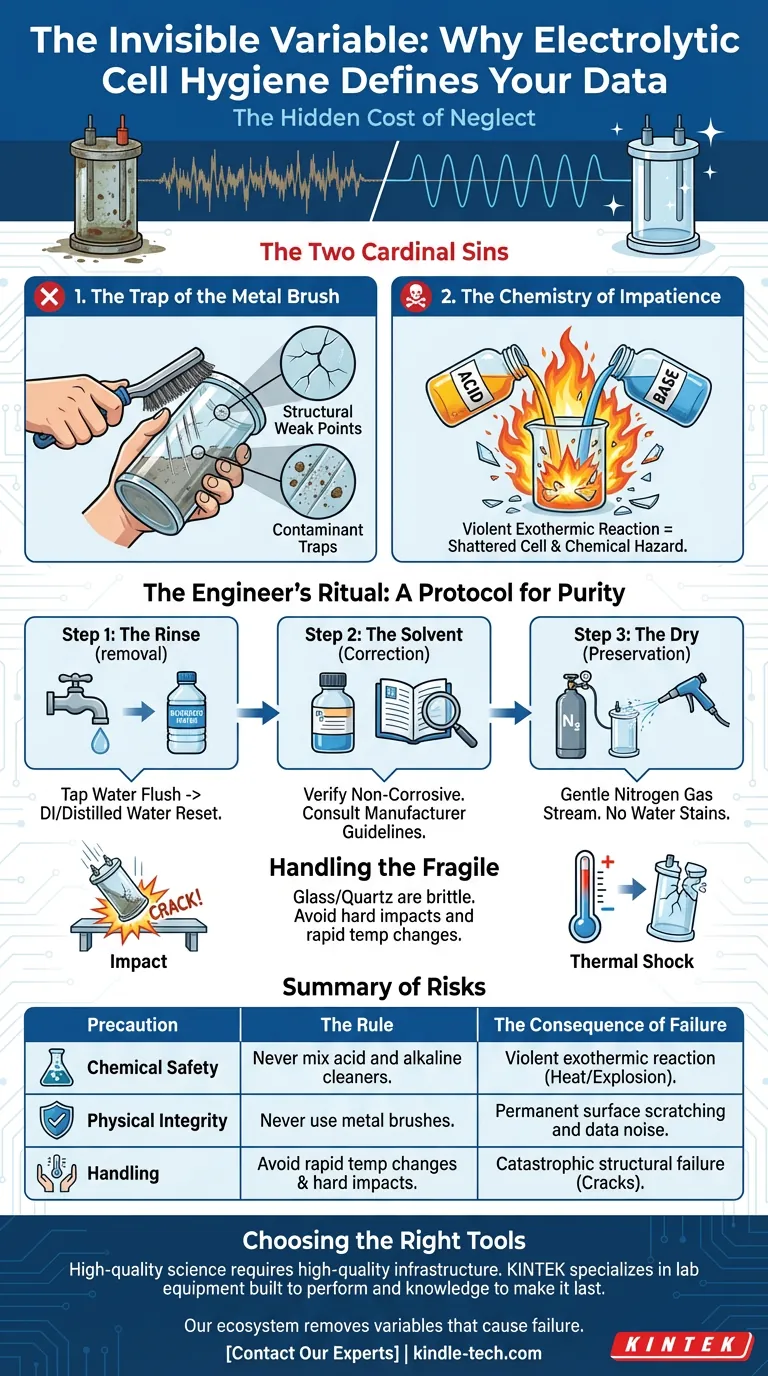
1. The Trap of the Metal Brush

It is tempting to scrub. When we see residue, our instinct is to use force.

However, using a metal brush on an electrolytic cell is fatal to the equipment.

Whether the cell is glass, quartz, or contains coated electrodes, the surface is microscopically precise. A metal brush does not just clean; it gouges. It leaves permanent scratches.

These scratches are not just cosmetic issues. They become:

  • Structural weak points that lead to cracks under pressure.
  • Contaminant traps where ions hide, ruining future experiments.

2. The Chemistry of Impatience

The second sin is mixing cleaning agents without thought.

There is a tendency to believe that if an acid cleans well, and a base cleans well, using them in sequence (or worse, together) will clean perfectly.

This is false. Mixing acids (like nitric acid) and bases (like sodium hydroxide) triggers a violent exothermic reaction.

The resulting heat can shatter the cell instantly. It creates a chemical hazard that endangers the operator. Chemical safety is not about complex formulas; it is about respecting the simple rule of separation.

The Engineer’s Ritual: A Protocol for Purity

To maintain the "romance" of precise engineering—where tools work exactly as intended—we must treat cleaning as a ritual, not a chore.

Adopt this structured workflow to protect the cell's integrity.

Step 1: The Rinse (removal)

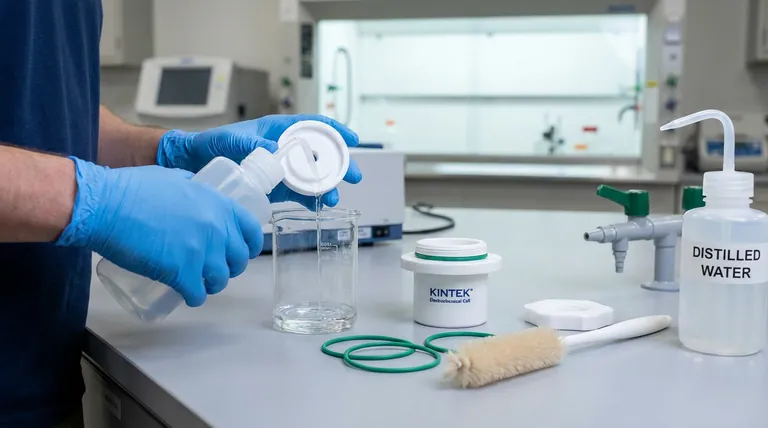
Start simple. Use standard tap water to flush out the bulk of electrolytes and reagents.

Follow immediately with deionized or distilled water. This is the reset button. It strips away the ions introduced by the tap water.

Step 2: The Solvent (Correction)

If residue persists, use a cleaning agent. But pause here.

You must verify that the chemical is non-corrosive to your specific cell material. An engineer knows the limits of their materials. Consult the manufacturer’s guidelines. If you guess, you lose.

Step 3: The Dry (Preservation)

Water stains are minerals left behind. Minerals are contaminants.

Do not let the cell air dry if precision matters. Use a gentle stream of nitrogen gas. This ensures the surface is physically dry and chemically neutral, ready for the next measurement.

Handling the Fragile

The body of an electrolytic cell is typically fashioned from glass or quartz.

These materials offer optical transparency and chemical resistance, but they pay for it with brittleness.

  • Impact: A minor collision with a lab bench can render a thousand-dollar piece of equipment useless.
  • Thermal Shock: Moving a quartz cell from a hot bath to a cold rinse will cause it to fracture. Glass cannot handle the stress of rapid expansion and contraction.

Allow the equipment to breathe. Let it return to room temperature gradually.

Summary of Risks

The following table outlines the relationship between behavior and consequence.

Precaution The Rule The Consequence of Failure
Chemical Safety Never mix acid and alkaline cleaners. Violent exothermic reaction (Heat/Explosion).
Physical Integrity Never use metal brushes. Permanent surface scratching and data noise.
Handling Avoid rapid temp changes & hard impacts. Catastrophic structural failure (Cracks).

Choosing the Right Tools

Your data is only as good as the vessel it is generated in.

If your focus is safety, your protocol must ban the mixing of incompatible chemicals. If your focus is accuracy, your protocol must obsess over nitrogen drying and deionized rinsing.

At KINTEK, we understand that high-quality science requires high-quality infrastructure. We specialize in lab equipment that is built to perform, but we also provide the knowledge to ensure that equipment lasts.

From durable electrolytic cells to the specific consumables needed to maintain them, our ecosystem is designed to remove the variables that cause failure.

Do not let a dirty cell be the reason your hypothesis fails.

Contact Our Experts

Visual Guide

The Invisible Variable: Why Electrolytic Cell Hygiene Defines Your Data Visual Guide

Related Products

Related Articles

Related Products

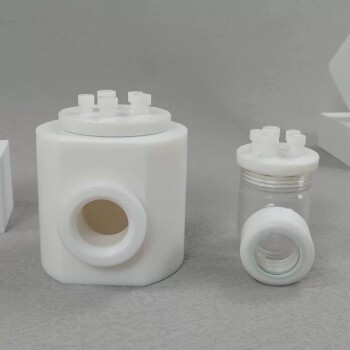
PTFE Electrolytic Cell Electrochemical Cell Corrosion-Resistant Sealed and Non-Sealed

PTFE Electrolytic Cell Electrochemical Cell Corrosion-Resistant Sealed and Non-Sealed

Choose our PTFE Electrolytic Cell for reliable, corrosion-resistant performance. Customize specifications with optional sealing. Explore now.

Customizable PEM Electrolysis Cells for Diverse Research Applications

Customizable PEM Electrolysis Cells for Diverse Research Applications

Custom PEM test cell for electrochemical research. Durable, versatile, for fuel cells & CO2 reduction. Fully customizable. Get a quote!

Side Window Optical Electrolytic Electrochemical Cell

Side Window Optical Electrolytic Electrochemical Cell

Experience reliable and efficient electrochemical experiments with a side window optical electrolytic cell. Boasting corrosion resistance and complete specifications, this cell is customizable and built to last.

Thin-Layer Spectral Electrolysis Electrochemical Cell

Thin-Layer Spectral Electrolysis Electrochemical Cell

Discover the benefits of our thin-layer spectral electrolysis cell. Corrosion-resistant, complete specifications, and customizable for your needs.

Battery Lab Equipment Battery Capacity and Comprehensive Tester

Battery Lab Equipment Battery Capacity and Comprehensive Tester

The scope of application of the battery comprehensive tester can be tested: 18650 and other cylindrical, square lithium batteries, polymer batteries, nickel-cadmium batteries, nickel-metal hydride batteries, lead-acid batteries, etc.

Customizable CO2 Reduction Flow Cell for NRR ORR and CO2RR Research

Customizable CO2 Reduction Flow Cell for NRR ORR and CO2RR Research

The cell is meticulously crafted from high-quality materials to ensure chemical stability and experimental accuracy.

Electric button battery sealing machine

Electric button battery sealing machine

The electric button battery sealing machine is a high-performance packaging equipment designed for mass production of button batteries (such as CR series, LR series, SR series, etc.), suitable for electronic manufacturing, new energy research and development, and industrial automation production lines.

Button Battery Case for Battery Lab Applications

Button Battery Case for Battery Lab Applications

Button batteries are also known as micro batteries. It looks like a small button-shaped battery. Usually larger in diameter and thinner in thickness.

Nickel Aluminum Tabs for Soft Pack Lithium Batteries

Nickel Aluminum Tabs for Soft Pack Lithium Batteries

Nickel tabs are used to manufacture cylindrical and pouch batteries, and positive aluminum and negative nickel are used to produce lithium-ion and nickel batteries.

Manual button battery sealing machine

Manual button battery sealing machine

The manual button battery sealing machine is a high-precision packaging device designed specifically for small button batteries (such as CR2032, LR44 and other models). It is suitable for laboratory research and development, small batch production and teaching demonstrations.

Platinum Sheet Electrode for Battery Lab Applications

Platinum Sheet Electrode for Battery Lab Applications

Platinum sheet is composed of platinum, which is also one of the refractory metals. It is soft and can be forged, rolled and drawn into rod, wire, plate, tube and wire.

Button Battery Disassembly and Sealing Mold for Lab Use

Button Battery Disassembly and Sealing Mold for Lab Use

The simple sealing and disassembly mold can be directly used on ordinary tablet presses, which can save costs, is convenient and fast, and can be used to encapsulate and disassemble button batteries. Other specifications can be customized.

Benchtop Laboratory Freeze Dryer for Lab Use

Benchtop Laboratory Freeze Dryer for Lab Use

Premium benchtop laboratory freeze dryer for lyophilization, preserving samples with ≤ -60°C cooling. Ideal for pharmaceuticals & research.

Laboratory Single Horizontal Jar Mill

Laboratory Single Horizontal Jar Mill

KT-JM3000 is a mixing and grinding instrument for placing a ball milling tank with a volume of 3000ml or less. It adopts frequency conversion control to realize timing, constant speed, direction change, overload protection and other functions.

Laboratory Disc Rotary Mixer for Efficient Sample Mixing and Homogenization

Laboratory Disc Rotary Mixer for Efficient Sample Mixing and Homogenization

Efficient Laboratory Disc Rotary Mixer for Precise Sample Mixing, Versatile for Various Applications, DC Motor and Microcomputer Control, Adjustable Speed and Angle.

High Energy Planetary Ball Mill for Laboratory Horizontal Tank Type Milling Machine

High Energy Planetary Ball Mill for Laboratory Horizontal Tank Type Milling Machine

KT-P4000H uses the unique Y-axis planetary motion trajectory, and utilizes the collision, friction and gravity between the sample and the grinding ball to have a certain anti-sinking ability, which can obtain better grinding or mixing effects and further improve the sample output.

VHP Sterilization Equipment Hydrogen Peroxide H2O2 Space Sterilizer

VHP Sterilization Equipment Hydrogen Peroxide H2O2 Space Sterilizer

A hydrogen peroxide space sterilizer is a device that uses vaporized hydrogen peroxide to decontaminate enclosed spaces. It kills microorganisms by damaging their cellular components and genetic material.

Custom PTFE Teflon Parts Manufacturer for Non-Standard Insulator Customization

Custom PTFE Teflon Parts Manufacturer for Non-Standard Insulator Customization

PTFE insulator PTFE has excellent electrical insulation properties in a wide temperature and frequency range.

High Energy Planetary Ball Mill Milling Machine for Laboratory

High Energy Planetary Ball Mill Milling Machine for Laboratory

Experience fast and effective sample processing with the F-P2000 high-energy planetary ball mill. This versatile equipment offers precise control and excellent grinding capabilities. Perfect for laboratories, it features multiple grinding bowls for simultaneous testing and high output. Achieve optimal results with its ergonomic design, compact structure, and advanced features. Ideal for a wide range of materials, it ensures consistent particle size reduction and low maintenance.

High Energy Planetary Ball Mill Milling Machine for Laboratory

High Energy Planetary Ball Mill Milling Machine for Laboratory

The biggest feature is that the high energy planetary ball mill can not only perform fast and effective grinding, but also has good crushing ability


Leave Your Message