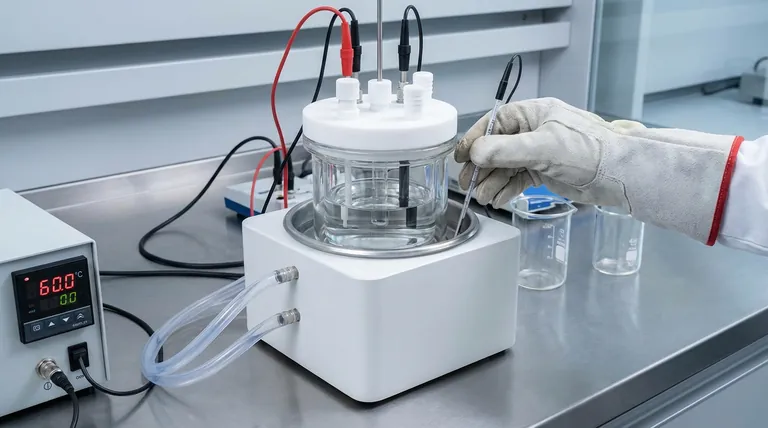
Blog The Thermodynamic Paradox: Balancing Precision and Safety in Electrolytic Cells
The Thermodynamic Paradox: Balancing Precision and Safety in Electrolytic Cells

The Thermodynamic Paradox: Balancing Precision and Safety in Electrolytic Cells

2 weeks ago

The Silent Tension of Heat

There is a quiet paradox in the laboratory. We use heat to drive reactions, to accelerate kinetics, and to simulate environments. Yet, that same energy, if mismanaged, becomes the enemy of both the apparatus and the operator.

In the context of a double-layer water-bath electrolytic cell, this tension is palpable.

On one hand, you need heat. You need a stable, elevated temperature to validate your electrochemical data. On the other hand, the materials you are using have strict thermal limits.

Safety in this environment is not just about avoiding burns. It is about understanding the "personality" of your materials. It is an engineering romance between the rigidity of glass and the fluidity of thermal expansion.

The Material Disconnect: Glass vs. PTFE

The most common failure in electrolytic setups usually stems from a single, flawed assumption: That the cell is a single unit.

It is not. It is an assembly of disparate materials.

The body is often glass. The lid is frequently PTFE (Teflon).

Glass is rigid and brittle. PTFE is chemically resistant but thermally dynamic. When you heat PTFE, it expands. When it cools, it contracts.

If you autoclave or aggressively heat a fully assembled cell, the PTFE lid will expand against the glass threads or clamps. Upon cooling, it often refuses to return to its original shape.

The result? A warped lid. A compromised seal. A ruined cell.

To protect the integrity of your equipment:

  • Dissociate before heating: Never sterilize the cell fully assembled.
  • Respect the thermal limit: Understand that the lid and the body react to heat at different rates.

The Human Factor: Preventing Physical Injury

Complexity is the enemy of safety. When an experiment becomes complex, we tend to focus on the data and forget the physical reality of the machine.

The water bath apparatus is a thermal mass. It holds heat long after the controller is turned off.

The precautions here are simple, yet often ignored during the rush of discovery:

  • Thermal Gloves are mandatory. Not just for handling the cell, but for adjusting the bath.
  • Distance is safety. Avoid direct skin contact with any component connected to the thermal loop.

We often assume we are too smart to get burned. But fatigue and distraction make us all vulnerable.

Precision as a Safety Protocol

Inaccurate data is a form of danger. It leads to false conclusions and wasted resources.

A water bath that reads $60^{\circ}\text{C}$ but delivers $65^{\circ}\text{C}$ is not just an annoyance; it is a variable that renders your experiment invalid.

Calibration is your baseline. Before the experiment begins, verify the water bath’s thermometer against an external standard.

If the environment is not stable, the data is noise. And in science, noise is the ultimate failure.

The Ritual of Inspection

Atul Gawande famously argued that the simple checklist is the most powerful tool in medicine. The same applies to electrochemistry.

A cell does not fail suddenly; it fails gradually.

  • The Seals: Are they aged? Are they brittle?
  • The Glass: Are there micro-fractures invisible to a glancing eye?
  • The Electrodes: Are they bent? Will they short-circuit against the wall?

These checks are not "extra work." They are the work. They are the non-negotiable tax we pay for reliable results.

Summary of Critical Controls

Here is how to align your safety protocols with your experimental goals:

Focus Area The Hidden Risk The Engineering Solution
Material Integrity PTFE warping due to thermal expansion. Never autoclave the fully assembled cell. Disassemble first.
Personal Safety Latent heat in the water bath causing burns. Treat every surface as hot until proven otherwise. Use proper PPE.
Data Validity Thermal drift in the water bath controller. Calibrate the thermometer before every critical run.
System Reliability Micro-fractures and degraded seals. Perform a visual inspection of glass and O-rings before use.

Conclusion

Great science requires a respect for the tools we use. It requires acknowledging that a glass cell and a PTFE lid are not just holders for liquid, but engineered components with distinct physical limits.

By respecting the temperature, calibrating your tools, and handling your equipment with the care of a craftsman, you protect more than just your skin. You protect the truth of your data.

At KINTEK, we understand the nuances of laboratory materials. We build equipment designed to withstand the rigors of precise thermal regulation. Whether you need robust electrolytic cells or high-precision water baths, our experts can help you build a safer, more reliable lab environment.

Contact Our Experts

Visual Guide

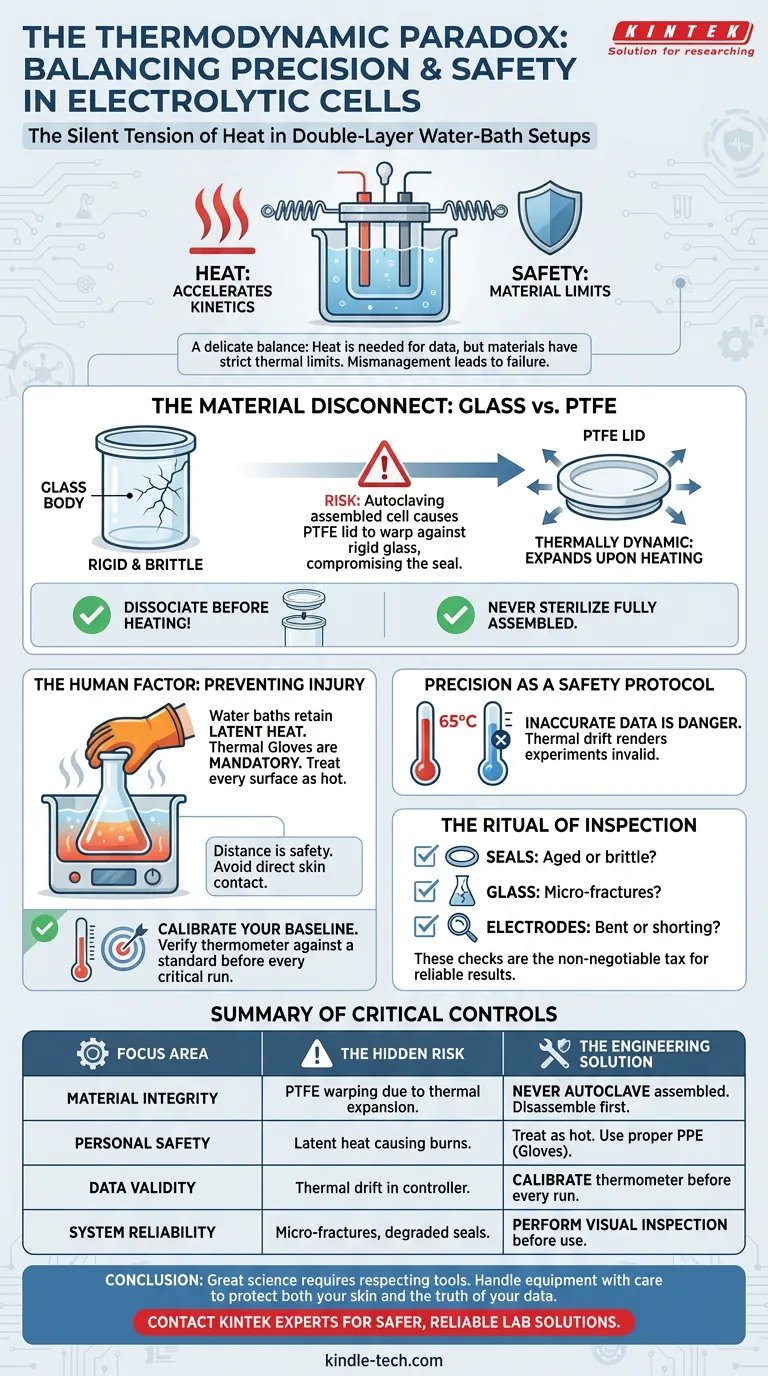
The Thermodynamic Paradox: Balancing Precision and Safety in Electrolytic Cells Visual Guide

Related Products

Related Articles

Related Products

Multifunctional Electrolytic Electrochemical Cell Water Bath Single Layer Double Layer

Multifunctional Electrolytic Electrochemical Cell Water Bath Single Layer Double Layer

Discover our high-quality Multifunctional Electrolytic Cell Water Baths. Choose from single or double-layer options with superior corrosion resistance. Available in 30ml to 1000ml sizes.

Double-Layer Water Bath Electrolytic Electrochemical Cell

Double-Layer Water Bath Electrolytic Electrochemical Cell

Discover the temperature-controllable electrolytic cell with a double-layer water bath, corrosion resistance, and customization options. Complete specifications included.

Double Layer Five-Port Water Bath Electrolytic Electrochemical Cell

Double Layer Five-Port Water Bath Electrolytic Electrochemical Cell

Experience optimal performance with our Water Bath Electrolytic Cell. Our double-layer, five-port design boasts corrosion resistance and longevity. Customizable to fit your specific needs. View specs now.

Customizable PEM Electrolysis Cells for Diverse Research Applications

Customizable PEM Electrolysis Cells for Diverse Research Applications

Custom PEM test cell for electrochemical research. Durable, versatile, for fuel cells & CO2 reduction. Fully customizable. Get a quote!

H-Type Double-Layer Optical Electrolytic Electrochemical Cell with Water Bath

H-Type Double-Layer Optical Electrolytic Electrochemical Cell with Water Bath

Double-layer H-type optical water bath electrolytic cells, with excellent corrosion resistance and a wide range of specifications available. Customization options are also available.

Quartz Electrolytic Electrochemical Cell for Electrochemical Experiments

Quartz Electrolytic Electrochemical Cell for Electrochemical Experiments

Looking for a reliable quartz electrochemical cell? Our product boasts excellent corrosion resistance and complete specifications. With high-quality materials and good sealing, it's both safe and durable. Customize to meet your needs.

Electrolytic Electrochemical Cell Gas Diffusion Liquid Flow Reaction Cell

Electrolytic Electrochemical Cell Gas Diffusion Liquid Flow Reaction Cell

Looking for a high-quality gas diffusion electrolysis cell? Our liquid flow reaction cell boasts exceptional corrosion resistance and complete specifications, with customizable options available to suit your needs. Contact us today!

Super Sealed Electrolytic Electrochemical Cell

Super Sealed Electrolytic Electrochemical Cell

Super-sealed electrolytic cell offers enhanced sealing capabilities, making it ideal for experiments that require high airtightness.

PTFE Electrolytic Cell Electrochemical Cell Corrosion-Resistant Sealed and Non-Sealed

PTFE Electrolytic Cell Electrochemical Cell Corrosion-Resistant Sealed and Non-Sealed

Choose our PTFE Electrolytic Cell for reliable, corrosion-resistant performance. Customize specifications with optional sealing. Explore now.

H Type Electrolytic Cell Triple Electrochemical Cell

H Type Electrolytic Cell Triple Electrochemical Cell

Experience versatile electrochemical performance with our H-type Electrolytic Cell. Choose from membrane or non-membrane sealing, 2-3 hybrid configurations. Learn more now.

Electrolytic Electrochemical Cell for Coating Evaluation

Electrolytic Electrochemical Cell for Coating Evaluation

Looking for corrosion-resistant coating evaluation electrolytic cells for electrochemical experiments? Our cells boast complete specifications, good sealing, high-quality materials, safety, and durability. Plus, they're easily customizable to meet your needs.

Side Window Optical Electrolytic Electrochemical Cell

Side Window Optical Electrolytic Electrochemical Cell

Experience reliable and efficient electrochemical experiments with a side window optical electrolytic cell. Boasting corrosion resistance and complete specifications, this cell is customizable and built to last.

Thin-Layer Spectral Electrolysis Electrochemical Cell

Thin-Layer Spectral Electrolysis Electrochemical Cell

Discover the benefits of our thin-layer spectral electrolysis cell. Corrosion-resistant, complete specifications, and customizable for your needs.

Customizable CO2 Reduction Flow Cell for NRR ORR and CO2RR Research

Customizable CO2 Reduction Flow Cell for NRR ORR and CO2RR Research

The cell is meticulously crafted from high-quality materials to ensure chemical stability and experimental accuracy.

Flat Corrosion Electrolytic Electrochemical Cell

Flat Corrosion Electrolytic Electrochemical Cell

Discover our flat corrosion electrolytic cell for electrochemical experiments. With exceptional corrosion resistance and complete specifications, our cell guarantees optimal performance. Our high-quality materials and good sealing ensure a safe and durable product, and customization options are available.

FS Electrochemical Hydrogen Fuel Cells for Diverse Applications

FS Electrochemical Hydrogen Fuel Cells for Diverse Applications

KINTEK's FS Electrochemical Cell: Modular PEM fuel cell stack for R&D and training. Acid-resistant, scalable, and customizable for reliable performance.

Customizable Swagelok Type Test Cells for Advanced Battery Research Electrochemical Analysis

Customizable Swagelok Type Test Cells for Advanced Battery Research Electrochemical Analysis

The KINTEK Swagelok-type test cell is a modular, T-shaped device constructed from high-quality, chemically inert materials.

Platinum Sheet Electrode for Laboratory and Industrial Applications

Platinum Sheet Electrode for Laboratory and Industrial Applications

Elevate your experiments with our Platinum Sheet Electrode. Crafted with quality materials, our safe and durable models can be tailored to fit your needs.

5L Heating Chilling Circulator Cooling Water Bath Circulator for High and Low Temperature Constant Temperature Reaction

5L Heating Chilling Circulator Cooling Water Bath Circulator for High and Low Temperature Constant Temperature Reaction

KinTek KCBH 5L Heating Chilling Circulator - Ideal for labs and industrial conditions with multi-functional design and reliable performance.

Gold Electrochemical Sheet Electrode Gold Electrode

Gold Electrochemical Sheet Electrode Gold Electrode

Discover high-quality gold sheet electrodes for safe and durable electrochemical experiments. Choose from complete models or customize to meet your specific needs.


Leave Your Message