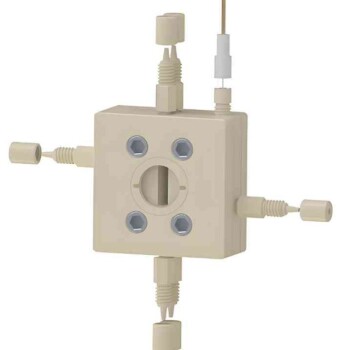
Electronic flowmeters act as the critical control mechanism for establishing a stable nitriding atmosphere. By precisely dosing the input of process gases like ammonia and hydrogen at specific rates—for example, 200 mL/min—they directly regulate the nitrogen potential within the furnace. This precise regulation is the foundational step required to determine the metallurgical structure and quality of the treated component.
Control over gas flow is not merely about consumption; it is about chemical potential. By maintaining exact flow rates, electronic flowmeters stabilize the nitrogen potential, which dictates the specific phase composition of the iron-nitride layer and ensures consistent growth kinetics across every production batch.
The Mechanism of Atmosphere Control
Precision Dosing of Gases
In industrial nitriding, the atmosphere is created by introducing specific gases, primarily ammonia and hydrogen.
Electronic flowmeters govern this input with high accuracy. They ensure that the volume of gas entering the chamber remains constant, regardless of minor upstream pressure fluctuations.
Defining Nitrogen Potential
The ratio of the gases introduced determines the nitrogen potential of the atmosphere.
This potential acts as the chemical driving force for the process. Without the stable delivery provided by electronic flowmeters, the nitrogen potential would fluctuate, leading to unpredictable surface conditions.
Impact on Metallurgical Properties
Determining Phase Composition
The nitrogen potential directly influences the type of iron-nitride layer formed on the surface.
By holding the flow rates steady, operators can specifically target the formation of either the $\epsilon$ (epsilon) phase or the $\gamma'$ (gamma prime) phase. This phase selection is vital, as different phases offer different wear and fatigue properties.
Regulating Growth Kinetics
Beyond the type of layer formed, the flow rate influences the growth kinetics of the diffusion zone.
Accurate metering ensures the diffusion zone grows at a predictable rate. This allows for precise calculation of cycle times to achieve the required case depth.
ensuring Process Reliability
Batch-to-Batch Consistency
In an industrial setting, repeatability is the ultimate metric of quality.
Electronic flowmeters eliminate the variability associated with manual valves or less precise mechanical meters. This ensures that a recipe run today yields the exact same results as a recipe run next month.
Understanding the Operational Risks
The Sensitivity of Nitrogen Potential
It is important to understand that the relationship between gas flow and nitrogen potential is highly sensitive.
Even minor deviations in the flow rate of ammonia or hydrogen can shift the potential enough to alter the phase composition.
Consequences of Instability
If the flowmeter fails to maintain the setpoint, the process may inadvertently produce a mixed-phase structure.
This can lead to inconsistent hardness profiles or unexpected brittleness in the treated parts. Therefore, the calibration and reliability of the flowmeter are as critical as the furnace temperature itself.
Making the Right Choice for Your Goal
Reliable nitriding is impossible without precise flow control. Use these guidelines to align your equipment strategy with your metallurgical objectives:
- If your primary focus is specific wear properties: Ensure your flowmeters are calibrated to target the exact nitrogen potential required for either the $\epsilon$ or $\gamma'$ phase.
- If your primary focus is production repeatability: Prioritize electronic flowmeters with high stability to guarantee consistent growth kinetics across all processing batches.
Precision in gas delivery is the only way to transform a chemical reaction into a controlled manufacturing process.
Summary Table:
| Feature | Role in Nitriding Quality Control | Impact on Metallurgical Outcome |
|---|---|---|
| Precision Dosing | Constant ammonia and hydrogen input rates | Stable chemical driving force for nitriding |
| Potential Control | Regulates the specific nitrogen potential | Determines $\epsilon$ (epsilon) vs. $\gamma'$ (gamma prime) phases |
| Growth Kinetics | Ensures predictable diffusion zone growth | Consistent case depth and optimized cycle times |
| Batch Reliability | Eliminates manual valve variability | Guarantees repeatable hardness profiles and surface quality |
Elevate Your Heat Treatment Precision with KINTEK
At KINTEK, we understand that achieving the perfect metallurgical structure requires more than just heat—it requires absolute control. Our high-performance laboratory equipment and consumables are designed to meet the rigorous demands of industrial nitriding and material science.
From high-temperature furnaces (muffle, tube, and atmosphere) to advanced high-pressure reactors and autoclaves, we provide the tools you need for uncompromising quality control. Whether you are optimizing nitrogen potential or conducting sophisticated battery research, KINTEK offers the stability and precision your lab deserves.
Ready to transform your chemical processes into repeatable manufacturing success?
Contact KINTEK Experts Today to find the perfect solution for your research and production needs.
References
- T. Frączek, M. Ogórek. The Impact of Heating Rate on the Kinetics of the Nitriding Process for 52100 Steel. DOI: 10.3390/ma16206708
This article is also based on technical information from Kintek Solution Knowledge Base .
Related Products
- Customizable CO2 Reduction Flow Cell for NRR ORR and CO2RR Research
- Controlled Nitrogen Inert Hydrogen Atmosphere Furnace
- 1400℃ Controlled Atmosphere Furnace with Nitrogen and Inert Atmosphere
- 1200℃ Controlled Atmosphere Furnace Nitrogen Inert Atmosphere Furnace
- 1700℃ Controlled Atmosphere Furnace Nitrogen Inert Atmosphere Furnace
People Also Ask
- Why is a customized electrochemical flow cell used for eCO2RR? Achieve Industrial-Grade Performance and Current Density
- What is the purpose of an anion exchange membrane (AEM) or PEM? Enhance Electrochemical Efficiency
- How do the electrochemical cell and three-electrode testing system collaborate? Optimize Zinc Anode Deposition Control
- What is the difference between a voltaic cell and an electrochemical cell? Understand the Two Types of Energy Conversion
- Why must the electrochemical cell be continuously purged with nitrogen? Ensure Precision in Ni-Cr Corrosion Tests