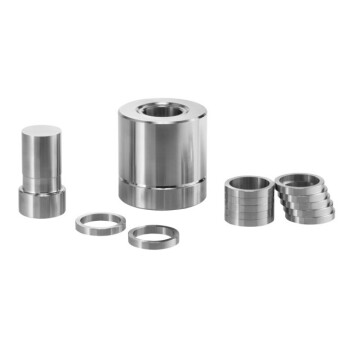
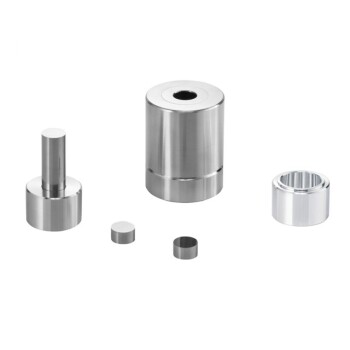
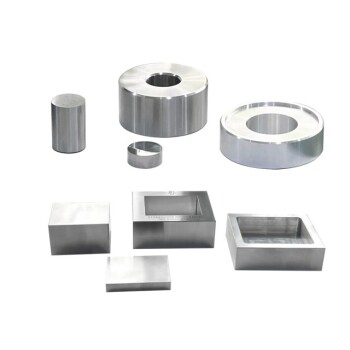
Equal-Channel Angular Pressing (ECAP) molds and high-pressure equipment function as the primary drivers of microstructural refinement by subjecting Ferritic-Martensitic (FM) steel to intense shear forces. Through a process known as Severe Plastic Deformation (SPD), this hardware dramatically reduces grain size to sub-micron or nanometer levels and increases dislocation density while maintaining the specimen's original cross-sectional area.
By utilizing specialized mold geometry to enforce severe shear strain, ECAP processing transforms standard FM steel into an ultra-fine-grained, high-strength material without altering its physical dimensions.
The Mechanics of Severe Plastic Deformation (SPD)
Inducing Intense Shear Forces
The core function of ECAP molds is to introduce intense shear forces into the material. Unlike traditional forging which compresses material, ECAP forces the FM steel through an angled channel within the mold.
As the material passes through this angle under high pressure, it undergoes significant shear strain. This mechanical action is the catalyst for changing the internal structure of the steel.
Grain Refinement and Dislocation
The primary outcome of this shear stress is the refinement of the grain size. The process breaks down the microstructure of Ferritic-Martensitic steel, such as the T91 variant, into sub-micron or even nanometer scales.
Simultaneously, the equipment facilitates an increase in dislocation density. These dislocations—defects within the crystal structure—impede the movement of atoms, directly contributing to the enhanced strength of the final product.
The Role of Mold Geometry and Equipment
Maintaining Cross-Sectional Integrity
A defining feature of ECAP molds is their "equal-channel" design. The entry and exit channels possess the exact same cross-section.
Consequently, despite the massive strain introduced to the material, the cross-sectional area remains unchanged. This distinguishes ECAP from processes like rolling or extrusion, where the workpiece is thinned or elongated.
High-Pressure Requirements
To force high-strength FM steel through these angular molds, high-pressure equipment is essential. The machinery must overcome the material's yield strength to facilitate plastic flow through the shear zone.
This requirement necessitates molds designed for extreme structural integrity, similar to those used in Multi-directional Upsetting-Extrusion (MUE), to prevent tool failure under load.
Understanding the Trade-offs
Equipment Complexity and Durability
Implementing ECAP requires specialized, robust tooling. The molds must be constructed from high-strength materials to withstand the immense pressures required to process hard alloys like FM steel.
Process Intensity
While the process yields superior material properties, it is mechanically intensive. The equipment must provide consistent pressure to ensure uniform deformation, as inadequate pressure or mold deflection could lead to inconsistent grain refinement or structural flaws in the workpiece.
Making the Right Choice for Your Goal
When selecting a thermomechanical treatment method for Ferritic-Martensitic steel, consider your specific structural requirements.
- If your primary focus is material strengthening: Utilize ECAP to achieve ultra-fine-grained microstructures and increased dislocation density for superior strength.
- If your primary focus is dimensional consistency: Choose ECAP to process the material repeatedly without altering the specimen's cross-sectional area or overall shape.
The proper application of ECAP molds allows engineers to push the boundaries of FM steel performance, creating high-strength components that retain their original geometry.
Summary Table:
| Feature | ECAP Process Impact | Benefit for FM Steel |
|---|---|---|
| Microstructure | Sub-micron/Nanometer refinement | Drastic increase in material strength |
| Cross-Section | Maintains original dimensions | Near-net-shape processing without thinning |
| Dislocation | Significant density increase | Enhanced hardness and structural integrity |
| Mechanism | Severe Plastic Deformation (SPD) | Uniform shear strain throughout the specimen |
| Equipment | High-pressure hydraulic systems | Overcomes material yield for plastic flow |
Elevate Your Material Research with KINTEK Precision Engineering
At KINTEK, we specialize in the high-performance laboratory equipment required to push the boundaries of metallurgy and material science. Whether you are conducting Severe Plastic Deformation (SPD) or standard thermomechanical testing, our robust range of hydraulic presses, high-temperature furnaces, and specialized milling systems provides the reliability your research demands.
Our portfolio includes:
- Hydraulic Presses (Pellet, Hot, Isostatic): Engineered for the extreme pressures required in ECAP and MUE processes.
- High-Temperature Furnaces: Precise control for the thermal treatment of Ferritic-Martensitic steels.
- Advanced Consumables: High-strength ceramics and crucibles built for extreme environments.
Ready to refine your results? Contact KINTEK today to discuss how our laboratory solutions can enhance your lab's efficiency and material performance.
References
- H.Yu. Rostova, G.D. Tolstolutska. A REVIEW: FERRITIC-MARTENSITIC STEELS – TREATMENT, STRUCTURE AND MECHANICAL PROPERTIES. DOI: 10.46813/2022-140-066
This article is also based on technical information from Kintek Solution Knowledge Base .
Related Products
- XRF & KBR steel ring lab Powder Pellet Pressing Mold for FTIR
- XRF & KBR plastic ring lab Powder Pellet Pressing Mold for FTIR
- Round Bidirectional Press Mold for Lab
- Cylindrical Press Mold for Lab Applications
- Ring Press Mold for Lab Applications
People Also Ask
- What is the purpose of using a mold for pellet pressing when preparing catalyst test samples? Ensure Data Consistency
- What are the advantages of using the pressed pellet method for XRF sample preparation? Optimize Your XRF Analysis
- What is the pressed powder pellet method? A Guide to Accurate FTIR Sample Preparation
- How does the selection of a pressure mold affect the performance of all-solid-state batteries? Expert Pelletizing Guide
- What are the different types of XRF samples? A Guide to Solid, Powder, and Liquid Prep