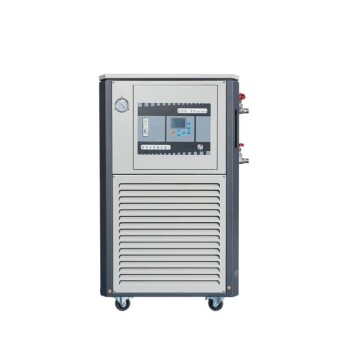
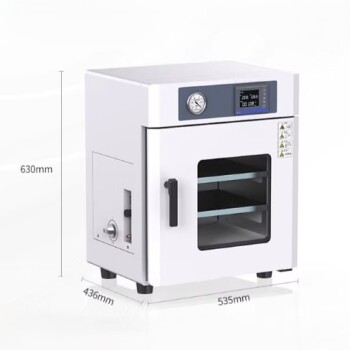
High-precision constant temperature ovens and circulators function as the primary control mechanism for ensuring data integrity in mineral carbonation studies. They establish a strictly stable thermal environment surrounding high-pressure reaction vessels, which is necessary to minimize experimental variables. Because the chemical transformation of minerals—such as wollastonite into calcium carbonate—is highly sensitive to heat, this equipment ensures the reaction environment matches the theoretical design.
Because mineral carbonation rates are typically governed by temperature-dependent laws, high-precision thermal control is required to isolate specific kinetic variables. Without this stability, it is impossible to accurately derive reaction rate constants or calculate activation energy.
The Critical Role of Thermal Stability
The study of mineral carbonation kinetics is fundamentally a study of how fast reactions occur under specific conditions. Constant temperature equipment is the tool that locks down the most volatile variable in this equation: heat.
Eliminating Environmental Noise
In high-pressure reaction vessels, external temperature fluctuations can cause internal pressure changes or alter reaction pathways.
High-precision equipment mitigates this by maintaining a static environment. This ensures that any observed changes in the mineral structure are due to the reaction mechanics themselves, not artifacts of a drifting temperature gauge.
Determining Reaction Rate Constants
To model how a mineral like wollastonite sequesters carbon, researchers must identify the reaction rate constant.
This constant is valid only at a specific temperature. If the oven or circulator allows the temperature to waver, the "constant" becomes a variable, rendering the resulting data mathematically useless for kinetic modeling.
Calculating Activation Energy
Activation energy is a measure of the energy barrier that must be overcome for the carbonation reaction to occur.
Calculating this requires comparing reaction rates across different, distinct temperature points. High-precision equipment ensures that these points are exact, allowing researchers to plot accurate slopes and derive the true activation energy of the process.
Understanding the Trade-offs
While high-precision temperature control is essential for kinetic accuracy, it introduces specific challenges that researchers must manage to ensure valid results.
Equilibration Time vs. Reaction Time
Setting an oven to a precise temperature does not mean the reaction vessel reaches that temperature instantly.
There is always a lag time for the heat to penetrate the high-pressure vessel. If the reaction is fast (high kinetics), significant transformation may occur during this "warm-up" phase, potentially skewing the data before the target temperature is achieved.
Spatial Uniformity
A high-precision controller ensures the sensor point is accurate, but it does not guarantee the entire oven volume is uniform.
If multiple vessels are placed in one oven, or if a vessel is large, thermal gradients can exist. This means one part of the sample may be reacting at a slightly different rate than another, introducing heterogeneity into the kinetic data.
Making the Right Choice for Your Research
When configuring your experimental setup for mineral carbonation, align your equipment choice with your specific data requirements.
- If your primary focus is Kinetic Modeling: Prioritize stability over speed. Use circulators or ovens with tight PID control to ensure the temperature deviation is negligible, allowing for the calculation of precise activation energy.
- If your primary focus is Process Throughput: Ensure the equipment has high thermal capacity. It must be able to return to the set point quickly after the reaction vessel is introduced to minimize the "warm-up" data gap.
Accurate thermal control is not just a feature; it is the prerequisite for reproducible kinetic data in mineral carbonation.
Summary Table:
| Feature | Impact on Carbonation Kinetics | Research Benefit |
|---|---|---|
| Thermal Stability | Eliminates environmental noise and pressure fluctuations | Ensures data integrity and repeatability |
| Precise PID Control | Maintains exact set points for rate constant derivation | Allows for accurate kinetic modeling |
| Temperature Accuracy | Enables comparison across distinct temperature points | Precise calculation of activation energy |
| High Thermal Capacity | Minimizes heat-up lag for high-pressure vessels | Reduces data skewing during equilibration |
Elevate Your Geochemical Research with KINTEK Precision
Unlock the full potential of your carbon sequestration studies with KINTEK’s high-precision thermal solutions. Whether you are modeling mineral carbonation kinetics or optimizing industrial-scale sequestration, our advanced equipment provides the stability your data demands.
Why choose KINTEK?
- Comprehensive Laboratory Range: From high-temperature furnaces (vacuum, tube, atmosphere) to high-pressure reactors and autoclaves, we provide the tools to simulate extreme environments.
- Unmatched Precision: Our high-precision ovens and cooling solutions (ULT freezers, cold traps) ensure your reaction variables remain constant.
- Total Support: We offer everything from crushing and milling systems to essential PTFE and ceramic consumables to streamline your workflow.
Don't let temperature fluctuations compromise your activation energy calculations. Contact KINTEK today to discover how our high-performance laboratory equipment can transform your research outcomes.
References
- Kristoff Svensson, Herbert Pöllmann. The Conversion of Wollastonite to CaCO3 Considering Its Use for CCS Application as Cementitious Material. DOI: 10.3390/app8020304
This article is also based on technical information from Kintek Solution Knowledge Base .
Related Products
- High Temperature Muffle Oven Furnace for Laboratory Debinding and Pre Sintering
- 1400℃ Muffle Oven Furnace for Laboratory
- 1700℃ Muffle Oven Furnace for Laboratory
- High Temperature Constant Temperature Heating Circulator Water Bath Chiller Circulator for Reaction Bath
- Graphite Vacuum Continuous Graphitization Furnace
People Also Ask
- Why is the annealing treatment in a high-temperature muffle furnace critical for the preparation of an Sb-SnO2 interlayer?
- What is the primary function of high-temperature muffle or tube furnaces for ceramic coatings? Ensure Peak Durability
- What is the role of a high-temperature muffle furnace in preparing Cs-aluminosilicate waste? Key Simulation Insights
- Why is a high-temp muffle furnace essential for ZnO-WO3 & ZnO-BiOI? Optimize Heterojunction Catalyst Performance
- What is the significance of integrating a high-temperature muffle furnace into an impact wear testing system?