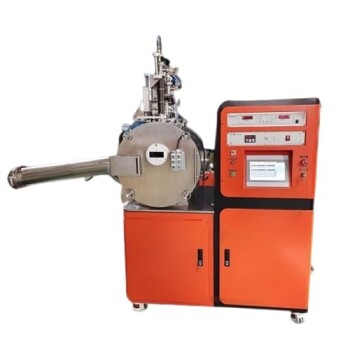
High-temperature sintering and melting systems are the critical enablers for optimizing vanadium-based (V-Si-B) alloys, acting as the catalyst for essential microstructural changes. By sustaining a controlled thermal environment exceeding 900°C, these systems drive the in-situ reaction of silicon and boron additives, transforming the raw alloy into a material capable of surviving the extreme environment of a nuclear fusion reactor.
Core Insight: The value of high-temperature processing lies in microstructural refinement, not just material consolidation. The heat drives the uniform distribution of silicide strengthening phases, which acts as the primary mechanism for overcoming the inherent weaknesses of vanadium—specifically its susceptibility to embrittlement and oxidation.
Driving Phase Formation Through Heat
Controlled Thermal Environments
For V-Si-B alloys to perform effectively, precise temperature control is non-negotiable.
Processing systems must maintain temperatures exceeding 900°C.
This specific thermal threshold provides the necessary energy to trigger chemical reactions within the alloy matrix that would not occur at lower temperatures.
In-Situ Phase Creation
The high heat does not simply melt the material; it facilitates an in-situ reaction.
During this process, silicon (Si) and boron (B) react chemically with the vanadium.
This reaction results in the formation of silicide strengthening phases, which are new structural components that reinforce the material from the inside out.
Enhancing the Microstructure
Achieving Uniform Distribution
A major challenge in alloy fabrication is the clumping or segregation of additives, which creates weak points.
High-temperature melting and sintering systems promote the uniform distribution of these newly formed silicide phases.
This homogeneity ensures that the strengthening effects are consistent throughout the entire component, rather than localized in specific areas.
Structural Reinforcement
The presence of these silicide phases fundamentally alters the mechanical properties of the vanadium matrix.
This microstructural refinement is directly responsible for increasing the alloy's high-temperature strength.
Without this processing step, the alloy would lack the structural integrity required for reactor operations.
Solving Fusion-Specific Challenges
Mitigating Neutron Irradiation Embrittlement
One of the most significant hurdles in fusion reactors is the constant bombardment of neutrons, which typically causes metals to become brittle and crack.
The refined microstructure of V-Si-B alloys helps counteract this neutron irradiation embrittlement.
By stabilizing the matrix, the alloy retains its ductility and toughness even under radiation stress.
Improving Oxidation Resistance
Standard vanadium alloys suffer from poor resistance to oxidation, degrading rapidly in harsh environments.
The silicide phases generated during high-temperature processing significantly improve oxidation resistance.
This allows the material to maintain its surface integrity and prevent degradation over long operational cycles.
Understanding Processing Sensitivities
The Criticality of Temperature Thresholds
The efficacy of this process is strictly bound to the 900°C threshold.
If the processing temperature drops below this limit, the necessary silicide phases may fail to form or distribute correctly.
This results in a sub-par material that retains the inherent weaknesses of pure vanadium.
Dependency on Process Control
The term "controlled thermal environment" implies that temperature stability is just as important as the maximum temperature reached.
Fluctuations during the sintering or melting phase can lead to inconsistencies in the microstructure.
Such inconsistencies can reintroduce vulnerabilities to oxidation or embrittlement in localized areas of the reactor component.
Making the Right Choice for Your Goal
When evaluating V-Si-B alloys for fusion applications, consider which performance metric is most critical for your specific component.
- If your primary focus is Structural Integrity: Prioritize processes that guarantee high-temperature strength through the verified uniform distribution of silicide phases.
- If your primary focus is Component Longevity: Ensure the processing history confirms the material's enhanced oxidation resistance and mitigation of irradiation embrittlement.
Success in fusion applications depends not just on the alloy composition, but on the rigorous thermal processing that unlocks its protective microstructure.
Summary Table:
| Enhancement Factor | Role of High-Temperature Systems | Impact on V-Si-B Alloy Performance |
|---|---|---|
| Phase Formation | Triggers in-situ reaction of Si and B at >900°C | Creates critical silicide strengthening phases |
| Microstructure | Ensures uniform distribution of additives | Eliminates weak points and increases high-temperature strength |
| Radiation Stress | Refines matrix stability | Mitigates neutron irradiation embrittlement and cracking |
| Oxidation | Facilitates chemical reinforcement | Significantly improves surface resistance to harsh environments |
Elevate Your Nuclear Fusion Research with KINTEK
Precision thermal processing is the bridge between raw alloy composition and reactor-ready performance. At KINTEK, we specialize in the high-performance laboratory equipment necessary to achieve these critical microstructural refinements.
From high-temperature muffle and vacuum furnaces capable of sustaining stable environments above 900°C to crushing and milling systems for precursor preparation, our tools are designed for the rigors of advanced metallurgy. Whether you are developing V-Si-B alloys or testing advanced ceramics and crucibles, KINTEK provides the comprehensive solutions—including isostatic presses, CVD systems, and cooling solutions—to ensure your materials survive extreme conditions.
Ready to optimize your sintering and melting workflows? Contact our technical experts today to discover how our high-precision systems can enhance your research outcomes.
References
- Chantal K. Sudbrack. Advances in High-Temperature Alloys. DOI: 10.1007/s11837-016-2107-7
This article is also based on technical information from Kintek Solution Knowledge Base .
Related Products
- Vacuum Heat Treat and Pressure Sintering Furnace for High Temperature Applications
- 2200 ℃ Tungsten Vacuum Heat Treat and Sintering Furnace
- High Temperature Muffle Oven Furnace for Laboratory Debinding and Pre Sintering
- Ultra-High Temperature Graphite Vacuum Graphitization Furnace
- Vacuum Induction Melting Spinning System Arc Melting Furnace
People Also Ask
- What is the purpose of the heat treatment (sintering) step? Engineering Robust Electroactive Membranes
- What is a vacuum sintering furnace? Unlock Purity and Performance in Advanced Materials
- How does the vacuum environment impact sintering of diamond-copper composites? Protect Against Thermal Damage
- What are some alternative atmospheres to pure hydrogen for powder metallurgy sintering processes? Top Sintering Solutions
- Why must green bodies produced via binder jetting undergo treatment in a vacuum sintering furnace?