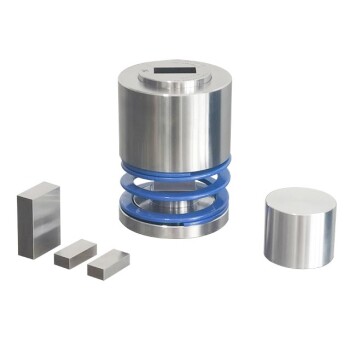
Industrial-grade testing hardware ensures reliability by combining precision mechanical engineering with advanced environmental controls to replicate harsh operating environments. These devices apply a constant compression force on the Membrane Electrode Assembly (MEA), ensuring tight layer contact. Simultaneously, they utilize corrosion-resistant liners and sophisticated pressure-temperature interfaces to simulate industrial realities, eliminating external variables that could skew catalyst and membrane data.
Core Takeaway To generate actionable data, you must move beyond theoretical setups and replicate the physical stresses of an industrial plant. Reliability is achieved by minimizing contact resistance through uniform compression and protecting the system integrity with materials capable of withstanding extreme operational conditions.
Engineering for Consistent Contact
The primary mechanical challenge in electrolyzer testing is maintaining the integrity of the internal assembly. Industrial-grade reactors address this through rigorous mechanical design.
Precision Compression
The hardware utilizes precision mechanical engineering to apply a constant, uniform compression force. This force is directed specifically onto the Membrane Electrode Assembly (MEA).
Minimizing Contact Resistance
By ensuring a constant force, the device maintains tight contact between the layers of the cell. This physical stability drastically minimizes contact resistance, which is a common source of data error in lower-grade setups.
Simulating Real-World Conditions
Reliability is not just about the device holding together; it is about the device acting like a full-scale industrial unit. Specialized reactors are built to mimic these specific environments.
Advanced Control Interfaces
These devices are equipped with advanced temperature and pressure control interfaces. This allows researchers to push the system to the specific limits found in actual industrial operations, rather than testing in benign laboratory ambients.
Material Integrity
To prevent contamination or equipment failure during high-stress testing, these reactors employ corrosion-resistant liners. This ensures that the data collected reflects the performance of the catalyst and membrane, rather than the degradation of the test rig itself.
The Risks of Inadequate Hardware
Understanding what these devices prevent is as important as understanding what they do. Failing to use industrial-grade equipment introduces specific failure points in your data.
The Cost of Variable Pressure
Without constant compression force, contact between layers becomes inconsistent. This leads to fluctuating contact resistance, making it impossible to distinguish between actual catalyst degradation and simple mechanical looseness.
The Illusion of Performance
Testing without precise temperature and pressure simulation yields data that is theoretically interesting but practically irrelevant. You may validate a catalyst in a low-stress environment, only to have it fail immediately under industrial operating conditions.
Making the Right Choice for Your Goal
Select your testing infrastructure based on the specific data points critical to your development phase.
- If your primary focus is Catalyst Activity: Prioritize systems with advanced temperature and pressure controls to ensure you are measuring efficiency under realistic thermal and baric loads.
- If your primary focus is Membrane Durability: Ensure the device features precision mechanical compression and corrosion-resistant liners to isolate structural wear from environmental contamination.
Reliable testing requires hardware that serves as a flawless simulation of the final industrial application.
Summary Table:
| Feature | Impact on Reliability | Industrial Benefit |
|---|---|---|
| Precision Compression | Minimizes contact resistance across the MEA | Ensures consistent and repeatable data |
| Corrosion-Resistant Liners | Prevents system contamination and degradation | Protects integrity under extreme conditions |
| Advanced Control Interfaces | Simulates exact industrial P&T limits | Validates performance for real-world scaling |
| Uniform Force Distribution | Eliminates variables from mechanical looseness | Distinguishes catalyst wear from assembly error |
Elevate Your Electrolyzer Research with KINTEK Precision
Transition from theoretical lab results to industrial-grade performance. KINTEK specializes in advanced laboratory solutions designed to withstand the rigors of modern energy research. Whether you are developing next-generation catalysts or testing membrane durability, our high-temperature high-pressure reactors, specialized electrolytic cells, and high-performance electrodes provide the stable, controlled environments necessary for actionable data.
From high-temperature furnaces and crushing systems to our comprehensive range of battery research tools and PTFE consumables, we empower researchers to simulate real-world stresses with absolute confidence.
Ready to eliminate variables and accelerate your path to industrial scale? Contact our technical experts today to find the perfect hardware solution for your laboratory.
References
- Inês Rolo, F. P. Brito. Hydrogen-Based Energy Systems: Current Technology Development Status, Opportunities and Challenges. DOI: 10.3390/en17010180
This article is also based on technical information from Kintek Solution Knowledge Base .
Related Products
- Customizable Laboratory High Temperature High Pressure Reactors for Diverse Scientific Applications
- Customizable High Pressure Reactors for Advanced Scientific and Industrial Applications
- Stainless High Pressure Autoclave Reactor Laboratory Pressure Reactor
- Visual High-Pressure Reactor for In-Situ Observation
- Mini SS High Pressure Autoclave Reactor for Laboratory Use
People Also Ask
- How do high-pressure and high-temperature reactors ensure the effective treatment of lignocellulosic wastewater in WAO?
- What equipment is required for high-pressure high-temperature reactions? Master Extreme Chemistry Safely
- How do you control high pressure in a reactor? A Guide to Safe & Stable Operation
- How does initial oxygen pressure affect the wet oxidation of pharmaceutical sludge? Master Your Oxidation Depth
- Why is argon better than nitrogen for inert atmosphere? Ensure Absolute Reactivity & Stability